Showing posts with label Nakagawa Shoichi. Show all posts

Saturday, October 3, 2009

The end of an era

Nakagawa Shoichi, the finance minister under Aso Taro who, becoming infamous worldwide for his behavior at a G7 meeting in Rome in February, was forced to resign and then lost his seat in the August general election, was found dead at his home in Tokyo's Setagaya ward Sunday morning. Yomiuri notes an absence of external wounds, suggesting that Nakagawa, like his father Ichiro, took his own life.

This last detail should give us pause. As became apparent when Nakagawa's alcoholism finally made its way into the media, it seems likely that he was struggling with demons that few of us can truly understand. As I remarked at the time, Nakagawa ought not to have been an object of ridicule; the only question raised by his behavior was why Aso put a man struggling with a serious disease in charge of the finance ministry in the midst of "a once-in-a-century financial crisis."

The timing of his death also has important symbolism, coming as it does in the wake of the election of Tanigaki Sadakazu, one of Nakagawa's predecessors as finance minister, as LDP president. By choosing the dovish Tanigaki by a substantial margin — Tanigaki received 300 of 498, more than double the 144 votes received by Kono Taro, who finished second — LDP Diet members and party supporters gave their support for a new policy direction, an impression reinforced by Tanigaki's naming Ishiba Shigeru as chairman of the LDP's policy research council. The balance of power within the LDP, which, as discussed in this post has favored revisionist hawks for much of the post-cold war period, has shifted decisively in the direction of the LDP's past, the past of "income doubling" and egalitarianism. Appropriately Tanigaki belongs to the revived Kochikai, the faction that was home to Ikeda Hayato, Miyazawa Kiichi, and other LDP leaders who kept the party focused on economic welfare and social stability.

Appealing to this tradition alone is not enough, of course: Tanigaki faces an uphill battle to change the LDP into a party that can commit to any one policy line, let alone an agenda that prioritizes the wellbeing of Japan's citizens and addresses the dilemma facing Japan's government today. Indeed, I think Tanigaki is more likely than not to fail in remaking the LDP into a party that will be positioned to return to power in the immediate future. He may be wholly sincere in his desire to reform the party, but as the candidate of the LDP's establishment, Tanigaki won precisely because he poses less of a risk to the LDP's traditional institutions than Kono.

But Nakagawa's death calls attention to just how precipitously the influence of the LDP's ideological conservatives has declined since the 2007 upper house election. Having lost their best opportunity to move their agenda when the LDP lost and then Abe Shinzo resigned and promptly checked himself into Keio hospital, the conservatives rallied to irritate Fukuda Yasuo, managed to get their man Aso into the premiership, but then were utterly lost as the global financial crisis ravaged the Japanese economy. They are still there: Abe still thinks he can return to glory and Aso has already stated that "sooner or later the Hatoyama government will fail," which may be factually true but Aso seems to think it will happen sooner rather than later due to Hatoyama's personal failings. But they are irrelevant to the LDP's future, able to irritate a party leader, much as they did to Fukuda, but unable to shape the party's agenda in a way that will enable the LDP to return to power.

The Japanese public has made clear in the past two elections what it wants from the government: government action to mitigate economic insecurity, especially regarding pensions and retirement. The LDP's conservatives have made clear that they have very little to say about these issues, and on the issues that they do have a lot to say — foreign policy, national defense, "moral" education, the constitution — the voting public has little to no interest.

So Nakagawa's passing may be the final exclamation point on the revisionist era of the LDP.

But politics aside, Nakagawa's death should not be an occasion for having one last laugh at his expense. The British politician Enoch Powell famously wrote, "All political lives, unless they are cut off in midstream at a happy juncture, end in failure, because that is the nature of politics and of human affairs." But Nakagawa's end — both his political end in August and his mortal end — was particularly tragic, if only because it was in large part the product of his all-too-human failings. Whatever one thinks of his politics — I certainly have had little positive to say over the years — one ought to spare a thought for the late Nakagawa Shoichi. RIP.

Monday, August 10, 2009

Nakagawa Shoichi in trouble

As a follow-up to Saturday's review of the races in Hokkaido, this story from Hokkaido should be of interest.

Nakagawa Shoichi, the former finance minister who I suggested faces an uphill battle for reelection in Hokkaido's eleventh district, went before a meeting of his koenkai to declare that from henceforth he will abstain from alcohol (cold turkey, I wonder).

That Nakagawa felt it necessary to do so presumably suggests that his antics in Rome rattled his supporters' confidence in him, perhaps to the point of abandoning him in this election.

Saturday, August 8, 2009

Hokkaido, a DPJ stronghold

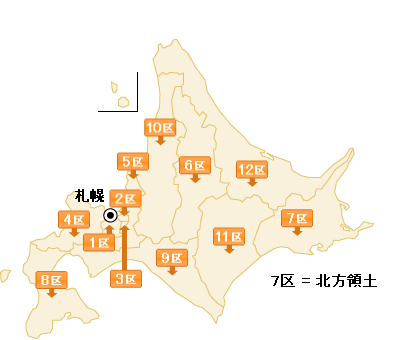
In 2005, the DPJ managed to win eight of twelve single-member districts in Hokkaido, while equaling the LDP with three of the block's eight proportional representation seats. By receiving three of eight seats, the DPJ in Hokkaido outperformed the DPJ nationwide, winning 33% of the vote and 37.5% of the seats, compared with 31.02% of the vote nationwide and 33.9% of the 180 PR seats.

Since 2005, the DPJ had a strong showing in Hokkaido in the 2007 unified local elections, increasing its total in the Hokkaido assembly to forty seats, with ten newcomers winning in addition to successful campaigns for all of the party's incumbents. At the same time, however, Takahashi Harumi, the LDP-backed candidate for governor in 2007 won reelection with 60% of the vote — and she is actively campaigning on behalf of LDP candidates, squaring off against DPJ-backed Sapporo mayor Ueda Fumio in providing assistance to candidates.

Hokkaido is home to heavyweight members from both parties: Yokomichi Takahiro, the leader of DPJ's former Socialists, represents Hokkaido's first district and Hatoyama Yukio, the DPJ's president, represents the ninth district. In the LDP, Machimura Nobutaka, former cabinet member and current faction boss, represents the fifth district, Nakagawa Shoichi, the disgraced former finance minister, represents the eleventh district, and Takebe Tsutomu, onetime Koizumi lieutenant and LDP secretary-general, represents the twelfth district.

Aside from these heavyweights, however, the DPJ is fielding a number of strong incumbents. The Hokkaido second district will be one district to watch. Mitsui Wakio, the DPJ incumbent in the second district, first won the seat in 2003, defeating Yoshikawa Takamori, the then-incumbent LDP member. Mitsui won again in 2005, despite the Koizumi tailwind behind Yoshikawa, besting Yoshikawa by just over 2,000 votes. Mitsui won despite Oka Chiharu, JCP candidate's receiving nearly 30,000 votes. Oka will be running again, as will Honda Yumi, a SDPJ candidate. Mitsui has faced a divided field before — when he won in 2003 there were two independents in addition to Oka — so he arguably remains the favorite, given that the DPJ has demonstrated that it has become the opposition party of choice. But his margin of victory should reveal much about the DPJ's ability to draw votes away from other opposition parties.

The third district is also worth watching as it features a rematch in an ongoing battle between DPJ candidate Arai Satoshi and the LDP incumbent Ishizaki Gaku. These two have contested the third in every election since 1996, with Ishizaki winning in 1996 and 2005 and Arai winning in 2000 and 2003. 2005 saw the most lopsided victory yet, with Ishizaki's winning by more than 13,000 votes. Previous elections had been decided by less than 3,000 votes twice (1996 and 2003) and roughly 6,000 votes in 2000. Arai will likely win this seat due to the absence of a JCP candidate: the JCP received roughly 22,000 votes in 2005, more than Ishizaki's margin of victory.

The presence of a JCP candidate could be decisive in the sixth district, where incumbent DPJ candidate Sasaki Takahiro, who managed to win the seat for the first time in 2005 by little more than 2,000 votes. Being able to win in 2005 despite the national trend ought to help him this year, although the JCP will be fielding Ogiu Kazutoshi: the JCP drew roughly 23,000 and 18,000 votes in 2005 and 2003 respectively, and could draw votes from JCP. But, as in other districts, the national trend ought to prove decisive for Sasaki.

Hokkaido's tenth district may be worth watching for its national significance, in that the LDP gave its nomination to PR representative Iijima Yukari — a Koizumi assassin in 2005 — in her bid to defeat six-term DPJ incumbent Kodaira Tadamasa. In 2005, Kodaira won reelection despite Iijima and ousted LDP member Yamashita Takafumi's combining for nearly 30,000 votes more than Kodaira. It seems unlikely that Iijima will pick up all those votes, especially since the tenth includes Yubari, famous as the city that went bankrupt: can a candidate identified with Koizumi win this time around?

And what of the LDP's four incumbents? Hokkaido is obviously one location where LDP heavyweights will be tested. Nakagawa may be particularly vulnerable: Ishikawa Tomohiro, a PR representative, ran against Nakagawa in 2003 and 2005, and narrowed Nakagawa's margin of victory in 2005 to 23,000 votes, impressive considering that Nakagawa had previously won by 60,000 votes. Given his shameful exit from the Aso cabinet (and his association with the prime minister) and the growing strength of the challenger, Nakagawa could be one of the LDP's heavyweights to go down to defeat. Takebe is similarly vulnerable: Matsuki Kenko, his DPJ challenger, did well enough against Takebe in 2003 and 2005 to win PR seats, and may profit from disillusionment with the LDP and Takebe's tarnished reputation to win in 2009. Machimura may be slightly better off, but Kobayashi Chiyomi, the DPJ challenger, did well enough against Machimura in 2003 (losing by 9,000 votes) to win a PR seat. While she lost by 50,000 votes in 2005, 2009 is likely to resemble 2003 more than 2005.

In short, it is entirely possible for the DPJ to win all twelve Hokkaido SMD seats, a gain of four seats from 2005. Given the difficulty of squeezing another seat out of the PR vote, it needs a strong showing in the SMDs to squeeze more seats out of the Hokkaido block. One question in PR voting is whether Suzuki Muneo's New Party Big Earth, running two PR candidates (including Suzuki) in alliance with the DPJ, will win two seats, stealing one of the LDP-Komeito coalition's four seats.

(I used this d'Hondt method simulator to get a rough estimate of the possibility of the DPJ's winning a fourth seat. Using the Yomiuri Shimbun's recent PR voting poll, which put the DPJ at 41% and the LDP at 24% and using the total votes from 2005, the DPJ could pick up another seat if it polls at 41% or higher in Hokkaido.)

In short, it is possible for the DPJ to increase its seats in Hokkaido to sixteen, up from eleven.

The next installment is here, the Tohoku regional block.

Sunday, April 19, 2009

The conservatives undaunted

Abe Shinzo, former prime minister and favorite of many alliance managers in Washington, was in Washington, D.C. this past week, meeting with Vice President Joe Biden and delivering addresses at the Brookings Institution and the Ocean Policy Research Foundation's US-Japan Seapower Dialogue.

Chris Nelson, eponymous author of The Nelson Report, concluded from Abe's visit that "he sure sounds like he intends to try and come back into power." In other words, consistent with how he became prime minister in the first place, Abe is beginning his comeback tour in a place where he may still enjoy some support.

His Brookings speech may seem like a response to the global financial crisis and a vehicle to soften his image, but Abe said little different from what the Aso government is trying to do, using the economic crisis to promote investment in technological innovation. Abe is still more focused on the distant future than on the dismal present: "However, statesmen also have an obligation to tackle tomorrow's problems. Statesmen have to build systems and projects that will allow their citizens to enjoy benefits over the long term and invest in those systems and projects." He talks about his "Innovation 25" program, but it is unclear what the Japanese government has been able to do to make Japan more innovative and productive. When Abe and others talk about fostering innovation, it strikes me as bordering on technofetishism, a belief that Japan's problems will vanish with technological innovation, which at the same time gives the impression of a certain degree of callousness to the Japanese people who are struggling in the present. Abe is still dreaming of his utsukushii Nihon to come, while the Japanese people continue to live in an increasingly kibishii Nihon.

Nelson noted that Abe came across as more internationalist in his Brookings address, which I guess is true, but for the most part I read it as the same old Abe. The same uneasy balance between a belief in the need for a "mutually-beneficial strategic relationship" with China while stressing the dangers of China's military modernization program. The same blindspot for South Korea, Japan's democratic neighbor. The same uncompromising position on North Korea and the emphasis on the abductees, although with the bizarre modification that the US can talk directly with North Korea as long as it continues to support Japan on the abductions issue. (This was, in a sense, precisely what the US was doing at the end of the Bush administration, pursuing a nuclear bargain in Beijing while the president and other officials assured Japan that it would not forget the abductees. And we saw how well that went over in certain circles in Japan.) He said nothing about constitution revision, although not for lack of belief in its importance.

He also did his part in the campaign to paint Ozawa Ichiro and the DPJ as dangerously irresponsible. Answering a question at Brookings, he said that only if Maehara Seiji becomes prime minister will a DPJ administration not undermine the alliance. As many of his fellow LDP members — and all too many people in Washington — have done, he singled out Ozawa Ichiro's remarks about the US presence in Japan as indicative of some sort of fundamental incoherence on the part of the DPJ, a point which I've previously argued overstates the case. Meanwhile, I find it a bit rich for an LDP politician to bemoan the diversity of opinions within the DPJ, given how consensus has eluded the LDP on numerous policy questions. One day some LDP politician criticizes the DPJ for being Ozawa's personal fiefdom; the next day another criticizes the DPJ for being too diverse in its opinions; the next day another criticizes the party as a reincarnation for the old Socialist Party. Which is it?

Earlier in his trip Abe met with Biden to talk about President Obama's plans for nuclear arms reductions, delivering a message from Prime Minister Aso stating his desire to cooperate with the Obama administration on arms reduction and non-proliferation, although, as Ralph Cossa argued recently, Japan may be less enthusiastic about nuclear arms reductions than meets the eye. To put an exclamation point on Cossa's argument, back in Japan Nakagawa Shoichi, another conservative exiled from power, was delivering a different message about nuclear weapons. Continuing the argument that he and other conservatives have made since North Korea's rocket launch earlier this month, Nakagawa stressed that the only answer for North Korea's nuclear weapons is for Japan to have its own nuclear weapons, an argument that Nakagawa says is "common sense" and not unconstitutional. The nuclear umbrella is apparently not porous, it's non-existent. Why else would Japan need its own nuclear weapons? Can Nakagawa conceive of a situation in which North Korea would strike Japan with nuclear weapons without the US being drawn into the conflict?

Presumably Nakagawa realizes that Japan's acquiring nuclear weapons would be a grave, if not mortal blow to the alliance, and yet he continues to make the argument — how is that somehow less detrimental to the alliance than anything Ozawa has said? There may be no quicker path to an independent Japanese security policy than the acquisition of nuclear weapons, as it is hard to see how the US could maintain the status quo arrangement were Japan wielding its own nukes. Nakagawa may be a disgraced former cabinet member, but he is not alone in making this argument, and the persistence with which conservatives make this argument make it more worrisome. They have a long-term project of making the case for a Japanese nuclear deterrent, and the more their argument goes unanswered, the more respectability it will acquire.

If Aso meant what he said to Obama, he ought to criticize Nakagawa and others publicly and unambiguously for their remarks. This isn't a matter of taboos — they should be able to say whatever they want — but their arguments should not go unanswered. They should be met not with an irrational outcry, but with cool, rational arguments that illustrate the many dangers associated with the policy they are advocating.

Is there no one in the Japanese establishment willing or able to take up Nakagawa's call for a debate on nuclear weapons and then proceed to destroy the idea?

As both Abe and Nakagawa illustrated last week, Japan's conservatives are undaunted in their quest to remake Japan. They continue to wield considerable power, their ideas go largely unchallenged in the public sphere, and they have no shortage of the will to power despite setbacks.

Monday, April 6, 2009

After the launch

In the wake of North Korea's Unha-2 launch Sunday, the Japanese establishment and public have uniformly reacted with a sense of outrage and a desire for an vigorous Japanese and international response to the test.

With substantial public support — 78% of respondents in a Yomiuri poll — the government is investigating tightening sanctions and plans to secure a cabinet decision authorizing further sanctions on 10 April. The Aso government is also working with the US and South Korean governments to secure a new UN Security Council resolution condemning North Korea's actions over Chinese and Russian doubts. Sankei reports that in its work to assemble a coalition in support of the resolution, the foreign ministry is not looking for new sanctions to be included in the UN resolution, as a means of making the resolution more attractive to China and Russia.

Other Japanese are thinking beyond sanctions and resolutions. Nakagawa Shoichi, the disgraced former finance minister and leading conservative in the LDP, responded to the launch on Sunday by once again calling for a debate on acquiring nuclear weapons. (He most recently did so after the October 2006 nuclear test, when he was head of the LDP's policy research council — at which time Aso Taro, then foreign minister, joined him in calling for a debate on acquiring a nuclear arsenal.) To my knowledge, Jiji is the only news outlet that reported on Nakagawa's comments. The Tokyo Shimbun reports that he spoke only of a debate about how Japan can defend itself, and suggesting that it should consider acquiring the ability to strike at "enemy bases." I'm inclined to believe that Jiji's report is correct: why would Nakagawa be any more discreet now than he was when he had an official position? No longer a leader of the LDP's conservatives, his words carry less weight, but he still provides insight into how Japan's conservatives think about the region. After all, Nakagawa's remarks echo what Tamogami Toshio, former ASDF chief of staff and the new darling of the right, has said about nuclear weapons. In an interview with Sankei last November, Tamogami spoke of the deterrent effect of even publicly considering the acquisition of nuclear weapons — and suggested that ruling out the acquisition of nuclear weapons from the start weakens deterrence. More recently, in a conversation with defense affairs commentator Ushio Masato (a former ASDF airman, trustee of Sakurai Yoshiko's think tank the Japan Institute for National Fundamentals, and regular in the pages of Sapio, Seiron, and Shokun!) published as the book「自衛隊はどこまで強いのか」(To what extent is the JSDF strong?), Tamogami calls for the acquisition of ballistic missiles as the best way to negotiate with North Korea and says that "the most effective way for Japan to become an independent country is to be nuclear-armed."

The conservative argument has little to do with North Korea's test, which was once again a failure, albeit less of a failure than July 2006, when its Taepodong-2 dropped into the Sea of Japan within a minute of launch. This time it managed to drop the first stage before the second and third fell into the Pacific. (Geoffrey Forden considers North Korea's progress in missile development here.) Despite no tangible change in US deterrent capabilities or the US commitment to Japan's defense — by all accounts US-Japan cooperation went smoothly in anticipation of the launch — the conservatives are agitating about Japan's vulnerabilties. For example, Sankei, in a news article that reads more like an article in a conservative opinion magazine, writes of the "possibility that data collected by the US military will not be adequately transferred" to Japan. As Tamogami's remarks above suggest, the acquisition of nuclear weapons is not about — or not only about — their deterrent value. Nor it is about the nature of the North Korean threat, which has gotten no worse as a result of the latest launch. (And, MTC suggests, the missile threat may be less worrisome than the ability of North Korean agents to cause havoc on Japanese soil.)

It is be about Japan's being able to defend itself without having to worry about the reliability of the US-Japan alliance. Conservatives like Nakagawa and Tamogami would be calling for more robust military capabilities even if the rocket launch had failed immediately after liftoff as in 2006. (We should be thankful that Tamogami is so open with his thoughts.)

All that has changed is that for the moment the eyes of the news media and the Japanese people are on North Korea.

Nevertheless, the conservative position has little public support. A new Shin-Hodo 2001 poll found 19.4% of respondents in favor of Japan's going nuclear and 72.8% opposed. (By comparison, a Hodo 2001 poll released on 15 October 2006, after the nuclear test, found 82.6% opposed to Japan's going nuclear and only 13.8% in favor: A slight shift, but for now probably not a significant shift.)

But will the legal and economic measures favored by the government and the public make any difference? What can Japan and the other participants in the six-party talks realistically do in response to North Korea's launch, other than protest?

As Mainichi reports, further sanctions will have little effect due to earlier sanctions on trade between Japan and North Korea. Economic sanctions on North Korea strikes me as the economic equivalent of "making the rubble bounce." The same holds true, even more so, for further US sanctions or even a reversion to a hardline on North Korea. Susan Rice, the US ambassador to the UN, has insisted that if the UN does nothing in response to a clear violation of UNSC Resolution 1718 it will weaken the six-party talks, which may or may not be true but shows that the Obama administration will likely press on with talks, although Yomiuri claims to see evidence of a US shift to a harder line.

Joshua Stanton suggests that there are a number of tools at the Obama administration's disposal, including a number of financial measures that could choke off the regime's access to hard currency from abroad. Maybe so, but at what cost? As Fred Kaplan argues at Slate, the US has no good options for dealing with the DPRK. The six-party talks will not result in denuclearization, not any time soon at least. Ignoring North Korea raises the prospect that North Korea will up the ante in its bid for attention. Boxing in the regime, as recommended by Stanton, presumably raises the risk of the regime lashing out in desperation — or, worse yet, that the regime will collapse for the US and its neighbors are prepared to deal with the consequences of regime collapse (a contingency that the US and North Korea's neighbors, China especially, should be devoting considerable energy to preparing for). There is no good option available to the US, Japan, and South Korea in the absence of more Chinese pressure, which may not be as viable an option as Kaplan suggests it is.

The only course of action may be getting a token resolution out of the Security Council and delaying a bit before resuming the six-party talks, and preparing for the possibility of regime collapse, in the meantime doing whatever possible to coax North Korea open in the hope of making collapse marginally less dangerous for North Korea's neighbors and less jarring for the downtrodden people of the DPRK.

And as for Japan, it ought to be less worried about its deterrent capabilities than about fixing the defense ministry, which over the weekend once again revealed its problems with handling information.

Sunday, February 22, 2009

Aso's missed opportunity

As Aso Taro's poll numbers continue to plummet — in addition to reaching 11% approval in the Mainichi and Sankei Shimbun polls, his disapproval rating in the Sankei poll is at 80.2% — and as the likelihood of an LDP defeat in this year's general election rises, it is worth asking whether there was anything Aso could have done differently.

Looking back, Aso's downfall may be presented as inevitable, the result of the economic crisis and the missteps of his predecessors over which Aso had little control.

But to render that judgment would be letting the prime minister off too easily. While Aso has faced tough conditions, he has done remarkably little to help himself.

Waiting until Nakagawa Shoichi's blowup in Rome to appoint Yosano Kaoru as finance minister may prove to be one of his greatest errors.

In a party full of spoiled second-, third-, and fourth-generation politicians, weary old guardsmen desperate to keep the old system together, and conservative ideologues who have little to say about the problems facing the public, Yosano is uniquely earnest in his desire to get things right. (I cannot top MTC's praise of Yosano in this post from when he was appointed Abe Shinzo's second chief cabinet secretary.) As I noted last week, Yosano stressed the importance of decency in his book, and it shows how he conducts himself in public life.

In an appearance on NHK Sunday, Yosano, discussing a new round of economic stimulus, said that he wants to include input from all of society — including the opposition parties — in the new package. This desire for harmony is, as I've mentioned, the essence of Yosano's political philosophy, and I have no reason to doubt his sincerity when he says he wants to consult with others outside the governing coalition in responding to a national crisis.

Compare this with what Aso tried to do with the second stimulus package, a package that was at least in part rooted in the LDP's political needs. The unpopular payment portion of the stimulus was, as has been widely reported, the product of Komeito pressure, and the prime minister reasoned that Komeito support was more important for the LDP than public support.

We know how that turned out.

But it's more than just bowing to Komeito. Aso has made it easy for the DPJ to take a more confrontational stance with the government. Treat the DPJ like an irrelevant, noisy opposition party and it will act like an irrelevant, noisy opposition party. The LDP continues to treat DPJ control of the upper house as an irritant, instead of revising the policymaking process to acknowledge that the DPJ has a veto over policy and incorporating the opposition in policy discussions at a much earlier point in the process.

The prime minister should have been doing everything he could to get DPJ input and participation in drafting the government's response to the crisis, not just because it would smooth the passage of the government's agenda but because it would signal the government's recognition that a national crisis demands a national response.

What's the worst that could have happened? If the DPJ and the other opposition parties reacted to the government's olive branch like the Republican Party has responded to President Obama's efforts to forge a bipartisan stimulus package, the DPJ would likely have suffered in public opinion polls. The government would still have to deliver effective policies — easier said than done — but at least it would have made a good faith effort to build a working coalition to formulate an effective response to the economic crisis.

Instead, from the moment he took office, the prime minister has attacked the DPJ. Anyone remember his speech to open last year's extraordinary session? Meanwhile on Sunday, the same day that his chief economic adviser was emphasizing the importance of working with the opposition in drafting new economic stimulus plans, Aso was in Aomori questioning whether the DPJ can be trusted to deliver change. (Not a question to be asking, Mr. Prime Minister, not when it is all too easy to substitute "LDP" for DPJ in that question. It would behoove you not to emphasize "change" as a campaign theme.)

The government has made it easy for DPJ leader Ozawa Ichiro to be focused on campaigning in the countryside. Had the government made a sustained effort to include Ozawa and his lieutenants in policy consultations, he would have had a harder time escaping Tokyo, not without being punished for it.

As such, it is amazing looking back over the past five months how little Aso has learned from the mistakes of his predecessors and how easily he has allowed himself to be trapped by the same dynamic that destroyed their governments, with an assist from the global economy this time around.

Tuesday, February 17, 2009

Aso follows Mori's path

"President Bush will welcome Prime Minister Yoshiro Mori to Washington for a working visit March 19. In addition to their important shared security objectives in the Asia-Pacific region, the United States and Japan have common interests on a broad range of global issues. The President looks forward to exchanging views with Prime Minister Mori on regional and global issues and to discussing ways to strengthen the alliance and overall bilateral cooperation." — 12 March 2001

"President Obama will meet with Prime Minister Taro Aso of Japan at the White House on Tuesday, February 24, 2009. Japan is a close friend and a key ally of the United States and the President looks forward to discussing ways in which the two countries can strengthen cooperation on regional and global challenges. The two leaders will consult on effective measures to respond to the Global Financial Crisis and will discuss North Korea and other issues." — 17 February 2009

In a surprise move, Secretary of State Hillary Clinton extended an invitation to Prime Minister Aso Taro to visit Washington next Tuesday, which the prime minister gladly accepted, which will make him the first foreign leader to visit President Barack Obama.

But upon seeing the news of Mr. Aso's forthcoming trip, I immediately thought back to March 2001, when Mori Yoshiro visited George W. Bush. Former President Bush was then barely two months into his administration. Mr. Mori had been prime minister less than a year, and a little more than a month after his visit, he was replaced by Koizumi Junichiro. And the rest is, as they say, history. In June, Messrs. Koizumi and Bush played catch at Camp David, in September Mr. Koizumi acted quickly in supporting the US following the 9/11 attacks, and from then on the alliance was remade (from the perspective of 2009, perhaps only momentarily).

Why was it so urgent that Mr. Bush meet with Mr. Mori? By the time Mr. Mori went to Washington he had already faced Kato Koichi's attempt to overturn his government in November 2000. In February, the bottom virtually fell out of the Mori government. On February 9, Mr. Mori came under fire for continuing to play golf after learning that the USS Greeneville had collided with the Ehime Maru. On February 19, Asahi published the figure that will forever be attached to Mr. Mori's name: 9% public approval. The poll prompted Mr. Koizumi, whose popularity was beginning to grow as he traveled the country, to call for the prime minister to give up. (Incidentally, Mr. Mori is only the second least popular prime minister in the postwar period: Takeshita Noboru bottomed out at 7%.) The rest of the month was spent in debate on when Mr. Mori would resign and how the LDP would choose his successor, before Mr. Mori finally indicated on March 11 — note the date — that he would resign once the 2001 budget passed. In other words, the day after Mr. Mori indicated that he would resign, the White House announced that he would be coming for a visit the following week. Naturally the planning for the meeting occurred before, but was no one in the administration aware that Mr. Mori was fighting for his political life? Did no one ask whether it would be better off waiting for a new prime minister?

What was Mr. Mori doing in Washington?

The joint statement released following the Bush-Mori summit has the answer: not much at all. The two leaders affirmed that they were committed to continuing to improve the US-Japan relationship in all its facets, bringing the agenda forward from the latter years of the Clinton administration. All well and good, but nothing that merited sending an outgoing prime minister to Washington to perform a task that could just as easily have waited for a new prime minister. One of the benefits of face-to-face meetings, after all, is in the working relationships that emerge between leaders that last over time and provide some support for the working-level officials laboring on alliance management. This importance of relationships between leaders can be overstated — and was overstated in the case of the Bush-Koizumi relationship — but it should be a consideration when leaders, particularly of allied countries, meet.

And so we come to February 2009. While not as embarrassing as the Bush administration's announcing Mr. Mori's visit the day after he announced that he would resign, the Obama administration's invitation overlapped with the embarrassing resignation of Nakagawa Shoichi, Mr. Aso's finance minister, following accusations of drunkenness at the G7 meeting in Rome. In the latest Asahi Shimbun poll, the poll in which Mr. Mori reached 9% back in 2001, Mr. Aso's approval rating is at 14%, and is trending downward. (Mr. Nakagawa's resignation may be enough to push Mr. Aso into single digits in the Asahi poll.) Mr. Aso has already broken the 10% barrier in at least one poll, and will likely do so in other polls soon. But unlike in 2001, not only is the prime minister deeply unpopular, but his party has been surpassed in the polls by the DPJ, as the voting public looks increasingly willing to give the DPJ an opportunity to govern, possibly within the year, as an election must be held by September.

The result is that beyond the public opinion figures, Mr. Aso has lost the ability to govern. Mr. Aso has entered a vicious cycle in which the failure to act in response to the economic crisis has damaged his popularity, which has undermined his authority, which makes it that much more difficulty to respond to the crisis, which lowers his popularity further, and so on until he steps down or calls an election. As the Financial Times put it in an editorial today, "At this moment, it is dangerous for an administration to continue in office when it has already lost power." What will a meeting between President Obama and Prime Minister Aso accomplish that has not already been accomplished by Hillary Clinton's visit to Tokyo? By sending Mrs. Clinton to Tokyo as her first foreign destination, surely the Obama administration has made an appropriate symbolic gesture to show that it is still committed to the US-Japan alliance. (As Mrs. Clinton said, repeating the standard line, "The alliance between the United States and Japan is a cornerstone of our foreign policy.") Doesn't Mr. Obama have bigger things to worry about at this point? What is so important that Mr. Aso has to hurry to Washington instead of waiting for a meeting on the sidelines of the G20 summit in London in April? This trip — which Mr. Aso is clearly desperate to take, as foreign travel is the last resort for an unpopular prime minister — is nothing more than a photo opportunity for the prime minister, an attempt to bask in the glow of a leader who enjoys the confidence of his people (and the Japanese people) in the hope that he might enjoy an Obama bump. (Cf., Colbert, Stephen.)

At some level, the US government should be blind to political conditions within Japan, but given the turmoil within Japan, wouldn't it be sensible to wait and see first whether Mr. Aso survives long enough to pass the 2009 budget and govern into the new fiscal year? The start of the fiscal year conveniently coincides with the G20 meeting. After Mr. Nakagawa's resignation, however, Mr. Aso's survival is even less certain than before. It would have been better to see whether Mr. Aso will survive the next few weeks — during which his government could conceivably be toppled when the bills related to the second stimulus package come before the lower house a second time — and then meet with Mr. Aso in London instead of agreeing to a meeting that will be held largely for reasons of Mr. Aso's domestic standing. Not that it will make much difference. At this point I don't think the Japanese public will be particularly impressed by images of Mr. Aso conferring with Mr. Obama.

Interestingly, when Mr. Mori traveled to Washington in March 2001, who do you suppose was traveling with him? None other than Aso Taro, then the minister of state for economic and fiscal policy.

And there you have it

Nakagawa Shoichi has indicated that he will resign following the passage of the 2009 budget and budget-related bills.

As MTC notes, "Provided that the Asō Cabinet is still existence then, I would have to add."

I would add that with Nakagawa Shoichi's self-destruction, the power of the LDP's ideological conservatives appears to be in freefall.

Consider the HANA club, the group of ideological conservatives named for Hiranuma Takeo, Abe Shinzo, Nakagawa Shoichi, and Aso Taro that formed in the early days of the Fukuda government to rally the LDP's conservatives after the premature departure of Mr. Abe from the Kantei. Aso Taro is venturing into the Mori Yoshiro range of public support and increasingly looks to be the gravedigger for the LDP as we know it. Abe Shinzo is taking baby steps back into public life and has lost some of his ideological bravado in the process. Mr. Hiranuma continues to tilt at the windmill of a conservative party that could serve as a third major party (mentioned in this post). And now Mr. Nakagawa, who I once thought might be next in line to lead the conservatives, appears to have been consumed by his demons and will likely end up as a footnote when the post-Koizumi history of the LDP is written. Beyond those four are an assortment of second-tier figures, including a couple in the Aso cabinet, none of whom look capable of competing for the leadership of a broken LDP.

After nearly fifteen years of ascendance, it appears that the conservatives might once again be anti-mainstream, frustrated in their efforts to achieve remilitarization, constitution revision, and national greatness (as they see it) — with the difference being that they will have footholds in both major parties, while lacking the numbers to be a force in their own right. To a certain extent this was already the case, but Mr. Nakagawa's fall makes it all the more clear.

Monday, February 16, 2009

Nakagawa will not survive

Nakagawa Shoichi's behavior at the G7 meeting in Rome — the slurred speech heard around the world — has quickly become a full-blown scandal.

With the rallying cry of "exposing disgraceful behavior," the DPJ, the SDPJ, the JCP, and the PNP are preparing to submit a (non-binding) censure motion in the upper house.

Mr. Nakagawa will go because his transgressions occurred on the world stage, in full view of the foreign media. While I do not expect it, if Mr. Nakagawa's conservative comrades were consistent, they would call for his immediate resignation for having defamed the Japanese nation abroad. Indeed, if Mr. Nakagawa was as serious about national pride as his past rhetoric suggests, he would willingly step down. But in lieu of such behavior from Mr. Nakagawa, the DPJ appears more than willing to take up the cudgel of nationalist rhetoric — more often used to criticize leaders "guilty" of traitorous negotiations or apologies — and pressure Mr. Nakagawa and the government. (Yet another reminder that the DPJ, far from being a progressive party, is comfortable with the language of the nationalist mainstream.)

But it appears that Mr. Nakagawa and Prime Minister Aso are digging in; Mr. Aso has asked Mr. Nakagawa to stay on, and Mr. Nakagawa continues to insist that his unusual behavior was the result of taking too much cold medicine combined with pain killers for back pain. The government will, not surprisingly, ignore any censure motion passed by the upper house. It will continue to insist on the "cold medicine" story — Mr. Nakagawa visited a doctor who certified that he has cold symptoms — in the hope that the scandal will go away quickly. Members of the team that traveled with Mr. Nakagawa have been called before the lower house's fiscal and monetary affairs committee to attest that they do not recall seeing the minister drink during lunch at the G7.

But despite these gestures, it is unlikely that the government will succeed in protecting Mr. Nakagawa for long.

More significant than the opposition calls for Mr. Nakagawa's head, Yomiuri reports that members of the LDP and Komeito want the finance minister to go. Some fear that a prolonged struggle with the opposition over Mr. Nakagawa's fate will stall the debate on the 2008 second supplementary budget related bills and the 2009 budget, and are ready to toss the finance minister overboard if it means that debate can resume. Of course, removing the finance minister in the midst of debate over the government's response to the economic crisis could be equally detrimental to pushing legislation forward, and would no doubt be accompanied by calls for an election from the opposition.

The question of the cause of Mr. Nakagawa's behavior, however, seems tangential to the debate over Mr. Nakagawa's future. Whether he was drunk or not, his alcoholism is no longer an open secret — it's simply open. Following closely on the heels of Mr. Nakagawa's mistake-prone performance in late January when he gave his policy speech to a joint session of the Diet, when he made a number of errors in presenting his remarks, it is hard to avoid the impression of the finance minister as, in MTC's word, a "broken" man. Should he be punished for overdosing on cold medicine? No, of course not. But if Mr. Nakagawa's addiction has become a problem, it is a matter of national concern. For that reason, Mr. Nakagawa's doctor's note will not be enough to dispel questions about his behavior. The Japanese people have a right to know the state of Mr. Nakagawa's health, beyond whether he has the sniffles.

But ultimately it will come down to where Mr. Nakagawa's indiscretion occurred. By appearing drunk when representing Japan in one of the world's most exclusive club — membership in which is a point of pride for Japanese elites — Mr. Nakagawa has disgraced his government and his country, an impression that will be reinforced the more video of his performance circulates around the internet and in foreign media. Japanese leaders, always sensitive to how Japan is perceived abroad, may ultimately feel compelled to approve Mr. Nakagawa's resignation, whatever the consequences for the Aso government.

This scandal reinforces the impression that the Aso government is completely bereft of authority and legitimacy. If it has not become a laughingstock home and abroad already, the Aso government is rapidly becoming one. And yet in the midst of this scandal and his plummeting popularity, Mr. Aso insisted that he is throwing his whole being into fixing Japan's economy.

Like Beaumarchais's Figaro, I laugh so as not to cry.

Sunday, February 15, 2009

Nakagawa Shoichi is now Aso's problem


As the above video illustrates, Nakagawa Shoichi, finance minister, financial services minister, and Aso ally appeared at the G7 meeting in Rome, where he stumbled and slurred his way through his remarks to the press and fell asleep during the plenary session.

Hatoyama Yukio, DPJ secretary-general, has already called for Mr. Nakagawa to be fired for "doing immeasurable harm to the national interest." (Presumably Mr. Hatoyama was referring to ABC's reporting on Mr. Nakagawa's falling asleep.) Ozawa Ichiro added that for a minister to act as Mr. Nakagawa did on the world stage is a "disgrace."

The question now is whether Mr. Nakagawa was drunk. As this Asahi article reviewing the response to Mr. Nakagawa's behavior notes (in passive voice), "Mr. Nakagawa is known as a drinker." Kawamura Takeo, the chief cabinet secretary, admitted that while Mr. Nakagawa had some wine at lunch, it was not enough for Mr. Nakagawa to become inebriated — the cause was his taking too much cold medicine.

Former Prime Minister Mori Yoshiro, however, did not help the government by noting in an appearance on TBS that he had warned Mr. Nakagawa about his drinking in the past. (Mr. Mori has become almost fatalistic about the future of his party in recent remarks — in the same appearance on TBS, he said that an election should be held as soon as the budget passes, in effect admitting that there is nothing Mr. Aso can do to rescue his government and his party before September so he might as well go through with an election sooner rather than later.)

Given that Mr. Nakagawa's alcoholism is an open secret in the Japanese political world, it is unlikely that the government's explanation will hold water, which raises the question: should it matter?

On this question it is worth looking at a 2006 article at Slate by British historian Geoffrey Wheatcroft on the fall of Charles Kennedy, the leader of Britain's Liberal Democrats. Wheatcroft looks back at the role of alcohol in democratic politics over the twentieth century and concludes that times have changed.

Kennedy," he wrote, "is a likable man, but you have to say he had it coming. He had regularly given the impression in public of being either sozzled or monumentally hung-over, making an awful mess of policy presentation during last spring's election."

He concluded, "Charles Kennedy's departure is sad but not tragic."

The same might be said of Mr. Nakagawa should he be forced to step down as the result of this scandal.

Mr. Nakagawa clearly has a problem to deal with, but that is his concern; he should not be the object of ridicule. The important question is whether Japan's finance ministry should be headed by a man struggling with a disease that clearly affects his ability to work just as its economy collapses, the answer to which is no. In some sense, this is a symbolic question, because I have to imagine that the finance ministry bureaucrats have ensured the smooth functioning of the ministry under Mr. Nakagawa's watch. (Indeed, I imagine that the finance ministry's power has waxed in recent months, despite the anti-bureaucratic wave in Japanese politics.) But the symbols do matter; surely pictures of the finance minister falling asleep at a summit alongside the finance ministers and central bankers of the developed world do little to inspire confidence in the ability of the Japanese government to respond to the crisis.

It is, of course, possible that the government's explanation is correct. Mr. Nakagawa has said that his behavior was the result of mixing alcohol and cold medicine, but even if this is true, this incident has shed light on Mr. Nakagawa's alcoholism, which, as suggested by Wheatcroft, should be considered problematic. The lid has come off on the open secret, and it is now a subject for discussion.

The bigger question, beyond Mr. Nakagawa's fitness for office, is Aso Taro's capacity for governing. When Mr. Aso named Mr. Nakagawa as his finance minister, I suggested that naming Mr. Nakagawa as finance minister was akin to John McCain's naming Sarah Palin as his running mate — not because Mr. Nakagawa is as abjectly clueless as Mrs. Palin, but because both choices suggested that the choosers were unserious about governing, as they handed important posts to manifestly unqualified individuals for wholly political reasons (Mr. Aso to reward an important ally in the party, Mr. McCain to shore up his support among conservatives and to try to poach disgruntled Hillary voters). Now we learn that Mr. Aso handed an important post in the midst of a "once in a century economic crisis" to not only a political ally with little background or expertise in financial and economic affairs, but to a political ally with little background or expertise in financial and economic affairs struggling with a medical problem that can affect his ability to perform his duties.

Mr. Mori, in the same TV appearance mentioned previously, said that had he not been on a trip to the US when the Aso cabinet formed, he would have protested Mr. Nakagawa's being named the finance minister.

It is too late to lament the original mistake. With the government's committing to the story that Mr. Nakagawa was simply doped up on cold medicine, it may be too late to fix the mistake without mortally wounding a government already nearing death. It is entirely conceivable that this scandal, with its international ramifications (mostly in terms of Japan's pride), could set in motion a train of events that will bring down the government and trigger an election, the final blow to the prime minister's support within his own party.

The can kicks back (Noah Smith)

In my earlier post, I stated that Japan's current-account surplus can vanish in one of two ways: either Japan can consume more (which it won't because of debt and demographics), or it can (over)produce less. That is true. But when the adjustment happens is not set in stone.

A casual observer might think that Nakagawa Shoichi's speech condemning protectionism might sound a little hypocritical, coming as it does on the same day that he threatened to intervene in currency markets to weaken the yen. But from the perspective of very-short-term Japanese national interests, the policies are complementary: the only way to stave off the day of reckoning I described earlier is to pump up exports. Naturally, that will only make the adjustment more painful when it happens, but given current electoral politics one could understand why the LDP isn't exactly planning for the long term. Instead of letting Japan take its lumps now and planning for a brighter future, it seems fairly certain that the LDP will fall back on the old "developing-country" export-promotion, and kick the can a few feet down the road.

But kicking the can carries another, little-mentioned risk. So far, American and British economists and executives have been holding the line against a rising protectionist tide, evoking the memory of "Smoot-Hawley" like a mantra. So far the line has held, as America's Democratic politicians have been too afraid to reach for the bazooka. But the consensus is badly fraying, with Paul Krugman saying he can see the case for "Buy American" provisions in America's stimulus bill. The monster is straining the bars of its cage. And if America's ire is ever roused against Japanese currency manipulation, the US will be far quicker to act than it has been against China; after all, US multinationals do not have their factories in Japan.

No one knows how much a modern-day round of "Japan bashing" would hurt Japan's economic model, but I suspect it would be more severe than nearly anyone can imagine. Japan's much-discussed "dual economy" relies on a compact in which the bureaucracy distributes the rents from world-beating export industries to a host of less efficient domestic industries and small businesses. In the 70s and 80s those rents came from the superior operational efficiency of Japan's auto, electronics, and machine-tool champions; in the mid-2000s they came from the costs saved when those champions moved their operations to China. If America closes its doors to Japanese imports, those rents will vanish and the compact will be broken.

So a best-case scenario for the LDP's kick-the-can strategy is a delayed, more-painful adjustment in maybe three or five years. A worst-case scenario is that American protecionism rises from the dead and smashes Japan's economic model like the hammer of a vengeful god.

In choosing to run the dreadful risk of delaying Japan's day of reckoning, the LDP has proven what many of us always knew — that it represents only a subset of the Japanese people, all its claims to the contrary.

- Noah Smith

Saturday, August 23, 2008

The onslaught begins

Last week, when Amari Akira announced his support for Aso Taro's taking over for Fukuda Yasuo when the latter's public approval dips below twenty percent, I wondered, "Will Mr. Amari's remarks be followed by a series of leaks to the press from anonymous LDP sources about disarray in the government and Mr. Fukuda's inadequacies as leaders, in the hope that a whisper campaign can drive the approval rating down to Mr. Amari's target?"

Nakagawa Shoichi, the "N" in the NASA and HANA clubs, creator of the "True Conservative Policy Study Group," and like Mr. Amari a confidante of Mr. Aso, lambasted Mr. Fukuda in remarks in Hokkaido Saturday, criticizing "do-nothing politics" and the "do-nothing prime minister."

The context of his remarks was a call for greater economic stimulus that includes tax cuts on investments and financial flows (echoing METI's plan for tax reform that encourages Japanese companies to repatriate profits earned abroad).

Nevertheless, the message is unmistakable: Mr. Nakagawa and other conservatives are clearly interested in damaging Mr. Fukuda's image in the hope of pushing his numbers down to the threshhold identified by Mr. Amari.

But apparently I was wrong to think that pressure on Mr. Fukuda would take the form of an "anonymous" whisper campaign, because far from being something as subtle as a whisper campaign, Mr. Nakagawa opted for a frontal assault against the prime minister.

I doubt that this will be the last we hear from the conservatives. They clearly smell the blood in the water. And Mr. Aso appears to be helping his own cause by refusing to let the furor over MAFF Minister Ota Seiichi's remarks die.

So who's next? Suga Yoshihide, the "S" in the NASA club (who still holds a party leadership post as vice chairman of the LDP's election strategy committee)? Or Abe Shinzo himself? I expect, however, that being a member of the Machimura faction Mr. Abe will receive a stern reprimand from Mr. Mori should he join the chorus. Not that that would stop him.

The point is that this appears to be only the beginning of a conservative campaign to undermine Mr. Fukuda's image in the hope of driving him out. The question remains whether the prime minister will exercise his nuclear option — calling a general election — instead of yielding to pressure to step down.

Wednesday, June 25, 2008

Web developments

The Yomiuri Shimbun, Japan's largest daily by circulation, is finally entering the twenty-first century.

Earlier this month it revamped its website, introducing an RSS feed and other web tools. It also created a clipping service, for which users must register.

Meanwhile Japan's other political parties have followed the LDP and created YouTube channels of their own (DPJ; JCP; NKP; PNP; SDPJ; NPJ — links also available at YouTube's Japanese politics portal). Koike Yuriko has her own channel too.

Like the LDP channel — which at the moment features an odd video of Abe Shinzo promoting a Diet tour led by Mr. Abe himself — none of these channels is particularly interesting: lots of videos of people sitting in front of microphones. Nevertheless they should provide the occasional laugh.

Speaking of laughs, allow me to close with this video, featuring silly pictures of everyone's favorites, the "dangerous" ANA (Abe-Nakagawa-Aso) politicians.

Monday, June 23, 2008

On the national interest

In the 20 June edition of his column in Yukan Fuji, an evening newspaper, Nakagawa Shoichi tackled recent developments in Japan's relations with its neighbors.

Not surprisingly, he wrote that the government should be taking a harder line in negotiations with North Korea over the abductee problem, China over East China Sea gas rights, and Taiwan over possession of the Senkakus.

What is of interest is how he advanced these positions. In discussing the negotiations with China over the East China Sea gas fields, Mr. Nakagawa emphasized the importance of defending the national interest. "When I was METI minister, I gave prospecting rights in the East China Sea to Japan's private oil companies," he said. "The government, in order to defend the national interest, should support this prospecting work." (国益, こくえき, national interest.)

The "national interest" is a popular term not just among Japan's conservatives, but among Japanese intellectuals at large. As Japan struggles to find its place in a changing world, this phrase is used to justify any number of foreign policies. But it is rare that the people using the phrase define exactly what it means. It is often used as a bludgeon; when the speaker or writer uses the phrase to describe a policy he or she is advocating, the implication is usually that anyone who disagrees with said policy is acting against the national interest and thus betraying Japan. After all, who could be against the national interest?

The national interest, however, is not a given. As Ishizuka Masahiko argued in Nikkei Weekly in April, it is not exactly clear what the "national interest" means. Mr. Ishizuka was addressing comments by Komori Shigetaka, chairman of NHK's board of governors, in which Mr. Komori suggested that NHK programs "targeted at audiences outside the country should be more assertive about 'Japan's national interest' on issues where the Japanese point of view differs from that of other nations." In response, Mr. Ishizuka wrote, "The source of the controversy arising from Komori's remark seems to be that what exactly dictates "national interest" as he calls it is not clear at all, and it tends to be identified with the establishment to which he obviously is considered to belong. Making the issue more complicated is that national interest and its perception can change from issue to issue." He goes on to argue that Japan will be best served by emphasizing the multiplicity of voices within Japan — in short, that there is no single national interest for NHK to beam abroad.

The phrase "national interest" is (or should be) the beginning of a discussion, not the end of one. An example of the former usage is US Secretary of State Condoleeza Rice's essay in the July/August issue of Foreign Affairs, entitled "Rethinking the National Interest." The first sentence of Ms. Rice's essay poses the question, "What is the national interest?" She spends the rest of the essay trying to answer it. Not only does she try to posit a definition of the national interest, she also considers whether the US has the means to defend its national interests. I have yet to see a Japanese policymaker or commentator make a similar argument for Japan, clearly articulating not only what Japan's national interests are, but, more importantly, listing them in descending order of priority and explaining what means Japan needs to secure them (or what it needs to do domestically to ensure it has to wherewithal to secure designated national interests).

I am in full agreement that Japan needs to give more thought to its national interests, but simply repeating the phrase does not equal giving the matter more thought. The way it is used now stifles rather than encourages a debate to define Japan's national interests.

Wednesday, April 16, 2008

Komori on US China policy

Komori Yoshihisa, veteran correspondent and Washington-based editor of the Sankei Shimbun, was invited to speak to Nakagawa Shoichi's "True Conservative Policy Study Group" last Friday, where he explained the reality of US China policy and contemporary attitudes in Washington towards the US-Japan alliance.

He provides a summary of his remarks at his blog.

For the most part, they're innocuous. He notes that Congress and Washington in general are alarmed about China on a number of fronts: China's military modernization, trade practices, intellectual property violations, and human rights violations are causes for concern among US elites. (Indeed, according to Pew's November 2005 survey of public and elite foreign policy attitudes, US elites are far more concerned about China than the public at large. This may have changed after several years of media reports about shoddy Chinese imports, but I still expect that the US public as a whole remains more sanguine about China than Washington.) He reports that while the US-Japan alliance is rarely discussed in the media, it enjoys a solid bedrock of support from both the Republican and Democratic parties.

Broadly speaking, Mr. Komori's picture is accurate.

But there are a few problems. First, whatever the fears of US elites about a multi-dimensional Chinese "threat," I think US policymakers, especially in the executive branch, are willing to silence their fears and work with China when necessary. This is consistent with the enduring pattern of Sino-US relations since 1972. Congress has been obsessed with threats from China and aggressive in its criticism of human rights violations, threats against Taiwan, etc.; the White House, whatever its unease with China and regardless of the party affiliation of the president, has sought closer coordination with China. There is an enduring realism in US China policy that is entirely absent from Mr. Komori's remarks.

This realistic tendency will likely become even more pronounced in coming years, because — and this is my second qualm with Mr. Komori's remarks — the US obsession with Iraq and the Middle East more broadly will not abate anytime soon. Mr. Komori seemingly provides no context for US thinking about China, which for most of Washington remains of secondary importance to more urgent Middle Eastern questions, meaning the US will be ever more inclined to work with China on a range of regional and global problems.

While naturally there are China hawks in Washington who share the views of Mr. Komori's audience, it would be a mistake to suggest that their viewpoint is dominant and commonly accepted. Their viewpoint certainly hasn't been dominant under the Bush administration, despite early indications to the contrary, and the next administration will be forced to embrace a sort of "resigned realism." Even if a McCain administration were to talk about the importance of cooperation among democracies in Asia, such rhetoric would most likely not be backed by a decisive shift in how the US-Japan and US-Australia alliances interact with China.

I would add that Mr. Komori and other Japanese China hawks, much like their American compatriots, have nothing constructive to say about how the US and Japan should deal with China. Mr. Komori says that it is "appropriate to identify and criticize, frequently and clearly" China's military activities and human rights violations. Maybe so, but that cannot be the sum of a China policy, especially for Japan. As Fareed Zakaria argues, criticism and outrage can backfire if they promote a popular backlash among the Chinese people. A China policy that amounts to little more than jabbing China repeatedly with a pointy stick is no China policy at all.

Meanwhile, Mr. Komori has not been paying enough attention in Washington. He notes that he concluded his remarks saying that in other countries principles like "building a country in which the people have pride in their country" and "steadily defending the national interest" are not conservative at all: they are accepted by all as a matter of course. I wonder what country Mr. Komori has in mind. China maybe? Both examples cited by Mr. Komori are fiercely contested in US public discourse. Both the definition of the "national interest" and how to defend it are in constant flux. As for a country of which people can be proud, once again, "pride" means different things to different Americans. To some, including Senator Obama, being proud of the US means being proud of its ability to correct its own flaws; as Senator Obama said in Montana earlier this month, "I love this country not because it’s perfect, but because we’ve always been able to move it closer to perfection."

If anything, Japan needs more of this: more discussion about what its national interests and more discussion about how to secure those interests, but above all, more discussion about what it really means to be proud of one's country — and what it means for a Japanese to be proud of Japan.

Friday, March 21, 2008

What, me worry?

In an editorial Friday, the Hokkaido Shimbun wondered why Prime Minister Fukuda exhibits no sense of crisis despite mounting problems and falling popularity.

"It's strange," the newspaper writes, "that the prime minister's sense of crisis appears to be diluted," considering that the BOJ vacancy and the uncertain prospects for a compromise with the DPJ over taxes and road construction could spell the end of his premiership.

Yamamoto Ichita, LDP HC member, suggests that concerns about the durability of the Fukuda cabinet may be overblown because all Diet members are motivated by what he calls "election avoidance syndrome." His HR colleagues, he suggests, are terrified for their election prospects and will therefore be willing to bend considerably to delay a general election. He suggests that some younger LDP members will vote against renewing the gasoline tax if the tax is canceled and then comes up for a vote in the HR again. In a postscript, Mr. Yamamoto addresses the idea that the LDP might dump Mr. Fukuda prematurely: "With the Fukuda cabinet's approval rating dropping, 'Dump Fukuda' voices are strengthening within the party?!?...this case is inconsistent with 'election avoidance syndrome.'" The LDP will stick with Mr. Fukuda, he argues, because dumping him will raise the chances of an early election. (Then again, his logic that another leadership change will mean pressure to go to the people for a mandate is shaky, if only because the baton was passed from Mr. Abe to Mr. Fukuda without the people being consulted.)

Perhaps Mr. Fukuda's Thursday meeting with Nakagawa Shoichi and Yosano Kaoru, who represent two blocs that could potentially challenge Mr. Fukuda's leadership, suggests that his hold on the party, however tenuous, remains secure. (In other words, both men and their comrades are slight content to let Mr. Fukuda suffer the slings and arrows of the divided Diet.)

Mr. Yamamoto may be right: Mr. Fukuda could have nothing to worry about by virtue of being in possession of the leadership. But to echo a concern raised by the Hokkaido Shimbun, how long can he go without articulating a reform agenda? And for how much longer can he count on both the conservatives and the reformists to support his government?

Foreign policy could prove Mr. Fukuda's undoing. Sankei reported that the subject of the True Conservative Policy Study Group's meeting this week was China policy, which turned into criticism of Mr. Fukuda's reconciliatory approach. A muddled approach to Tibet could give the conservatives an opening, if they choose to exploit it.

The daunting political situation is probably enough to secure Mr. Fukuda's position through the July G8 summit — I still think that prospective successors would prefer that Mr. Fukuda take a thorny issue or two off the agenda first — but if his public support doesn't recover in the meantime, his opponents may be tempted to force him out before the start of the autumn extraordinary session, election avoidance syndrome or no election avoidance syndrome.

Sunday, March 9, 2008

The pride of the conservatives

If Nakagawa Shoichi, leading conservative, has a virtue, it is his refreshing candor. Back when he was serving as head of the LDP's Policy Affairs Research Council under Mr. Abe, I suggested that Mr. Nakagawa was Mr. Abe's id, saying things that would be improper for the prime minister to say himself.

Appearing on Fuji Television's Hodo 2001 program on Sunday, Mr. Nakagawa said in reference to the hounding of Japanese whaling ships by a ship operated by the non-profit group Sea Shepherd in the Antarctic Ocean, "They have wounded Japanese. If the Coast Guard were to arrive, they should not just fire warning shots, they should 'use force.'" Asked whether he was suggesting that the Sea Shepherd should be sunk, he replied, "Of course."

I think this provides a glimpse into the mindset of the conservative ideologues. Mr. Nakagawa suggests that a violent response is merited because "Japanese were hurt." I wonder, however, if what was hurt was not Japanese citizens but Japanese pride. I get the sense that Mr. Nakagawa is brimming with anger that these foreign activists were able to get away with these actions, which have been condemned by the IWC. And so Japan needs a new defense posture and more assertive foreign policy: Japan must never allow itself to be powerless in the face of foreign aggression, whether in the form of North Korea's abductions of Japanese citizens or Sea Shepherd's harrying of Japanese whalers. The harm to Japanese citizens is, I think, secondary; what matters is the harm to Japan's pride. The result is a burning anger directed both at foreign transgressors and at the institutions and individuals within Japan responsible (MOFA, etc.) for failing to uphold the nation's pride.

As MTC noted recently, pride — hokori (誇り) — is a favorite word of the Japanese right. It is impossible to understand the foreign and defense policies advocated by the right without appreciating this concept. Beyond the superstructural justifications for a more assertive Japan (the arc of freedom and democracy, etc.), the conservatives are desperate to be proud again, to meet every perceived offense with resolution. Postwar Japan to them has been one abdication after the other, and hence the postwar "regime" must be left behind.

And hence the Coast Guard should open fire on anti-whaling activists.

Thursday, March 6, 2008

Abe's — and the LDP's — dilemma

Former Prime Minister Abe Shinzo has been back in the headlines this week, first for his return to the Machimura faction, which he left when he became prime minister, second for the announcement that he will chair an LDP study group related to the implementation of his "Cool Earth 50" initiative. The latter prompted Asahi to ask whether this is the beginning of Mr. Abe's "re-challenge," referring to another of Mr. Abe's initiatives.

Mr. Abe's return to the Machimura faction makes him its sixtieth member from the House of Representatives.

I find the former of greater interest than the latter, because the Machimura faction increasingly appears to be a microcosm of the party at large.

Consider that the faction contains a moderate dove like Prime Minister Fukuda, risk-averse senior politicians like Mori Yoshiro, Nakagawa Hidenao, and Machimura Nobutaka, "true" conservative Abe Shinzo, and a healthy cohort (27) of first- and second-term members of the House of Representatives, many of them Koizumi Kids. With the Machimura faction having made the Kantei its private property over the course of this decade, its complexion matters considerably in the future of LDP governance.

The selection of Mr. Fukuda as prime minister, thanks in large part due to his own faction's support, illustrates this point — and illustrates that the party is, for the moment, in the hands of the cautious, reactionary Mr. Mori.

Will Mr. Abe's return make a difference? I suspect not. The very idea of an Abe comeback strikes me as laughable, and I expect that few of his conservative allies long for his return. (At least one of them doesn't.)

The next LDP presidential election, meanwhile, will likely test the Machimura faction's power. If it comes after the next general election — as I expect it will — it may find its numerical clout diminished somewhat as some of its one- and two-term members in vulnerable urban and suburban districts go down to defeat. The test will likely come from Nakagawa Shoichi's "True Conservative Policy Research Group" [The HANA group], or at least the movement symbolized by the HANA group. Unless the Machimura faction decides to take a chance on Mr. Aso this time around, which would defuse the situation, the next LDP election will ask certain LDP members to choose between their values and their faction, and perhaps ultimately, their values and their party. This dynamic was present in the September election, as evidenced by the subterranean support for Mr. Aso — and the formalization of a conservative anti-mainstream in the form of the HANA group only exacerbates the tension.

Mr. Abe will be no less immune to this dilemma than his less prominent colleagues. Indeed, his return, according to Mainichi, is the result of Mr. Mori's anger at Mr. Nakagawa's group. As noted previously, one of the first steps in Mr. Abe's political rehabilitation was his joining the HANA group last month. Writes Mainichi: "Mr. Mori, who frowned at this, urged Mr. Abe to return to the faction."

Mr. Abe will be serving as a counselor to the faction, a position offered perhaps in part to cement his loyalty.

Monday, March 3, 2008

Playing politics

For the second time in as many days, I have read of LDP members complaining of the DPJ's "playing politics" with matters of national import.

Yesterday I mentioned that Ibuki Bunmei complained about the DPJ's introducing politics into the debate over BOJ succession.

Today I read a column by Nakagawa Shoichi in which he chides the DPJ for playing politics in calling for Mr. Ishiba's resignation. "They should not be troublesome solely for reasons of parliamentary tactics," he writes.

This tendency for ruling parties to claim that opposition parties are playing politics with some important policy matters is probably universal. US Republicans have been doing it to Democrats on national security for decades — see this recent example. So I guess we shouldn't be surprised that LDP Diet members are complaining about the DPJ's supposedly placing politics before the national interest.

The LDP is, of course, struggling to define the narrative in advance of the next general election. Will the general election be about the ongoing series of policy failures and poor governance by the LDP, as the DPJ would prefer, or will it be about the DPJ's supposed inability to run a government? It seems hard to believe that the LDP will have a strong showing running from that position. If an election were held today or soon, what achievements could the LDP use to illustrate its fitness to govern? For all the talk by Mr. Fukuda about shaping policy to take into account the concerns of the Japanese people, it has remained talk. The Japanese people are insecure because of the LDP's failings, not because of the DPJ's "playing politics."

"My fear," Mr. Nakagawa writes, "is that confidence in the Defense Ministry, responsible for security, is being lost. Without the confidence of the people, the ministry cannot ensure the security of the nation."

Who, Mr. Nakagawa, is responsible, whether through sins of commission or omission, for the deplorable state of affairs in the defense establishment?

Playing politics? The LDP has spent decades playing politics by making it possible for private interests to pervert public policy to their ends, not least in the Defense Ministry, where trading companies have stuffed their pockets with public funds with the LDP's consent.

Saturday, February 16, 2008

Into the pig box with them

With the debate within the LDP over the human rights protection bill intensifying, Abe Shinzo, former prime minister, has followed Mr. Aso out of exile and is now openly reunited with his ideological comrades within the LDP. He announced Friday that he is joining Nakagawa Shoichi's "True Conservative Policy Research Group," making him the group's eightieth member.

Meanwhile on Saturday, Mr. Nakagawa continued his campaign against the mooted human rights bill in Osaka. According to Hokkaido Shimbun, at the Osaka LDP chapter's convention he said, "If the bill is passed, me, former Secretary-General Aso Taro, and former Prime Minister Abe Shinzo could quite possibly go to the 'pig box' [detention cell]." Politicians are, of course, prone to over-reliance on hyperbole, but Mr. Nakagawa could win an award for this whopper. With advisers like this around him, it's no wonder that Mr. Abe's government was so short-lived.

Even if it were true that the human rights bill could somehow lead to politicians being rounded up and imprisoned — based on the history of the prosecution of crimes by politicians, this is extremely unlikely — is this really the proper way to oppose a piece of legislation? How about an appeal to how it might affect the lives of Japanese citizens?

I still stand by the arguments made in this post. However, a few more comments by Mr. Nakagawa and his comrades might lead me to change my mind — but only if the government strengthens the provisions that supposedly targeting political activity, raising the chances of the nightmare scenario envisioned by Mr. Nakagawa will come to pass. In fact, talk of throwing politicians in jail in a country in which the political class has been loathed for decades is a good way of ensuring that the bill passes.