Showing posts with label Yamasaki Taku. Show all posts

Wednesday, September 9, 2009

The LDP heads into the wilderness

With less than ten days until the start of the campaign for the LDP's presidency, the field is shrinking, not growing.

Nakagawa Hidenao, who in the immediate aftermath of the general election was convinced that his survival was fate and declared he would contest the election, will not be running in the race after all. His reasoning is that the LDP needs generational change — and it needs a post-factional leader who won a single-member district.

The LDP, however, seems more concerned about who its members should vote for on 16 September when the Diet will pick a new prime minister than who should be charged with the difficult task of remaking the LDP for opposition. Uesugi Takashi reviews the struggle to decide who to vote for for prime minister — initially some wanted to vote for Aso Taro, while others wanted to abstain — and concludes that while the revival of the LDP is "absolutely indispensable for democracy," it looks as if the LDP's revival is "receding into the distance." For the record, the LDP has agreed that it will vote for Wakabayashi Masatoshi, an upper house member who was Abe Shinzo's third and fifth MAFF ministers, as well as Fukuda Yasuo's first. Wakabayashi, it seems, is a man who can be counted on to be pressed into service by his party when it needs to fill a spot.

A group of younger LDP members — twenty-two members from both houses who have been elected seven times or less — calling itself the "Party Rebirth Council" met Wednesday to review the LDP's defeat and to consider how the party can recover. The council plans to have a report ready by the time the new leader is elected. As I have previously suggested, the council will recommend replacing the cumbersome policymaking system and other internal structures that ensured that the LDP itself was a more effective obstacle to policy change than the "opposition" parties. It is good that at least some LDP members are considering how the party needs to be changed, but the choice of leader will be essential, especially because, as Yamamoto Ichita writes, the new leader will presumably contest next year's upper house election, the Hatoyama government's first electoral test. Aso himself has called for unity as the party begins its struggle to return to power, but the LDP, never unified in the first place, will require a leader with the power to force others to obey. In a party with too many leaders and not enough followers — and too many members elected thanks to their name — the next leader will struggle to unify the party, even if the factions are dissolved. (Yamasaki Taku is the latest to call for the dissolution of the factions — seemingly impressive, as Yamasaki is a faction leader despite losing his seat last month, but less impressive considering Yamasaki's history of independent behavior.)

So as much as some younger members claim to desire a change of generation within the party, no one seems particularly willing to step forward into what will likely be an impossible job that could end quickly with a defeat next summer.

They ought to pick someone telegenic: if the DPJ succeeds in changing the policy process as planned, there will be little role for the LDP but to ask meddlesome questions in the Diet, criticize the government in the media, mind the party's internal organization, and wait for the DPJ to become exhausted, corrupt, and incapable of controlling cabinet ministers and backbenchers.

Finally, as a sign of how low the LDP has sunk, Sankei's Komori Yoshihisa has a long blog post in which he tears into the LDP for basically being inadequately conservative (although still better than the "dangerous" DPJ and its policies, which Komori wonders, may not deserve the name "policies"). These are the kind of pressures awaiting the LDP's next leader. Caught between the voters and an agitated conservative media and intelligentsia, between oppositionists and constructivists within the party, the next leader will be set up for failure. It may be a long time before we see a new LDP emerge.

Thursday, August 27, 2009

The LDP on the brink of disaster

The general election campaign is heading into its final days. Despite another two days of campaigning, the LDP and DPJ are mostly battling for seats on the margins — the LDP to keep from falling below 100 seats, the DPJ to reach the magic number of 320, the number required for a supermajority. As the campaign has developed, the LDP's position has only slipped, both in polls and other measurements, such as weakening support from the organizations that have long been part of the LDP's vote-gathering machine. The latest slippage is from the Japanese Medical Association, which does not approve of everything in the DPJ's manifesto but expressed its support for several of the party's proposals, concluding that "the DPJ wrote too much in its manifesto, the LDP wrote too little." There seems to be little doubt which direction the JMA would prefer the parties to err.

After all, the latest round of polls making predictions for seat distributions matched the first round of polls, which astoundingly suggested that the DPJ could win around 300 seats. Asahi's latest poll suggests the possibility of 321 seats for the DPJ and 103 for the LDP. I still suspect something closer to 300, plus or minus twenty seats. But it will be a major victory for the DPJ regardless. (Asahi reports that the DPJ might not have named enough candidates to its PR list in the Kinki and Kyushu blocks, where all but two candidates are running simultaneously as SMD and PR candidates.) Similarly, Mainichi's final poll before the election records the DPJ doubling the LDP in nearly every category: party support, voting intentions in single-member districts, PR voting, although Mainichi notes that it is difficult to project how these figures — different from the party's survey of electoral districts that produced the 320 seat prediction recently — will play out in SMDs.

But unless we're about to witness what would surely be the greatest polling error in a developed democracy, the LDP is less than three days away from suffering a crushing, perhaps even mortal blow in this year's general election.

Not surprisingly the closer the LDP gets the defeat, the more desperate and bizarre the pronouncements of the party's leaders. MTC has already noted Yosano Kaoru's absurd warning of the dangers of one party dictatorship, which probably wins as the single worst justification for LDP rule made during the campaign.

But the remarkable thing about the past month of campaigning is that the LDP is no closer to offering a clear reason why it deserves another mandate than it was when Prime Minister Aso Taro dissolved the Diet last month. The one consistent strain in the party's message has been fear. While the LDP has tried to paint a "positive" message of itself as the "conservative party" — the party which protects that which should be protected (begging the obvious response of "The LDP: the party that will protect everything except your pension") — it has spent more time talking about how the DPJ will, through its flip-flopping and its blurring, make things worse.


And so in Osaka Thursday Aso wheeled out the punning critique he made of the DPJ back in June, although this time he removed the qualifier and said "if there is regime change, there will be a recession." (In Japanese the words for regime change and recession are homophones.) And not only will a DPJ government prompt a recession, but its advent will also be accompanied by "chaos." Aso has apparently also stopped apologizing for his party's poor performance, although it's probably just as well — why would anyone vote for a party whose leader opens by apologizing for the party's performance in office and then proceeds to ask for a new mandate?

Not surprisingly given his engrained optimism, Aso continues to throw all of his energy into the campaign, even as those around him in the party leadership freely admit the difficulties facing the LDP. After all, it won't be their names in the history books associated with the defeat that finally broke LDP rule. But even Aso's resolve may be cracking. In response to a query regarding the fading prospects of meeting the goal of retaining a majority between the LDP and Komeito, he could do nothing more than lamely stress that "compared with before, there are more young people (at campaign speeches), and the response isn't bad." He even paused to diagnose the LDP-Komeito coalition's problems, chalking it up the government parties' failure to "clearly state the appeal held by conservatism" before returning to the party's emphasis on defending that which should be defended. (Funny, I thought a major contributing factor to the LDP's decline since Koizumi Junichiro was Abe Shinzo's desire to explain the appeal of conservatism to the public when all they wanted to hear was that their pension records were safe.)

The question now is what happens to the LDP in the aftermath of the coming disaster. Echoing a point I made in this post, a Shukan Bunshun article suggests that the LDP's factions may be the feature of the LDP to go in the wake of the election, with next month's party presidential election being a truly post-factional contest. With five of eight factions potentially headless, the stage may be set for the factions to break and reorganize into two or three distinct ideological groups, the two most prominent being an "Abe faction" and a "Nakagawa [Hidenao] faction." (As both Abe and Nakagawa are currently in the Machimura faction, naturally the ideological split would begin, as I've argued before, in the Machimura faction, the faction that has controlled the LDP for the past decade.) At the same time, there is still a push to make Masuzoe Yoichi, the minister of health, labor, and welfare and the most popular politician in Japan (and the LDP politician I've seen on "two-shot" posters), Aso's successor. Yamasaki Taku, one of the embattled faction heads, said Tuesday that Masuzoe is the strongest candidate to rebuild the LDP. Of course, it is telling that Yamasaki spoke in favor of Masuzoe seeing as how Yamasaki, one of a handful of LDP liberals, would fit comfortably neither in the Nakagawa group nor the Abe group — not unlike Masuzoe, who is in the upper house, does not belong to a faction, and is relentlessly independent in his thinking. Masuzoe would indeed make a good leader, although I'm not sure why as bright as Masuzoe would want to take on the herculean task of cleaning up the LDP after this election. And I wonder how Masuzoe would fare in an election campaign split along the aforementioned ideological lines.

Ultimately it is difficult to say anything for certain until the votes are counted, until we know which ideological camp lost more seats in the general election.

But it is no longer in doubt that the LDP is about to suffer mightily at the hands of the Japanese people.

Wednesday, August 19, 2009

Kyushu, a conservative bastion

This is the eleventh and final installment in my general election guide. For an explanation of my purpose in making this guide, see here. For previous installments, see here, here, here, here, here, here, here, here, here, and here.

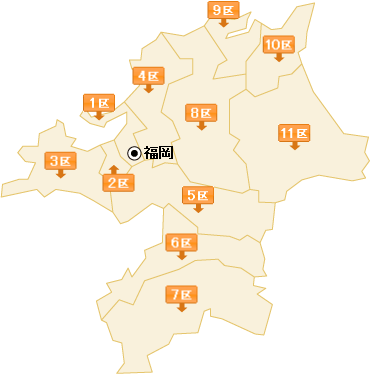
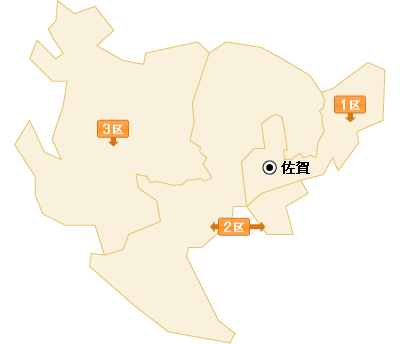
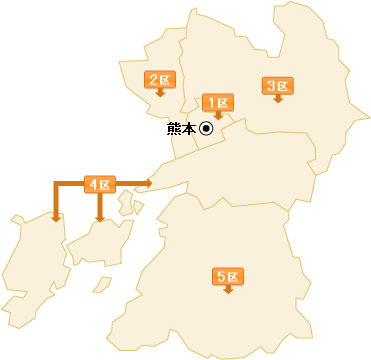
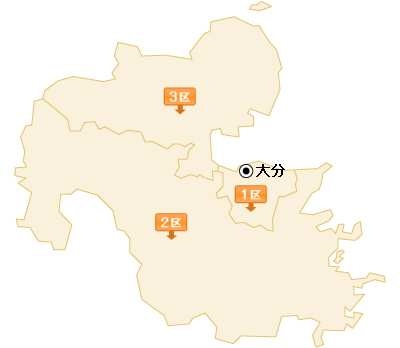
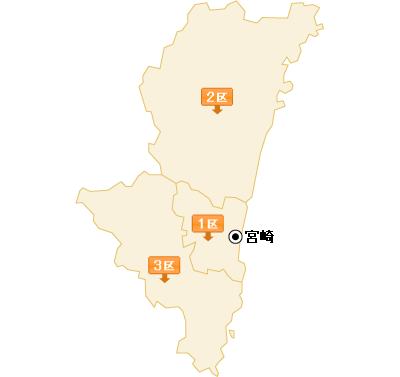
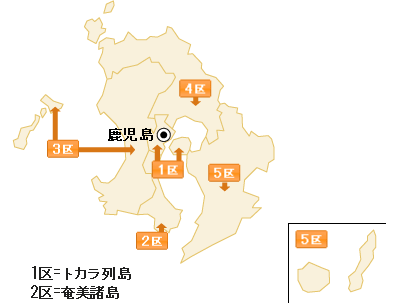
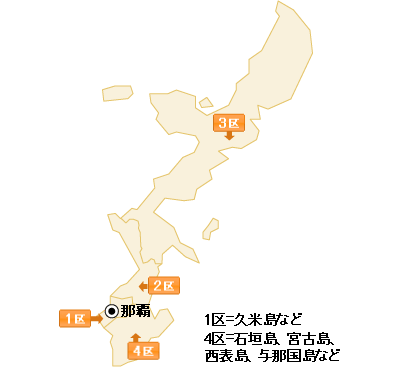
The Kyushu regional block contains thirty-eight single-member districts spread over eight prefectures: Fukuoka, Saga, Nagasaki, Kumamoto, Oita, Miyazaki, Kagoshima, and Okinawa. The block elects an additional twenty-one representatives through proportional representation, for a total of fifty-nine seats.

The region's major population center is Fukuoka, which constitutes roughly a third of the region's population, with the rest of the region's prefectures being roughly equal in population. The region's economic profile is mixed, including agricultural production suiting that region's sub-tropical climate and heavy industry in northern Kyushu. It was once a major mining center, home to Aso Mining, the family business of Prime Minister Aso Taro.

Along with Shikoku and Chugoku it has been a historically important electoral base for the LDP.

In 2005, opposition parties won seven SMDs, four of those being won by DPJ candidates. Meanwhile the LDP won twenty-five seats and Komeito won six. In PR voting, the LDP won nine, the DPJ seven, Komeito three, and the SDPJ and JCP one each. In 2003, the LDP won twenty-six seats, Komeito one, and the opposition parties eleven, with the DPJ winning eight.

However, opposition parties in five of the region's single-member upper house districts in 2007, suggesting the possibility of DPJ gains in the region.

Fukuoka

In Fukuoka in 2005, the LDP won nine seats and Komeito and the DPJ one each.

The DPJ's Matsumoto Ryu (first district) should easily win the district in which he has won every election since the first election under the new system in 1996.

Meanwhile LDP candidates are likely safe in two districts: Aso Taro (eighth district) and Takeda Ryota (eleventh district). Given that Aso is acting as if his seat is vulnerable — he is declined to run simultaneously as a PR candidate — perhaps I should not list his seat as safe, but I think that Aso will not join John Howard as a leader who loses his government and his constituency in the same election. DPJ candidate Yamamoto Gosei may put pressure on the prime minister — he'll be helped by the absence of a JCP candidate — but I expect Aso will win. If he doesn't, perhaps these predictions are the lower bound for the DPJ's performance on 30 August.

Takeda, who after three attempts finally won a seat in 2003 as a conservative independent who joined the LDP in 2004 only to leave it in 2005 as a postal rebel and win the district as an independent once more, will run as the LDP's candidate this year. He faces the SDPJ's Yamaguchi Haruna and JCP candidate Yamashita Tomiko. The fight will be over the 78,000 votes received by Yamamoto Kozo, the LDP candidate in 2005. Takeda will likely win.

But otherwise LDP candidates across Fukuoka are vulnerable. In the second district, Yamasaki Taku, an LDP faction leader, has profited from divided fields in 2003 and 2005 to win reelection. In 2000, the last time the field included only a DPJ candidate and a JCP candidate (as it does this year) Yamasaki lost by 10,000 votes. Yamasaki is high on the list of LDP heavyweights likely to go down to defeat, bested by DPJ newcomer Inatomi Shuji.

Ota Seiichi in the third district may be even more vulnerable than Yamasaki: in 2005 Ota defeated Fujita Kazue, this year's DPJ candidate and winner of the district in 2003. Fujita will likely win again.

In the fourth district the DPJ may benefit from the absence of a JCP candidate, as JCP candidates received around 15,000 votes in the past several elections, turning what would have been close races into comfortable victories for LDP incumbent Watanabe Tomoyoshi. This time DPJ candidate Koga Takaaki has the field to himself, and could emerge as the winner as a result.

Similarly, in the fifth district DPJ candidate Kusuda Daizo will try for the third time to unseat LDP incumbent Harada Yoshiaki. Harada won by 35,000 votes in 2005, 25,000 in 2003, when Kusuda won a PR seat. But in 2003 Harada shared the field with candidates from the JCP and the SDPJ, who combined for 30,000 votes, enough to swing the election to Harada. This time Harada won't have help from other opposition parties.

Also vulnerable is Hatoyama Kunio, DPJ leader Yukio's brother, who parachuted into the sixth district in 2005 and defeated DPJ incumbent Koga Issei. Koga lost by 22,000 votes and won a PR seat, with a JCP candidate taking 11,000 votes. The absence of a JCP candidate should help Koga, but for his part he is publicly skeptical of his chances, citing the press Hatoyama received due to his departure from the Aso cabinet. Hatoyama may hold on to win.

A third LDP faction leader — besides Yamasaki and Aso — is up for reelection in Fukuoka, Koga Makoto in the seventh district. Like Aso, Koga has declined to run simultaneously as an SMD and PR candidate. Koga faces the DPJ's Noda Kuniyoshi, who previously served as mayor of Yameshi city — and no other candidates. The JCP, for example, took nearly 20,000 votes in 2005, which made little difference in 2005 but could be decisive this year, especially since Koga's vote total has fallen gradually since 2000. Like Yamasaki, I think Koga will lose.

The DPJ may have an even easier time in the ninth district, which until 2005 had been represented by Kitahashi Kenji, first elected in 1996 as an NFP candidate and reelected in 2000 and 2003 as a DPJ candidate. He lost by 15,000 votes in 2005 and won a PR seat, but resigned to run for and win the mayoralty of Kita Kyushu city. In his place the DPJ is running Ogata Rintaro, a former foreign ministry official. Given the DPJ's history in the district, I suspect Ogata will win against LDP incumbent Mihara Asahiko.

Finally, in the tenth district LDP incumbent Nishikawa Kyoko faces the DPJ's Kii Takashi, who first ran in 2003 and finished 12,000 votes behind the LDP's Jimi Shozaburo. Jimi left the party as a postal rebel in 2005 and finished second behind Nishikawa with 65,000 votes, 5,000 votes ahead of Kii. The JCP is running a candidate again, but the SDPJ, which received 10,000 votes in 2005, is not. If Kii can take the bulk of the votes received by Jimi in 2005, he should win the seat.

The DPJ should do very well in Fukuoka, winning at least eight of eleven seats.

Saga

In 2005, postal rebels won two of three seats, with the LDP winning the third. As the postal rebels have returned to the LDP, the LDP is defending all three seats in the prefecture.

In the first district, DPJ candidate Haraguchi Kazuhiro has run in each of the four elections since 1996, winning in 1996 as an NFP candidate and 2003 as a DPJ candidate, and losing in 2000 and 2005 as a DPJ candidate but returning as a PR representative. In this race he faces Fukuoka Takamoro, the victorious LDP candidate from 2005 who Haraguchi defeated in 2003. Haraguchi should return as the SMD representative.

In the second district, 2005 postal rebel Imamura Masahiro returns as the LDP candidate facing Oogushi Hiroshi, the DPJ candidate from 2005 who lost by 15,000 votes and won a PR seat. The question in the second district is what will happen to the 35,000 voters who supported LDP candidate Dokai Chiaki in 2005: do they vote for the party or for the policy line, and if so, which policy line? Imamura could hold on to his seat.

The third district features, in addition to the LDP's Hori Kosuke — another postal rebel — and the DPJ-backed SDPJ candidate Yanase Eiji, candidates from the JCP and Watanabe's YP. Hori should retain the seat.

The DPJ will win at least one of three seats in Saga.

Nagasaki

In Nagasaki's four districts in 2005, the LDP won three and the DPJ one.

The DPJ Takaki Yoshiaki (first district), who has represented the district since 2000, should win reelection comfortably.

In the second district, Kyuma Fumio, Japan's first ever defense minister, faces Fukuda Eriko, the twenty-eight-year-old leader of the Kyushu group of victims of Hepatitis-tainted blood transfusions, handpicked by Ozawa to run against Kyuma. Kyuma is clearly worried after having years of being reelected comfortably. Like Koga Makoto in Fukuoka, Kyuma's vote shares have gradually declined in recent elections. Kyuma may also suffer from memories of the remarks regarding the Nagasaki bombing in 2007 that led to his resignation as defense minister. With the DPJ focused on defeating Kyuma, Fukuda might win the upset.

Tanigawa Yaichi, the LDP's incumbent in the third district, has fought close elections with the DPJ's Yamada Masahiko in the past two elections, winning by 6,000 votes in 2003 and 9,000 votes in 2005. Yamada won PR seats in both elections. Reporting suggests that Tanigawa is confident that he can retain his seat on the back of Komeito support in the district, as is the LDP's Kitamura Seigo in the fourth district, who faces DPJ candidate Miyajima Daisuke. Miyajima won a by-election in the district in 1998 as an LDP candidate but lost to Kitamura by 30,000 votes in 2005.

The result could be a split in Nagasaki.

Kumamoto

In Kumamoto in 2005 the LDP won four seats and the DPJ won one.

The DPJ's Matsumoto Yorihisa (first district) will win the seat he first won in 2000.

In the second district the LDP's Hayashida Takeshi, running again in the SMD after alternating with Noda Takeshi in a Costa Rica arrangement, faces DPJ newcomer Fukushima Kenichiro and should win the district.

The third district was won by the late Matsuoka Toshikatsu in 2005, and was won by independent Sakamoto Tetsushi in the by-election following Matsuoka's suicide. Sakamoto has since joined the LDP, and faces the DPJ's Goto Hidetomo and former LDP member Miura Issui, running as an independent. It seems, however, that Sakamoto and Miura may divide the support of groups that have traditionally supported the LDP. Nevertheless, the DPJ has never done well in the district, and the winner will be either Sakamoto or Miura. Miura may edge out Sakamoto, who did the same to Matsuoka running as an independent in 2003.

In the fourth district LDP incumbent Sonoda Hiroyuki should win reelection easily, as should Kaneko Yasushi in the fifth district.

The LDP will win three, the DPJ one, and an independent conservative one.


Oita

The LDP took two seats and the DPJ one in Oita in 2005.

The DPJ's Kira Shuji (first district), who first won as an independent in 2003 and won reelection in 2005, should win the seat again.

In the second district, the SDPJ may be poised to pick up a seat, as Shigeno Yasumasa runs for the third time against LDP incumbent Eto Seishiro. Shigeno lost by 21,000 votes in 2005, closing the gap from 2003 and earning Shigeno a PR seat. With no JCP candidate running this time — the JCP received nearly 15,000 votes in 2005 — Shigeno could unseat Eto.

In the third district, the DPJ's Yokomitsu Katsuhiko will try for the third time to unseat LDP incumbent Iwaya Takeshi. Yokomitsu, losing by 12,000 votes in 2003 and 15,000 votes in 2005, won PR seats both times. The election will be close, and may ultimately depend on the ability of Yokomitsu to bring out SDPJ voters — Yokomitsu ran in 2003 as an SDPJ candidate before switching to the DPJ, and the two parties had a bitter dispute over who should run in Oita in the 2007 upper house election, resulting in both parties' fielding candidates and the LDP's winning the Oita single-member district.

Iwaya could hold on, with the result that the DPJ wins one, the LDP one, and the SDPJ one.

Miyazaki

Miyazaki is odd: LDP-affiliated candidates won all three seats in 2005, although at the time two of three were running as independent postal rebels (and both had first won in 2003 by running as independents, joining the LDP after the election). The postal rebels have returned to the LDP, but meanwhile, Nakayama Nariaki (first district), the one LDP member who did win in 2005 and is now known for resigning three days after taking office as Aso's transport minister due to comments about Nikkyoso, initially announced that he would retire but changed his mind and is now running as an independent, albeit as an independent with the support of senior LDP leaders like Machimura Nobutaka.

In the first district, the field includes, in addition to Nakayama, LDP-related independent Uesugi Mitsuhiro, a former upper house member who ran as the LDP candidate in the second district in 2005 and lost, Kawamura Hidesaburo, a former MAFF official running as an independent with DPJ, SDPJ, and PNP backing, and a JCP candidate. I suspect that Nakayama will win reelection.

Eto Taku, a postal rebel who returned to the LDP, is seeking another term in the second district, facing the DPJ's Dokyu Seichiro and an independent. Eto will likely win reelection.

In the third district, Furukawa Yoshihisa should win reelection easily.

With Nakayama likely to return to the LDP after the election, the LDP will presumably win three seats in Miyazaki.

Kagoshima

Although the LDP did not win all five seats in 2005, it is now defending all five seats in Kagoshima.

The DPJ's best chance of picking up a seat is in the first district, where LDP incumbent Yasuoka Okiharu faces the DPJ's Kawauchi Hiroshi, who has lost to Yasuoka by roughly 20,000 votes the past two elections and 9,000 votes in 2000, winning PR seats each time. The JCP is fielding a candidate and independent Yamashita Junichi is running, but Kawauchi may manage to win the district this time.

The LDP candidate in the second district, Tokuda Takeshi, was elected as an independent in 2005 but migrated to the LDP and now faces DPJ candidate Uchikoshi Akashi, a former prefectural assemblyman. As the DPJ has never fielded a candidate in the district, it is unclear how the DPJ brand will do. Uchikoshi ran as an independent in 2005 and received nearly 45,000 votes, but Tokuda and the LDP candidate combined for nearly 160,000 votes. Tokuda will probably be reelected.

In the third district, the PNP may be poised to pick up a seat as the joint PNP-DPJ candidate, Matsushita Tadahiro, finished second in 2005 to the LDP's Miyaji Kazuaki, but the DPJ vote combined with Matsushita's votes would have bested Miyaji.

The DPJ candidate in the fourth district is former Rengo Kagoshima vice president Minayoshi Inao, who faces LDP incumbent Ozato Yasuhiro. Ozato has consistently beaten opposition candidate by 40,000 votes and should win again.

Moriyama Hiroshi, the LDP's former postal rebel incumbent in the fifth district, won by 55,000 votes of an LDP "assassin" in 2005 and in 2003 defeated the DPJ's candidate by nearly 100,000 votes. He will be reelected.

The LDP will win three seats, the DPJ one, and the PNP one.

Okinawa


In Okinawa in 2005 the LDP won two seats, the SDPJ won one, and a DPJ-backed independent who has since joined the PNP won one.

In the first district, PNP incumbent Shimoji Mikio should win reelection, as should the SDPJ's Teruya Kantoku in the second district.

The LDP's incumbent in the third district, Kakazu Chiken, won in 2005 because both the DPJ and the SDPJ fielded candidates, Tamaki Deni and Tomon Mitsuko respectively. Once again the two opposition parties will be fielding these candidates, despite their combined vote in 2005 being enough to defeat Kakazu. All that may change this year is that Tamaki finishes second instead of Tomon.

Finally, in the fourth district the LDP's Nishime Kosaburo faces DPJ newcomer Zukeran Chobin. Nishime also won due to a divided field, with the DPJ, JCP, and PNP dividing up 72,000 votes that would have been sufficient to beat Nishime. Zukeran, having the field to himself, may win the district for the DPJ.

The result in Okinawa will be one for the DPJ, one for the LDP, one for the SDPJ, and one for the PNP.

Proportional representation

It is unlikely that the DPJ will run as strong in the Kyushu regional block as it will elsewhere, especially because Komeito will run stronger in Kyushu than it will elsewhere. In 2005, for example, Komeito received nearly 16% of the vote and won three PR seats. The likely PR outcome is for the LDP and the DPJ to reverse their totals, and perhaps the PNP winning a seat instead of the SDPJ, leaving the distribution at nine for the DPJ, seven for the LDP, three for Komeito, one for the JCP, and one for the PNP.

If these predictions, the DPJ will win twenty-four seats, the LDP twenty-five, the PNP three, Komeito three, the SDPJ two, the JCP one, and an independent conservative will win the last seat.

Friday, July 10, 2009

Who's afraid of the conservatives?

Yamasaki Taku, perhaps the leader of the LDP's remaining doves, spoke at a Genron NPO meeting Thursday afternoon at which he addressed Murata Ryohei's revelations of the secret deal between the US and Japan that permitted the US to "introduce" nuclear weapons to Japan. (Previously discussed in this post.)

"It is appropriate to approve this kind of action for US deterrent power," he said, in light of the nuclear standoff with North Korea, this kind of action being a revision of the non-nuclear principles to permit explicitly the introduction of US nuclear weapons into Japan as in the 1960 secret agreement.

Yamasaki is no pacifist, so this statement is not exactly a bombshell, but it does suggest that there is more to this debate than suggested in Armchair Asia's discussion of Murata's revelations. The anonymous author of Armchair Asia outlines Murata's conservative motives in this post, arguing, "In reality, it is part of a convoluted Rightist strategy to repeal Article 9 and create a military independent of the United States."

I do not disagree that Murata has a number of affiliations that strongly suggest his political leanings. The Shokun! article cited in the initial post — Shokun! obviously triggers various red flags — uses a number of conservative code words, "pride," "independent country," and the like. A subsequent post includes a translation of an op-ed by Okazaki Hisahiko, the notoriously hawkish Foreign Ministry OB who was once known as "Abe's brain," defending Murata's actions. (Available in Japanese here.)

But so what? Why should it matter that Murata is a conservative nationalist? And why should it matter why he decided to reveal the secret agreement (or why Okazaki has defended him)? After watching the Abe government blow up, it is hard to muster up the same concern about the influence of the conservatives. The author writes that of how Murata's remarks will be used by those "who want to use any means to repeal Article 9 and advance Japan's rearmament." Events seem to have taken care of both causes. As I have written previously, the economic crisis has greatly diminished the power of the conservatives even within the LDP, to the point that constitution revision might not even be included in the LDP's manifesto this year (if the LDP ever gets around to writing one).

Is Article 9 really at risk? Even in the best of times, it was unlikely that the conservatives would get what they wanted on Article 9. Oh sure, they could get the article revised, but the need to assemble two-thirds of the members of both houses plus fifty percent plus one of the Japanese public would guarantee that the article would be amended but not abandoned. Revision would likely shift the yardsticks, ratifying changes that have been made that appear to depart from the letter of the law, without removing all limitations on Japanese security policy. And, incidentally, I see no problems with revision of this sort. No document drafted by human hands is beyond revision. My problem is with those obsessed with revision, like Abe Shinzō, not revision itself.

In any case, with the LDP in its death throes, it bears mentioning that constitution revision is even less likely under a DPJ-led government in coalition with the SDPJ. A DPJ government is likely to take its cue from public opinion polls that show the percentage of respondents interested in constitution to be under five percent. Raising constitution revision would only serve to weaken the coalition and sow dissent within the LDP, while strengthening an opposition LDP.

The same goes for "rearmament," the second concern voiced by the author of Armchair Asia. The conservatives have been ascendant for roughly the same period that Japan has let its defense spending stagnate, which suggests, of course, that for all their rhetorical might their reach exceeds their grasp. Their reach will only decline further should the LDP lose power this year. They have allies in the DPJ, but if the DPJ is able to deliver on its plans for a government that unifies cabinet and party, conservatives like Maehara Seiji will find themselves straitjacketed by government service. And there is no chance that a DPJ government elected on a platform of Seikatsu dai-ichi would, upon taking power, proceed to channel significant sums of money into defense spending. Elected on a platform stressing butter, butter, butter and facing skyrocketing pensions costs, it is highly unlikely that the DPJ will decide to invest in guns once in office.

There may be more to rearmament than defense spending, but as with some limited form of constitution revision, what is the problem with Japan doing incrementally more without drastically increasing its spending?

To conclude a discussion that has run longer than I intended, the conservatives should be challenged but their strength and influence should not be exaggerated. And if Ambassador Okazaki wants an open debate, then someone in Japan ought to give him his debate.

Meanwhile, as I wrote in my original post on Murata, I think that whatever his motive, it is good that the Japanese government will be forced to address the role of nuclear weapons in the US-Japan relationship openly. It is entirely possible that the Japanese public — with a nuclear North Korea next door — will recognize a revision of the non-nuclear principles that explicitly permits the US to do what it has been doing all along will strengthen Japan's security. Despite the wishes of the conservatives, the public isn't exactly pressing for Japanese nuclear weapons as a substitute for US nuclear weapons.

It is encouraging that the two governments will hold a working-level meeting this month to discuss the nuclear umbrella, a discussion that is long overdue. One meeting will not resolve the paradox of Japan's trying to be the world's conscience on nuclear weapons while being defended by US nuclear weapons but it will at least help call attention to the paradox and force the Japanese public and their representatives to address it. The US should not be forced into a position where it would have to use nukes to defend Japan (at the behest of its elites) even as the Japanese public condemns the US. Explicitly permitting US nuclear weapons in Japan would certainly help make both countries responsible.

Monday, December 15, 2008

Political Japan awaits a black swan


"SOCIAL ENTROPY: A measure of the natural decay of the structure or of the disappearance of distinctions within a social system. Much of the energy consumed by a social organization is spent to maintain its structure, counteracting social entropy, e.g., through legal institutions, education, the normative consequences or television." – Krippendorff's Dictionary of Cybernetics
The LDP is in an advanced state of decay. Not surprisingly, as its death throes worsen, as the chaos within its ranks grow, more energy is being expended simply to preserve the fiction that the LDP remains a coherent party capable of governing its own members, let alone Japan. As entropy grows, so too does the energy dedicated to preserving the structure.

The signs of decay are everywhere.

At present the leading example is the developing Watanabe mutiny, which shows no signs of abating. Watanabe Yoshimi appealed to Prime Minister Aso for cooperation in a speech in Fukushima prefecture Saturday, but only on Mr. Watanabe's terms. Mr. Watanabe criticized Mr. Aso's new stimulus package as doing little to shift power from the bureaucracy to the politicians. "Change for this country," he said, "is truly desired." Behind Mr. Watanabe stands what AERA suggests is a group of forty-eight young reformists who share Mr. Watanabe's desire for wide-reaching reform and fear for their political lives. These forty-eight, including Shiozaki Yasuhisa, chief cabinet secretary under Abe Shinzo, are more than sufficient to overthrow the government by depriving the government of its supermajority. The question is whether they are willing to do so. The article makes a good point in suggesting that the reformists may have nowhere to go: with the DPJ running candidates in nearly 250 of 300 single-member districts, many of the Koizumians — particularly those in their first or second terms — face uphill battles for reelection and are hardly in a position to run to the DPJ. In Albert Hirschman's terms, their exit option is limited, so they are left trying to exercise voice within the LDP by forming study groups and publicly criticizing the prime minister. (And the DPJ will do everything it can to encourage the exercise of voice by LDP members — just as LDP officials have cheered for DPJ members opposing Ozawa Ichiro and criticized the lack of voice within the DPJ.)

Perhaps this explains Kan Naoto's inclusion in what is now being referred to as the YKKK. Growing out of the LDP's liberal dynamic duo of Yamasaki Taku and Kato Koichi, the final two letters are for Kan Naoto, DPJ executive, and Kamei Shizuka, founder of the People's New Party. Messrs. Yamasaki and Kato are apparently in touch with the latter two regarding the possibility of a post-election realignment. Asahi reports that Mr. Kato is open to leaving the LDP before an election — as are the other two (naturally) — but Mr. Yamasaki is reluctant, saying only that his goal is ending the divided Diet. Accordingly, Mr. Yamasaki joined the six other faction leaders to voice their support of the Aso government.

Based on the combination of names, the YKKK looks to me more like a way for a potential DPJ-led coalition government to pry away some LDP members than the basis for a comprehensive political realignment. The liberals are even more alienated within the LDP than the Koizumian neo-liberals, and have little to lose from leaving the LDP. It's little wonder that Mr. Kan would want to pry the liberals into the DPJ; not only would the bolster the party's numbers, but they would strengthen Mr. Kan's group within the DPJ. Not surprisingly, Mr. Kan has rejected the notion of a realignment before a general election. (I should add that this must be precisely what Ozawa Ichiro wants: all talk of a realignment is focused on LDP members defecting, as opposed to the dissolution of both the LDP and the DPJ during a realignment. The YKKK resembles less a multi-partisan alliance than the opposition parties looking to pluck low-hanging fruit from the LDP.)

The LDP's leadership, consistent with the notion of social entropy, is taking all of these threats seriously — these manifestations of entropy within the LDP. The party elders have closed ranks around the prime minister. Mori Yoshiro, don of the Machimura faction and a former prime minister who knows something about low approval ratings, most recently lashed out at Messrs. Yamasaki and Kato, as well as Nakagawa Hidenao. "Deplorable," he said. "Nothing but carefree, thoughtless politicians who have profaned all who have done the hard work of building Japan's politics." Ibuki Bunmei, Mr. Abe's education minister and LDP secretary-general under Fukuda Yasuo, has also spoken up on the prime minister's behalf, first by arguing that the party has no choice but to stick with Mr. Aso, because the public would be outraged if the LDP picked a fourth leader without a general election (how is four any less bad than three?) and then by warning that the YKKK could be like the KKK, "assassinating" young LDP members who follow them. It's hard to describe just how offensive this is, although MTC tries. But lame attempt at a joke aside, Mr. Ibuki couldn't be more wrong. Staying loyal to the Aso LDP — Mr. Aso's name has been inserted before the party's name in recent promotional material — at the same time that the party has moved ever further from the platform that got so many of the young LDP members elected in the first place seems like a terrible career move. Mr. Ibuki forgets that the party has systematically alienated its young Koizumians in the two years since Mr. Koizumi left office. How could the YKKK, or whatever alternative emerges, possibly be worse?

The LDP leadership's goal is to both close off exit options and stifle the exercise of voice.

None of this is to say that any one scenario is inevitable. There are number of possibilities for the coming year: a pre-election realignment that involves defection of the liberals and/or the neo-liberals; the creation of a neo-liberal third party before or after the next election; no change before a general election, in which the Koizumians are defeated; a fierce leadership struggle in the DPJ should Mr. Ozawa be forced to step down due to ill health. No one can say with any certainty which scenario will come to pass. The actors themselves don't know. The Japanese political system is waiting for a black swan of one form or another, the next jump in the history of Japanese politics. "History and societies," Nassim Nicholas Taleb wrote, "do not crawl. They make jumps. They go from fracture to fracture, with a few vibrations in between."

What is certain is that the LDP establishment is losing its grip over the LDP and its constituent parts. They cannot silence mutinous backbenchers. They cannot stop backbenchers from forming study groups working at cross purposes with the government. When the right opportunity comes, they will most likely be unable to stop discontented members from leaving.

And they cannot stop voters and interest groups who have long supported the LDP from breaking with the LDP to support the DPJ.

Tuesday, December 9, 2008

The liberals step into the breach

Watanabe Yoshimi is not relenting in threatening rebellion against the Aso government.

Speaking at a fundraising party on Monday evening, Mr. Watanabe speculated openly about scenarios for political realignment. Edano Yukio, a DPJ reformist, was in attendance and stated that if Mr. Watanbe decides to leave the LDP for the DPJ, he should be welcomed with open arms.

Mr. Watanabe's three scenarios for realignment include (1) a franchise model, the creation of a new party bearing the LDP label (the Tokyo LDP, for example); (2) the amicable divorce model, freeing Mr. Watanabe to bargain with all possible partners; and (3) the "without means" model, jumping from the LDP without any guarantee of a successful landing.

It is unclear which scenario will come to pass, if any. Mr. Watanabe may be able to rely on the support of other young reformers, but it's by no means a sure thing. The Koizumi children and their fifty-something older brothers and sisters have shown themselves to be remarkably timid. The lot of them have been waiting virtually since Koizumi Junichiro's term as prime minister ended for someone to challenge the drift within the LDP. But even now, with Mr. Watanabe talking openly about challenging the government and leaving if the LDP they cannot make up their minds. Yamamoto Ichita has, for example, argued at his blog that Mr. Watanabe speaks only for himself — he does not speak for the reformists en masse. It may be that even Mr. Watanbe does not know what he wants to do. Sankei suggests that he may be driven as much by resentment at having been bounced from the second Fukuda cabinet at then-LDP secretary general Aso's urging as by policy disagreements with Mr. Aso. As such, it remains an open question whether he has the courage to act. He may yet tell himself that he has too much to lose from breaking with the LDP (although if he keeps talking he may lose more reputationally from speaking openly about challenging the government only to back down).

In the meantime, an older generation is also speaking of realignment, namely those old allies of Mr. Koizumi, Kato Koichi and Yamasaki Taku. The self-styled liberals have little to lose from publicly challenging the Aso government and threatening to leave the party. Both are their own men, insofar as LDP members are capable of being independent. Mr. Kato, having left politics for several years after being accused of corruption, is not affiliated with any faction and is something of an outsider within the LDP. Mr. Yamasaki is a faction chief, but as a liberal (and an advocate of normalization with North Korea), he is increasingly out of place within the LDP. Little surprise then that both men have been active in discussing a possible realignment. The latest is that Mr. Yamasaki appeared on TV Monday to argue for a new party drawing members from both the LDP and the DPJ that will be able to govern following the next general election.

I would argue that neither Mr. Kato nor Mr. Yamasaki is in a position to be the catalyst for a realignment. The problem with being independent is that there are few guarantees that anyone would follow them out of the LDP. Such is the paradox facing the LDP's malcontents today. A rebellion by Mr. Watanabe is meaningfuly precisely because as a promising future leader, a former cabinet minister, and an LDP princeling he has something to lose by rebelling against Mr. Aso and the party establishment. But for those same reasons he might ultimately decided not to rebel, especially if he is unable to rely on his fellow reformists for support.

Friday, July 4, 2008

Kato steps up

Kato Koichi has been chosen as the head of the Japan-China Friendship Association, an influential and venerable organization advocating closer relations between Japan and China. (A history of the organization can be read here.)

Mr. Kato has seen his influence vanish since his failed rebellion against Mori Yoshiro in 2000, which was followed soon thereafter by the arrest of his secretary and his (temporary) resignation from the Diet. He subsequently became LDP's leading liberal, criticizing both his onetime comrade Koizumi Junichiro and Abe Shinzo for their revisionism before declaring his support for Fukuda Yasuo. A retired diplomat who was in MOFA's China School, Mr. Kato has been a relentless critic of historical revisionism and a tireless advocate of cooperation in Asia. Indeed, as seen as in this 2004 speech at Johns Hopkins University, Mr. Kato, like Mr. Fukuda, has a vision for a peaceful, integrated Asia.

Not surprisingly, Mr. Kato is not particularly popular with the Japanese right — and his home was the target of arson on the auspicious date of August 15, 2006.

But now with a perch at the top of an influential organization that spans party lines, perhaps Mr. Kato may yet have an important role to play in Japanese policy making. The prime minister needs all the help he can get in making a case for a constructive relationship with China and a more cooperative approach to Asia more broadly. Few prominent, popular figures seem to be willing to make the case publicly and persistently for a more cooperative Asia-centered foreign policy, meaning that the conservatives have effectively won the propaganda war. Mr. Kato, however, still commands respect when he speaks, even as an outcast within the LDP.

Mr. Kato may now be prepared to reconnect with Yamasaki Taku, the other member of the YKK, to fight back on North Korea policy and Japan's Asia policy more broadly.

On Friday morning, Mr. Kato appeared on a TV program to join Mr. Yamasaki in his feud with Abe Shinzo, emphasizing the failure of the Koizumi-Abe line on North Korea. Arguing that Japan may be finally having a debate on North Korea, three years late, he said about Mr. Abe, "If Mr. Abe was a person who understood a little more about the international situation, the Six-Party talks on the North Korean nuclear problem would have been held in Tokyo." In other words, if Japan had remained engaged in finding a solution to the problem instead of going down the abductions rabbit hole, Japan would be enjoying greater influence in the region today, instead of wondering how Japan became so isolated, estranged even from the United States. (He also urged Mr. Fukuda to reshuffle his cabinet and distance himself from the Koizumi line, advice that runs contrary to Mr. Koizumi's, and is unlikely to be embraced by the prime minister, who, I think, is less concerned about embracing a "line" than balancing the various elements of the LDP and keeping his opponents off balance.)

Perhaps this is the beginning of pushback by the liberals against conservative-revisionist control of the LDP. It is unlikely that the pushback will get very far, resting as it does on Messrs. Kato and Yamasaki, politicians on the downhill side of their careers, unless they manage to encourage their compatriots to speak up (one of Mr. Kato's greatest strengths seems to be courage and fearlessness in the face of great opposition) and challenge the conservatives. However, it matters less what they do within the LDP than what they do in the public at large. If Mr. Kato can combat public skepticism towards China and challenge an abductions-centered North Korea policy in public, he will have accomplished something great — and something necessary for the future of a peaceful Asia.

Sunday, June 29, 2008

Yamasaki's lonely fight

What a difference fifteen years make.

In his memoir, Abe Shinzo wrote of his lonely fight — alongside Nakagawa Shoichi and a handful of other LDP conservatives — to oppose normalization with North Korea and place the abductions issue at the center of Japan's North Korea policy. They battled against the LDP, the media, academia, and the foreign ministry to force them to consider the plight of the abductees before providing North Korea with aid and clearing the way to diplomatic recognition.

Here we are in 2008 and Mr. Abe got his wish. Resolving the abductees issue has become a primary goal of Japan's North Korea policy, a goal that enjoys substantial support in the public, the media, and the LDP. The US is pilloried for giving (symbolic) ground to North Korea without resolution of the issue — and the Fukuda government is pilloried for letting the US shift happen. Mr. Abe, Hiranuma Takeo, and other conservatives set the tone on North Korea.

And Yamasaki Taku, an advocate of normalization with North Korea, is left to fight a lonely battle against a public largely opposed to his proposal.

His fight has become a personal one, as Mr. Abe has decided to make a mission of demolishing Mr. Yamasaki's argument.

Mr. Yamasaki appears happy to reciprocate. Appearing on a Western Japan TV program Saturday, he called Mr. Abe "the howling dog" of North Korea policy, whose baying has accomplished nothing. He further insisted that it was a mistake for Japan's North Korea policy to depend largely on US pressure; Japan, he said, had to take more proactive action itself in negotiations with North Korea.

Mainichi provides a longer quote from this appearance, that makes his argument even clearer: "America's greatest national interest is stopping North Korea's nuclear development, and compromise on the nuclear issue is possible. The Japanese abductee problem is a problem in Japan-North Korea relations, and it is not an appropriate attitude to depend on another country for the solution."

What a sensible — and rare — argument for a Japanese politician to make in the midst of the moaning about the "shocking" US shift. How ironic that conservatives, interested in an independent, assertive foreign policy, cannot tolerate the US government's taking a different position. Does Japan really need the US in order to solve the abductions issue, as implied by conservative dismay over last week's announcement (Japan has lost its "America card," Mr. Hiranuma said)?

Unfortunately there are few signs that Mr. Yamasaki's view will win out. The government is proceeding gingerly, emphasizing that nothing has changed yet and declaring that the Fukuda government will continue to make a priority of the abductions issue. (See statements by Machimura Nobutaka on Fuji TV's Hodo 2001 program.) But according to Mainichi, ambiguity surrounding the details of the recent agreement with North Korea to re-investigate the abductions has made the prime minister a target of public dissatisfaction.

Of course, the Fukuda government isn't alone in taking the blame. Plenty of blame is being directed towards the US. Over the weekend, Mr. Abe called on President Bush to honor his promise to the abductees. Ibuki Bunmei, the LDP's secretary-general, added his opinion, suggesting that the US has been "deceived" by North Korea. He suggested that the Bush administration may betray Japan further by repeating the Clinton administration's decision to send a senior official to Pyongyang.

Is there no other significant LDP official willing to support the Yamasaki line?

Another illustration of how the LDP has changed since the cold war ended. The party belongs to the revisionists now. Pragmatists like Mr. Yamasaki are tolerated but marginalized.

Wednesday, June 18, 2008

Abe charges in

Less than a week after the Fukuda government announced a new approach to the North Korea problem, Abe Shinzo, self-appointed defender of the abductees, has charged into the fray to criticize Yamasaki Taku, head of a Diet members' group advocating a normalized relations with North Korea. Mr. Abe claimed that Mr. Yamasaki's comments have diluted the government's bargaining power in the midst of negotiations.

Responding to Mr. Yamasaki's dismissing his thinking as "infantile," Mr. Abe admonished Mr. Yamasaki to "think and act in the national interest."

Not surprisingly, Mr. Abe also admonished the government (and the US) not to act unless North Korea moves substantially first.

Mr. Abe and his conservative colleagues are undoubtedly displeased with a foreign ministry announcement Wednesday. The foreign ministry declared that the Japanese government would view the launch of a reinvestigation into the abductions issue by North Korea as "progress," a far lower bar for lifting sanctions than the conservatives want. I will be curious to see who stands up to question Machimura Nobutaka and Saiki Akataka (head of MOFA's Asia-Pacific bureau) in the lower house's ad hoc committee on the abductions problem at a hearing being held today. Will LDP conservatives rake the government over the coals?

It will also be curious to see what Christopher Hill, US assistant secretary of state for East Asia and the Pacific, will say when he arrives in Japan today for talks — especially in light of Secretary of State Rice's statement Wednesday that she expects North Korea to declare its nuclear weapons program "soon."

By lowering the bar on what constitutes progress, is MOFA clearing the way to assist the US on the nuclear question? And will Prime Minister Fukuda survive the storm of criticism that will greet such a move?

Tuesday, June 17, 2008

More stress headed Fukuda's way

Prime Minister Fukuda held a press conference Tuesday with journalists from foreign wire services at which he said in response to a question about whether it is fun being prime minister, "It's not fun! It's like a painful lump." To deal with stress, he told the reporters that he sleeps and drinks wine.

Little wonder that Mr. Fukuda is feeling stressed.

In the days since Machimura Nobutaka announced the tentative agreement reached with North Korea, Mr. Fukuda has faced the predictable uproar from the right.

On Tuesday, Hiranuma Takeo, chairman of a Diet members' league on the abductions problem and member (controversially) of Nakagawa Shoichi's conservative study group, visited the Kantei to appeal to Chief Cabinet Secretary Machimura on lifting sanctions. There should be no relief to North Korea without the recognition of concrete progress, he said.

The government will likely bend to their demands. Mr. Fukuda acknowledged Monday that the success of the agreement will depend on North Korea's follow through. That said, the conservatives haven't won yet. The meaning of "concrete action" is disputed. It is unclear what North Korea can do to please the conservatives (who may in fact prefer that the issue drags on); "realists" like Yamasaki Taku, head of a Diet members' league for the promotion of normalization of Japan-North Korea relations, seem willing to lower the bar. Mr. Yamasaki wants the abductions issue to be resolved within the year. In between Mr. Hiranuma and Mr. Yamasaki is the group for the promotion of a prudent North Korea policy, which supports a carrots-and-sticks approach to North Korea. Yamamoto Ichita, a member of the group, reports that it delivered a list of demands to Mr. Fukuda on Tuesday. Like Mr. Hiranuma, they do not want Japan to lift any sanctions until North Korea has made clear progress on its reinvestigation (again, clear progress is left undefined). They want the government to make clear to Washington that the Japanese government does not want the US to remove North Korea from the state sponsors of terrorism list yet. They continue to oppose normalization until progress is made on all fronts: abductions, missiles, and nukes.

In addition to pressure from within his own party, Mr. Fukuda also faces pressure from the public, which is circumspect about the new agreement. A Mainichi poll found that 34% of respondents "value" the government's agreement, while 55% do not value it. Considering that 88% of respondents in the government's latest foreign policy survey were concerned about the abductions issue (more than any other area of contention with North Korea), that's actually not terrible. If North Korea actually follows through — at least enough to allow the government to argue that there's been progress — the agreement might eventually enjoy a plurality of support, if not an outright majority.

Time to send some more wine over to the Kantei.

Sunday, May 4, 2008

Fukuda loses another crutch

Following polls that showed the DPJ edging ahead of the LDP in party approval ratings and Mr. Fukuda's approval ratings falling to record lows — the lowest being Mainichi's 18% — Mr. Fukuda has suffered another blow in the latest Mainichi poll.

If the claim that the "LDP is still more popular than the DPJ" was one line regularly trotted out by LDP officials discussing the party's electoral prospects, another was that "no matter how unpopular Mr. Fukuda gets, he's still more popular than Ozawa Ichiro." Even DPJ members have bought into this, as they fear that Mr. Ozawa will be a major electoral liability in urban and suburban districts. The LDP has assumed that as long as Mr. Ozawa is the head of the DPJ, it enjoys some cushion.

But no longer. Mainichi found that in a poll taken May 1 and 2, 18% of respondents said Mr. Ozawa would make a suitable prime minister, compared with 14% for Mr. Fukuda. That said, 63% replied that they find neither suitable. More strikingly, the same poll confirmed the previous Mainichi poll's finding that the DPJ's support is now greater than the LDP's: the DPJ's support rose eleven points to 51%, the LDP's dropped twelve points to 24%.

As with previous polls showing a shift away from the LDP, this poll is significant because it deprives the prime minister of yet another argument justifying his continuing in office. It provides Mr. Fukuda's would-be successors with more evidence demonstrating why his premiership should end sooner rather than later.

In the midst of these latest blows, Yamasaki Taku, head of his eponymous faction, is arguing that the prime minister should reshuffle his cabinet following the G8 summit. Do Mr. Yamasaki and Mr. Fukuda really believe that the prime minister's problems lie in the members of his cabinet, as opposed to his broken party, a recalcitrant bureaucracy, and the prime minister's leadership deficiencies, which prevent him from surmounting these obstacles? I wonder whether the LDP would go along with a cabinet reshuffle, or whether LDP members — and not just Aso Taro and other leadership candidates — would call for a reshuffle that starts at the very top.