Monday, October 30, 2006

Around the Asia-Pacific region

To start, Patrick Porter of Oxblog posted an interview with Christopher Hitchens that dissects fascism, among other topics. Hitchens made an interesting point about the innate irrationality of fascists:

Another [characteristic] is its irrationality. With the Soviet Union there was a degree of predictability, it was essentially rational. There were certain things we knew they weren't going to do. It was containable. But fascism tends to irrationality. It is not an accident that suicide - the death cult - is a part of this. Attacking New York in broad daylight on 9/11, for example, when they could have taken over Pakistan, and had a nuclear-armed state in their hands, if they were just willing to do it quietly. On the other hand the elaborateness of the display meant battle is joined, which excited some of their constituents. It both hates and envies modernism. It doesn't want to do science, but it wants what science produces, to seize and pervert it. The Nazis could have had the nuclear bomb, but they got rid of all Jewish scientists. In this, you can look at A. Q. Khan, and his work to exploit science, and turn it against modernism.

A small quibble with this is that while the Soviet Union in its mature period was predictable and containable, under Stalin it was far more irrational, perhaps the best case being the purge of officers as Nazi Germany rearmed. But Hitchens's comment is interesting in light of a review of Mao's Last Revolution in the Washington Post. Arguably Maoist China in its most extreme periods was fascist by Hitchens's criteria -- the Cultural Revolution was a kind of autophagy in which the youth of China were an instrument used to devour China from within, an irrational act to the extreme and certainly anti-modern. The review's author, Berkeley China specialist Orville Schell, concludes by speculating on the meaning of "The Great Helmsman's" continuing presence in China:

China has come a long way since Mao. But neither he nor his revolution has been completely interred; his body still lies on public view in Tiananmen Square, his image remains on China's money, and his portrait still hangs on the Gate of Heavenly Peace. With China's political system still lacking the kinds of checks and balances that can bring a society back from the brink of extremism, optimism about its political future should be tempered by realism.

Indeed, this September, on the 30th anniversary of both Mao's death and the end of the Cultural Revolution, the party still chose to spend a week celebrating his legacy, culminating with an official concert in the Great Hall of the People entitled "The Sun is the reddest and Chairman Mao is the most beloved." No mention was made of the incalculable damage his Cultural Revolution inflicted on his country. In the future, one important index of China's passage toward political maturity will be the degree to which it feels able to repudiate both Mao and his Cultural Revolution legacy.

Indeed. China bulls will likely continue to be disappointed so long as China continues to maintain the pretense of being Communist, because doing so means the country will remain in the hands of increasingly parasitic cadres that will likely undermine further liberalization. When Mao goes, so too will the cadres.

Shifting to the North Korean front, in the New York Times Vaclav Havel, Kjell Magne Bondevik, and Elie Wiesel call for turning North Korea into a "human rights issue." The long-suffering North Korean people have indeed been the victims of a government that has shown more indifference to the people it is "responsible" for than most of its contemporaries. So it is hard to argue with their op-ed. But at the same time, one is led to wonder whether any humanitarian measure short of a regime change that brings an end to the DPRK's Juche ideology will make the slightest difference in the bleak lives of the North Korean people. The recommendations made by the authors, including nonbinding UN resolutions, seem to be feeble, futile gestures showing how little the rest of the world can do to improve the lot of North Koreans.

Indeed, the true scale of the devastation wreaked on North Korea by its government is yet unknown, because it's impossible for outsiders to guess the exact number of North Koreans who have died at the hands of the Kim Family Regime, whether by famine or gulag. The KFR has, moreover, created a kind of poison pill by cutting the North Korean people off from the world and making them dependent on the KFR. Imagine the severe disruptions to the lives of North Koreans when they suddenly find themselves without their Dear Leader, forced to make their own way in the world. This is no reason to refrain from hurrying the KFR to its demise, but the process of building a functioning society in North Korea will make the reunification of Germany look easy.

Meanwhile, in Japan, LDP policy chief Nakagawa Shoichi has repeated his call for a debate on nuclear weapons, this time while on a visit to Washington. Personally, I have no problem with Japan debating whether it should have nuclear weapons, because having a debate by no means obligates Japan to pushing forward in the direction of a nuclear arsenal. I strongly disagree with Nabeshima Keizo's column in the Japan Times, the title of which says it all: "Even nuclear talk detracts." If Japan is to become a "normal" country that contributes to global security alongside other great powers, then it must drop its taboos about even speaking about certain subjects, the nuclear question being the biggest. Even if the debate leads Japan's leaders to opt against acquiring nuclear weapons, as seems likely at this juncture, it is important to have the debate, because it will help outline the parameters of Japan's normalization and clarify its relations with the US. So have a debate, put the issue to rest, and get on with the business of building a foundation for Japanese security policy in the twenty-first century. At the moment, however, Japan is still not ready to initiate a broad debate on this fundamental question; as the Yomiuri Shimbun reports, the LDP and the Abe Cabinet will abjure from addressing the nuclear issue, although Abe's response -- "We won't discuss the issue at any organization within the government or the LDP, but we can't suppress discussions outside of them" -- hints at what could be a strategy to keep nuclear weapons on the agenda without the government's being burned politically.

Lastly, I want to call attention to an article in The Times on the bizarre criticism by former Malaysian Prime Minister Mahathir Mohammed of his successor Abdullah Badawi, with Mohammed, who brooked no dissent, suggesting that Badawi is running a "police state." Pot, kettle, black? I wish Malaysia the best of luck in the post-Mohammed period, and Mr. Mohammed a quiet, peaceful retirement -- you've done quite enough for Malaysia already.

Saturday, October 28, 2006

Vive le Koizumisme!

Everyone seems to be talking about France this weekend.

Christopher Caldwell, in the FT this weekend, discusses how French Socialist Segolene Royal is dangerously courting populist opinion (subscribers only).

In the Economist, meanwhile, this week's survey is about France's decline; Sophie Pedder, the survey's author, argues, as I did yesterday, that political will is the key to reversing the country's decline.

...This survey will argue that French decline is not inevitable, any more than British decline was inevitable in the 1970s. There is nothing that necessarily predisposes the French to conservatism or resistance to change. Just because political leaders in the past have failed to push through bold reforms—Mr Chirac himself, in 1986-88; Alain Juppé, a former prime minister, in 1995—does not mean that the country is unreformable. The unruly French do not make the task easy, but winning them over is a question of political leadership—the courage to level with voters and tell them why things need to change.

The question is who will be France's Junichiro Koizumi, a leader who vows to destroy a failed system and replace it with a new one for the sake of the long-term benefit of the nation, whatever the consequences to his (or her) political career.

So look east, France, because Japan is at the forefront of the latest wave of the transition from industrial to post-industrial societies. Vive le Koizumisme!

Returning to matters Asian, Richard Lloyd Parry, Times (of London) correspondent in Tokyo, provides an account on his blog of apparently busting the new sanctions on North Korea after returning to Japan from a trip to the DPRK. His amusing anecdote serves as a useful means for showing how little the new UN sanctions regime will impact North Korea, and that unless China opts to crush Kim, the US and Japan are out of luck. The key paragraphs:

Put at its most simple: the US and Japan (perhaps Britain and France too, although they don't give the impression of caring very deeply) regard Kim Jong Il as a poisonous, evil dwarf and want him to fall from power as soon as possible. China, Russia and South Korea regard him as an appalling necessity, preferable - for the time being - to the chaotic alternative. They have shaken their heads and tut-tutted and exhaled. But only China has the power to bring down Kim Jong Il (by literally turning off the oil tap). And it will never do this.

We may not like Kim Jong Il. We may, like George Bush, "loathe" him. But that's the easy bit (no prizes these days for harbouring ill feeling towards murderous dictators). The difficult bit is learning to accept (as the infant accepts as it emerges from infancy to childhood) that merely wanting something very much does not make it come to pass. Kim Jong Il is here. He won't go away because we detest him. There's nothing practical we can do to dislodge him. We must therefore live with him, for the time being, and either accept his expanding nuclear arsenal, or do what the the Chinese, the Russians and the South Koreans advise us to do - talk to him.

Depressing, perhaps, but I think Parry's on target. The alternative is constructing a new containment regime that isn't really mutually assured destruction -- because in a showdown between North Korea and the US and its allies, only one country would be destroyed (and I'm sure you can guess which country that would be). So if the US can ensure that Kim maintains control of his nuclear material, all involved can get on with things and wait for the day to come when the KFR finally collapses and China establishes a regime that it can instruct in the ways of the Beijing Consensus.

Meanwhile, I've been in Japan two weeks today -- it feels like a lot longer than that. And to celebrate two weeks in Japan, today is cleaning day! The students are spending the afternoon cleaning the entire campus, and we floor masters get to help. Huzzah?

"The French can reassure themselves that it is not just theirs but the whole Western model which is disintegrating"

The quote cited in the title of the post is by the French post-modernist philosopher Jean Baudrillard, noted in an article in The Nation by Sunil Khilnani (via Arts and Letters Daily). Khilnani explores the "malaise" evident in French society and the widespread disaffection with France's governing class -- "If trust in France's political leaders has plummeted, their legitimacy too is eroding: When the number of those who do not vote is combined with those who vote for extremist parties, around 50 percent of the electorate are turning their backs on their political elites."

Japan's experience since the end of the cold war in many ways presaged the problems seen in France and elsewhere in Europe, and the current contrast between the sclerorsis seen in the French political system and the vigor in the Japanese political system is illuminating. France, like Japan, has long been governed by bureaucrats and politicians drawn from the graduates of elite schools, ENA in the former, Todai in the latter. Both proudly developed economic models during the cold war that deviated from the "Anglo-Saxon" model, and both enjoyed considerable economic success during the cold war, gaining seats at the head table of international politics (the G7) in the process. But both were quite unprepared for the acceleration of globalization and the political reordering of the world in the unipolar world. Japan spent the 1990s adrift, its economy stagnant, its bureaucrats' right to rule discredited, and its position in East Asia in transition. But after its "lost decade," Japan has emerged stronger, its politicians having developed a clear view of how Japan must change so to thrive in the new century.

France, meanwhile, may be in the midst of a lost decade of its own. Its economy may not shrink -- Japan, after all, remained the second largest economy in spite of its decade of poor economic performance -- but the legitimacy of its governing institutions are in question and its place in the region (the EU -- see the May 2005 vote on the European constitution) and the world in doubt. Meanwhile, disaffection grows as voters question whether either of the two leading parties can effectively address the country's problems. Japanese voters showed similar alienation during the 1990s; after decades during which seventy percent turnout or higher was common, turnout fell to as low as 44.5% (in the 1995 election).

There is reason to doubt whether France will be able to recover quickly. Popular hostility remains high to any reform of the French social model that concedes any ground to globalization (unlike in Japan), and, compounding the problem of French intractability, France has yet to figure out how to integrate its disaffected and restive minorities, a problem which homogenous Japan has yet to confront. If France is to recover, however, it will, like Japan, have to find dynamic leaders willing to challenge the bankrupt status quo.

To return to Baudrillard, it is not the "Western model" that is disintegrating -- because there is no Western model. There are Western models, to be sure, but what we've seen throughout the developed world in the past three decades has been a progressive wave of malaise and discontent spreading from country to country, calling postwar modes of social organization into question and giving rise to new leaders capable of ushering in new orders. It is telling that in 1981, just as the Thatcher and Reagan revolutions unfolded in Britain and the US, France elected Francois Mitterand on a retrograde socialist platform. Having failed in the 1980s and 1990s to come to terms with the new world coming into being, France will be forced to do so now, or else see its international stature, and its stature within the EU, continue to diminish. Western models designed for the cold war have become outmoded, requiring societies to go through periods of political and economic upheaval -- relatively speaking -- as they determine the shape of new institutions. The US and Britain recognized early on that they needed to change, Japan has recognized the problem and is in the midst of changing. Now it is France's, as well as Germany's and Italy's, turn.

To see how the post-cold war transformation of Japanese politics has contributed to the progressive intensification of Japan's security role, check out a report written by Japan specialist Kenneth Pyle issued by the National Bureau of Asian Research. Pyle's analysis happens to confirm many of the conclusions of my M.Phil dissertation, but that's not the (only) reason why his report is worth reading. Using the inauguration of the Abe Cabinet as a starting point, Pyle makes a convincing case for how changing international conditions since the end of the cold war have contributed to a broad transformation of Japanese politics and policy. As he wrote: "In retrospect, the fifteen years after the end of the cold war may well be seen as a time of transition and of assessing the implications for Japan of the changes in its world, a phase of far-reaching adaptation to a radically changed international environment."

While I am less certain than Pyle about whether political change in Japan has been driven by changes in the international system -- I think that there were signs in the 1980s that Japan needed to reform its system, and in any event, there were other variables that accelerated the breakdown of the so-called 1955 system -- there is no question that the two are closely related. Japan's leaders have historically been extremely sensitive to the world around them, and the present era is no exception. Pyle notes how the failures of the 1990s discredited bureaucratic elites and the older generation of politicians, clearing the way for Shinzo Abe and other young turks in the LDP and DPJ, what Pyle calls the "Heisei Generation" after the reign name of the incumbent Emperor Akihito. To Pyle, members of the Heisei Generation are more globalized than their elders, more creative and independent, and less burdened by the weight of history, all of which make them more likely to desire that Japan take a more constructive, active role in East Asia. This need not entail intensive remilitarization -- as I've maintained before and as Pyle notes, the fiscal limitations that lie in wait beyond the legal limits are not inconsiderable -- but can also include Japanese leadership at the UN and in multilateral regional fora.

If there's a problem with Pyle's analysis, it's that he overprivileges the military dimension of Japan's transformation. It is no doubt important, as the US-Japan alliance has become a genuine alliance after decades of life as a paper-tiger alliance, but with competition with China in the region increasingly over political and economic ideas, Japan's political assertiveness, seen most recently in the aftermath of the North Korean nuclear test, may prove more important than its military assertiveness, which, while a considerable change, will still most likely be geared to MOOTW, Pyle's hints at Japanese desires for power projection capabilities notwithstanding.

Nevertheless, his piece is well worth reading, particularly as a primer for those unfamiliar with the specifics of Japanese foreign policy during the cold war and therefore unaware of how Japanese foreign policy has changed since the end of the cold war.

Thursday, October 26, 2006

The Diet's diet

In the current special session of the Diet, the most contentious subject under discussion is Prime Minister Abe's proposed revision of the 1947 Fundamental Law on Education. Abe's move has drawn fire from all opposition parties, as he has indicated that any education reform must include greater emphasis on patriotic education. Of course, of all the problems in the Japanese education system, a lack of patriotism is probably the least of concerns. As Abe said in his weekly email magazine this week:

Today, children are taking their own lives after being bullied. Children are being abused by their own parents. I am utterly shocked to hear the frequent occurrence of such incidents. How are such tragedies possible? How is it that even children with their whole future ahead of them are being abused and bullied at home and in school, the very places that should protect and nurture them? I sent Special Advisor to the Prime Minister Eriko Yamatani and Head of the Education Rebuilding Council Office Hiroyuki Yoshiie to Chikuzen Town in Fukuoka Prefecture immediately after a student committed suicide there as a result of having been bullied in school. It is the basic stance of the Abe Cabinet to listen directly to the voices of the people concerned.

As this article in The Japan Times indicates, there are considerable problems beyond the educational environment -- particuarly lax standards and a misplaced emphasis on preparing students for university entrance exams. It is unclear how exactly introducing patriotism into the curriculum will help. Perhaps it will create a more disciplined learning environment? Whatever the reasoning, it is difficult to see how it will improve the ability of Japanese students to thrive in a globalized world. Thus the DPJ's stalling tactics against the bill -- criticized in this editorial by the right-of-center Yomiuri Shimbun -- may prevent the passage of an education bill, but perhaps over the long run it will lead to the passage of a better education bill.

The measure of education reform in Japan, and, for that matter in other developed countries, must be how successful it is in preparing students for a world that is changing drastically. In the coming decades, Japan's role as a regional leader will grow and, mutatis mutandis, Japan will be more globalized than it has ever been before. It may be time to shift the balance in Japanese education away from producing nails that don't "stick out" (from the oft-used Japanese proverb 出る釘が打たれる, deru kugi ga utareru, "the nail that sticks out gets hammered down"), and begin emphasizing creative and critical thinking. Japan shouldn't completely abandon the old ways, but as Japan changes -- and Japan has been in the midst of tremendous, if understated upheaval for some time now -- so too should the Japanese education system.

The other piece of legislation of significance this term is a bill to elevate the Japan Defense Agency -- currently a 庁 (cho), an office subordinate to the Prime Minister's Office and therefore a second-tier participant in the Cabinet -- to a 省 (sho), a proper defense ministry that would be a member of the Cabinet with first-tier standing. This bill was actually leftover from the spring, but now, the Asahi Shimbun reports (link in English), it is likely to pass during the current session, thanks to the support of the DPJ. The bill is coupled with a revision of the Self-Defense Forces Law that elevates deployments outside of Japan to participate in UN peacekeeping operations or to provide rear-area support for US forces to one of the JSDF's primary missions, alongside territorial defense and disaster relief. The latter bill may be as significant as the former, because it enshrines into a new view of the JSDF as a force that excels at MOOTW, as I discussed yesterday. Both pieces are consistent with the "normalization through law" approach that has dominated Japanese security policy since the early 1990s: they push the envelope of permissible security activities, and expand the tools by which the Government of Japan will be able to act should a critical situation arise, but they do not in and of themselves constitute "normalization." So these bills are further positive steps in pursuit of the ever-elusive goal of a Japan fully capable of acting as a security provider.

What emerges from this picture of this term's activity in the Diet is a DPJ struggling to find the right strategy to confront a reforming LDP prime minister -- it struggled to find the right way to attack Koizumi, and it looks to be in the same place regarding Abe. The problem is that cleavages in Japanese politics do not neatly coincide with party lines. Cleavages are within parties, rather than between them, which puts the DPJ's conservative reformers (many in the younger generation in politics) in an uncomfortable position when confronted with initiatives generated by young conservative reformers in the LDP. That dilemma explains the pattern seen in this term: the DPJ supports strengthening Japan's national security apparatus, which is largely uncontroversial and valued by the DPJ's hawks, while taking a strong stand against the controversial revision of the education law. The DPJ will grasp whatever issue it can to contrast itself with the LDP. Whether this strategy will lead to the DPJ forming a government in the near future remains to be seen.

To conclude on a personal note, I have decided on an apartment. I will be living in Kamakura, walking distance to Kamakura Station on the Yokosuka line. A long commute perhaps, but what's a long commute when one has reading material. A pleasant beach town popular with toursts, Kamakura will probably be great (and noisy) come summertime. Upon moving in, however, I will have to furnish the place entirely -- and I mean entirely. There is not a single appliance or piece of furniture in the place (not counting the bathroom). It makes be tired just thinking about it, and there are a number of contractual steps I must take before I will be able to move into the apartment. Simply exhausting, although my present exhaustion is in part the long days I have day in, day out -- up before 6am, asleep after 11pm. On top of that, my earlier progress in recovering my Japanese abilities seems to have stalled somewhat. Sorry to end on a down note, but at the moment there's just not that much "up" there. After all, it's the start of the weekend, but the weekend schedule is no different than the rest of the week.

I'll close by linking to an article from the Chronicle on Higher Education on Wikipedia. As readers will notice, I regularly link to Wikipedia articles. As the gateway to information -- the "alpha," so to speak -- there's simply nothing better. It's not one-hundred percent authoritative, but it's an excellent place to begin looking something up -- and when in need of the answer to a trivia question or crossword clue, I've yet to be disappointed.

Japan's urban blur

I'm back in the saddle again after a couple days of riding around on trains.

Yesterday I went up to Kanagawa Prefecture to inspect apartments. The Shinkansen I was scheduled to take was delayed two hours because of this incident. Be sure to check out the picture -- unbelievable. Shinkansen service was affected the entire day. There were still delays when I returned in the evening.

Meanwhile, I have a decision to make about an apartment, having to choose between two places based on cost and location, with an additional dilemma being that my boss arranged for me to see the cheaper (but less well located) of the two I saw. I'm not entirely sure of what my obligations are in this situation.

Today I went to Nagoya, about an hour by local train in the other direction, just for kicks. It was a beautiful, warm day -- who knows when it will actually get cold here.

There's nothing like riding on trains in central Honshu to focus one's mind on how the Japanese live: namely, in densely packed cities. Seen from the window of the Shinkansen, Japan is an urban blur -- a random assortment of stumpy apartment blocks, single-family homes, the occasional apartment tower, neon adverts, convenience stores, fast food chains (varying somewhat by region), and industrial developments, with small agriculture plots as one city gives way to the next.

But looking at Japan is like looking at what the rest of the world will look like in the not-too-distant future. We live in an increasingly urbanized world, in part because the development of China and India has meant the urbanization of two countries that have long been primarily rural and agrarian. As this century progress, the number of city dwellers will constitute a majority of humanity, and that majority will no doubt continue to grow.

What will this mean for humanity?

For starters, an intensification of anomie across the developed world, following Japan's wake. Expect to see an explosion of 引き篭もり -- hikikomori, a Japanese term used to describe adolescents and young adults who reject society and refuse to leave their rooms. Hikikomori is an extreme example of the general alienation felt by urban dwellers, a kind of soulless existence lacking the social framework found in smaller villages.

How long before the millions of Chinese flowing into China's growing megacities from the countryside experience the kind of alienation seen among the Japanese? Will the booming cities of the twenty-first century be the breeding ground for radical ideologies just as European cities were during the first wave of the industrial revolution? (For a consideration of urbanization in India and China, check out this article from the FT's weekend section in August 2006.)

The urbanization of developing countries may be the greatest opportunity in history to raise the living standards of billions of people who have never before known prosperity -- but it must be handled right. This means that Architecture -- necessarily informed by the social sciences -- must become the ultimate social science, because the urban spaces within which the majority of humanity lives will play an extraordinary role in shaping societies and therefore shaping the future.

And now back to your regularly scheduled programming...

Today I read a pair of short articles from the American Enterprise Institute, my onetime stomping ground. In a short article that was originally an essay in the Weekly Standard, AEI scholars Daniel Blumenthal and Gary Schmitt argue that Abe Shinzo's nationalism is a liberal nationalism that will be a positive force in the region, as it will spur Japan onwards to contribute to the creation of a stable order in East Asia that favors the advance of democracy. I too am inclined to be phlegmatic about mainstream Japanese nationalism -- although the fringe is unsettling, to say the least (see here, here, here, here, here, and here). In fact, the liberal nationalism described by Blumenthal and Schmitt is not the unique preserve of the LDP; DPJ foreign policy hawks like former party leader Maehara Seiji and Shadow "Defense Minister" Nagashima Akihisa are equally inclined to see Japan play a role as an active promoter of regional security and democratic ideals (see the speeches they gave at a conference organized by AEI in Tokyo last October). Thus it should hardly be seen as controversial that Japan is on the brink of playing a more active role both within and outside of the US-Japan alliance.

At the same time, however, Japan still has to figure out exactly how it contribute to advance of democracy in Asia. As Michael Green observed in the Washington Post in June, Japan still hasn't committed to this agenda wholeheartedly. Japan still has yet to have a debate to this end -- such a debate on how and how much Japan will contribute to shape the East Asian regional environment is long overdue. If Japan's armed forces are to play a part in this grand strategy, then it is time that Japan clearly enumerate what that part is to be.

Accordingly, Chris Griffin, a friend at AEI, suggests in the Weekly Standard that Japan is undergoing a "silent revolution" in the aftermath of the nuclear test that will enumerate precisely how Japan will contribute to regional security by rolling back the prohibition on the exercise of the right of collective self-defense. Arguably that "silent revolution" has been building up since the first Gulf War, with tiny steps leading to bigger steps that will logically result in Japan's being able to cooperate -- and with steps in recent years to strengthen missile defense cooperation with the US being the strongest push in that direction (because by its very nature US-Japan missile defense is collective self-defense).

At the same time, however, as Griffin suggests at some point the silent revolution must become an overt revolution, because a silent revolution is really no revolution at all. The US government and the Japanese people have to know in advance exactly what Japan can and can't do in a crisis, or else the Pentagon cannot include Japan into its contingency plans, as any Japanese contribution could potentially be undermined by public wariness resulting in dithering in Tokyo. So Japan should ultimately revise its Constitution to resolve the ambiguities surrounding its security policy, and meanwhile continue to transform the JSDF into a force that excels at logistical support for US offensive capabilities and "military operations other than war" (MOOTW) include disaster relief and post-conflict stabilization operations. This will likely require Japan to do more than it did in its relief mission in Iraq, but, at the same time, Japan will not have to develop a force characterized by high-tech strike capabilities that would likely unnerve its neighbors and contribute to an East Asian arms race.

I'd like to conclude on a lighter note by directing you to a review in the New Republic by Stanley Kauffmann (free registration required) of Martin Scorsese's latest, The Departed. A remake of the superb Hong Kong Thriller Infernal Affairs, I found Scorsese's "Infernal Affairs: Boston" too long and lacking the dramatic power of the original, in part because of its length but also because, as Kauffmann noted, Jack Nicholson's gang leader dominates the film, detrimentally so. The story isn't about the gang boss; it's about the two moles. But Jack Nicholson being who he is, Matt Damon and Leonardo DiCaprio just can't compete. As Kauffmann wrote: "What a masterly performance that was: an outsize balletic rendition of a mythic figure, far past the imaginative reach of any other current American film actor. And how wrong that style is in this realistic picture. The crime boss whom Nicholson plays simply cannot stop acting. He cannot leave any gesture, any phrase, unadorned." There were other problems, but that was definitely the biggest.

It's back to work for me tomorrow after two days off, which means that posting will be back to a more regular schedule.

Tuesday, October 24, 2006

Japanese nukes revisited and Abe's agenda

In the midst of reading my students' essays today, I was continually distracted by interesting links that arrived in my inbox.

First, on the question of a Japanese nuclear arsenal, Brad Glosserman, executive director of Pacific Forum, the Honolulu-based Asia-Pacific research arm of the Center for Strategic and International Studies, wrote a brief article (article in PDF) distributed by Pacific Forum explaining why Japanese development of nuclear weapons is unlikely anytime soon -- and why talk of it is nothing to fear. As Glosserman concluded: "A nuclear weapon wouldn’t add to Japan’s defense capability but would do real damage to its core security interests. To their credit, the Japanese recognize that." As I've written before, there is little reason for Japan to consider nuclear weapons as a short or medium term response to North Korea's coming out of the closet, so to speak. The US nuclear deterrent is intact, the Japanese public shows little eagerness to develop nuclear weapons, and, above all, Japan, although it possesses the technical capabilities, would still have to find a way to pay for it. (Japanese public debt is well over 100 percent of GDP, based on the latest public debt figures here and GDP figures here [both Excel spreadsheets]).

Although the first month of the Abe Cabinet has focused extensively on foreign policy, first on Prime Minister Abe's overtures to Seoul and Beijing and subsequently on the response to the North Korean nuclear test, the Abe Cabinet may ultimately be judged by how it addresses the sword of Damocles that is Japan's public debt. If Japan is to ensure the continuation of its economic recovery, Abe must drastically shrink the public debt while deregulating the Japanese economy along the same lines as Koizumi. Doing so may require an increase in Japan's consumption tax, which could single-handedly derail Abe's government if not handled carefully -- by which I mean coaxing the public all while placating the LDP. As Ko Mishima observes in the CSIS Japan Chair's Platform newsletter, Abe heads an LDP that is fractured on policy questions and lacking the efficient policymaking apparatus that ruled Japan for decades, all the while facing a reinvigorated DPJ headed by the wily (albeit of late unhealthy) Ozawa Ichiro, who, in the soap opera that has been post-cold war Japanese politics, has gone from LDP secretary-general to kingmaker in the fractious coalition that ousted the LDP in 1993 to head of the opposition and later LDP coalition partner Liberal Party to current president of the opposition DPJ.

With Upper House elections in the summer of 2007, Abe has a short time period within which he has to convince the public of the sincerity of his vision to create a "beautiful" (and presumably less heavily indebted) country. As the Japan Times reports, the contest for the Upper House, where the LDP currently governs only with help from its coalition partner New Komeito, is very much open. To ensure that his government isn't toppled by disappointing returns next summer, Abe will have to gain public support while assuaging wary LDP factions and zoku (policy tribes) -- surely an unenviable task. As such, despite Abe's encouraging performance out of the starting gate, it is simply too early to judge the long-term viability of his government.

I had an interesting conversation over coffee today with George Fussey, nominally of Eton but helping out at Kaiyo for the year. He arrived here two months ago -- although he has been visiting for twenty years -- and is a very keen observer of Japanese life. We talked about the Japanese respect for public space and consideration for other people. He related a story about how he was walking with a Japanese friend recently and saw a wildflower that he wanted to pick and bring home. He asked his friend if it would be ok. "Sure," his friend replied, "But what if someone else wanted to walk here and see that flower?"

I was going to write more on this now, but I think the anecdote speaks for itself. I will, however, undoubtedly return to this thread over the course of the year.

Posting will likely be light or nonexistent tomorrow as I am going to Kamakura to see the apartment into which I plan to move next month.

Monday, October 23, 2006

Morning Reading

In The New York Times, Thom Shanker analyzes Condi Rice's whirlwind tour. The main point: "As Ms. Rice enters the autumn months of the Bush administration’s tenure in office, she dropped early administration mantras — like other nations are “either with us or against us” — on this trip, and instead repeated at each whistle-stop, “I did not come here, nor will I go anyplace else, to try and dictate to governments what they ought to do in response to Resolution 1718."

In the Financial Times (subscribers only), Lawrence Kaplan of the New Republic questions whether the Bush doctrine is dead, suggesting that in the rush to condemn the failure in Iraq, critics might jeopardize the survival of principle that the US should use its power to promote the spread of its ideals.

There is, of course, ample room for disagreement on the question of how to promote democracy, particularly in Iraq, where Washington applied a cartoon version of democratisation that equated the absence of oppression with the existence of democracy. What is being debated after Iraq, however, is not the mechanics of democracy promotion but its very desirability. Yet Iraq does not disprove the fact that democracies have a taboo about launching wars against one another, their thin history of exporting terrorism or their congeniality toward the US. For these reasons alone exporting democracy still falls squarely in the realm of America’s grand strategy...

That the lessons of Iraq should be heeded in policy deliberations makes sense. But such lessons, by themselves, provide no adequate response to a menacing international scene. Rather than offer a lucid analysis of the mismatch between the Bush doctrine’s objectives and accomplishments – refining or discarding its most controversial elements – critics on the campaign trail have offered a formula for virtual ­disarmament.

Meanwhile in The Washington Post, Sebastian Mallaby has a gloomy column about the ebbing of American power. Two paragraphs in particular caught my eye. He wrote:


In fact, it's hard to name a single creative policy that has political legs in Washington. Is anyone serious about tackling the crazy tort system, which consumes more than a dollar in administrative and legal costs for every dollar it transfers to the victims of malpractice? Nope. Is there any prospect of allowing the millions of immigrants who come here to do so legally? To be honest, not much.

Instead, the right and left are pushing policies that are marginal to the country's problems. The right wants to make its tax cuts "permanent," even though the boomers' retirement ensures that taxes will have to go up. The left wants to raise the minimum wage, even though this can only help a minority of workers.

This is a problem that I've noticed in recent months; indeed, it is the fundamental problem of our age. The leadership classes in the US and throughout Europe are completely unprepared for the tasks facing the entire developed world. (I hesitate to include Japan, because I think that leaders in both the LDP and the DPJ realize how Japan needs to change in order to adapt itself to the age of globalization.) The G7 (leaving out Russia, because its problems are of a different order) is completely unable to execute its agenda. The left and the right throughout the developed world seem spent, bereft of ideas for how to adapt their societies to the changes that are already underway. Mallaby is exactly right: both "tribes" in Washington are completely clueless, distracted by trivial issues. No one should think that a Democratic victory in one or both houses will change anything. What is needed is a revolution in how we think about policy, because the wall that has divided foreign and economic policy -- if it ever existed in the first place -- is breaking down. The decisions a government makes about taxes, pensions, health, and education will matter as much to its country's position in the world as a government's overt foreign policy decisions.

It seems that nothing short of a generational change will provide a leadership class in the developed world that is equal to the challenges of the new century -- and even that might be overly optimistic.

One way not to think about how the developed world should go forward can be found in an essay in the international section of Der Spiegel Online. In an essay adapted from his forthcoming book, Gabor Steingart calls for TAFTA -- a trans-Atlantic free trade area. Sounds unobjectionable, no? The problem is that he views TAFTA as a way of walling off the West economically in the face of competition from rising Asia. I believe his argument rests on a wholly mistaken view of Asian societies. He writes:

What looks like a market economy in Asia, actually follows the rules of a type of society which former German chancellor Ludwig Erhard liked to call a "termite state." In a termite state, it is the collective rather than the individual which sets the agenda. Tasks that serve the aims of society's leaders are assigned to the individual in a clandestine manner that is barely perceptible to outsiders. It is a state that encourages as much collective behavior as possible but only as much freedom as necessary. We don't know what they feel, we don't know what they think and we have no way of guessing what they are planning.
Does China, which is called the "Wild East" and characterized by massive corruption, really fit this profile? Does Japan really fit this profile? I don't believe so; more priority may be given to the collective, but that does not mean that tasks are handed down from on high. It simply means that Asian societies have different priorities than Western societies. A clash of civilizations is not foreordained simply because of these differences, and to throw up an iron curtain around the North Atlantic would halt global economic growth, including in the West. The rise of Asia, after all, is helping to propel Western economies forward into the post-industrial age.

Rainy day, shoes, Leo Strauss, Japanese baseball

Another rainy day in Gamagori: the clouds moved in early and settled over the mountains to the north, and shrouded the bay with an impenetrable mist. There seems to be little doubt that autumn has arrived here for good.

I spent much of today reading students' essays. My newest assignment is to give them prompts for the short writing assignment they must do every evening. No complaints from me; it's really good reading practice -- and even better writing practice, because I have to write short responses to their essays. Since I have to provide a prompt every day, I would be happy to receive suggestions from you about what they should write about.

I also had to go shoe shopping today, because I needed a pair of decent shoes to wear around the dormitory. I think I bought the largest size -- 10.5 -- that they had in stock, and it took a while to find a pair in that size. At least now I won't have to walk around in inadequate slippers purchased from the campus combini.

Lastly, I discovered the campus お風呂 (ofuro, a Japanese public bath) today. There is nothing better than ending the day with a hot bath, and I plan to use it often. (My day technically doesn't end until I go to sleep -- such is the life of a floor master -- but the principle remains valid.)

I read yet another superb essay in The American Interest today, this one actually being available online. It is by Nathan Tarcov, a professor of political science at the University of Chicago and a member of Chicago's Committee on Social Thought, once the stomping ground of Friedrich Hayek, Allan Bloom, and Saul Bellow; he expertly critiques the oft-made argument that contemporary "neo-conservatives" in and close to the Bush administration drew their inspiration from Leo Strauss. Using the few statements Strauss made on contemporary foreign policy questions, including two speeches made during World War II on the question of how to postwar Germany could be reformed and the introduction to his 1964 book The City and Man on the cold war.

Tarcov's conclusion:

What Strauss did say about foreign policy hardly resembles the errors with which he has recently been charged. First of all, he spoke not of unilateral American foreign policy or American hegemony or even American national interest, but in 1942 and 1943 of the policy of “the United Nations” (the wartime Allies, not the post-war organization), “the liberal powers”, “the Anglosaxon nations and the other nations interested in, or dependent on, Anglosaxon preponderance”, and in 1963 of “the West.” Furthermore, he stressed the impossibility of imposing a lasting form of government through conquest, the obstacles to the democratic education of one people by another posed by differences of political tradition and intellectual climate, and the need for re-education toward liberal democracy to be the work of the people involved rather than of foreigners or exiles. And Strauss seems to have erred in the direction of underestimating, not overestimating, the prospects for the spread of liberal democracy—exactly the opposite fault from that with which he has recently been charged. Strauss can remind us of the permanent problems, but we have only ourselves to blame for our faulty solutions to the problems of today.


The portrait of Strauss presented by Tarcov is of a thinker who had much more in common with the early neoconservatives -- Irving Kristol, Nathan Glazer, Daniel Bell, and Daniel Patrick Moynihan, i.e. the real neoconservatives -- than with their supposed ideological descendants active today. According to Tarcov, Strauss was concerned about the limits of what the West can achieve by its actions. He questioned the enlightenment notion that by superior reason the West can transform the world's regimes and usher in a period of Kantian perpetual peace. Like his Chicago colleague Hayek (this conclusion is strongly implied in The Constitution of Liberty, in which Hayek discusses the spontaneous order that undergirds liberal democracies), Strauss questioned whether Western governments could effectively execute regime change and replace tyrants with democracies. In his remarks on how postwar Germany should confront its political "mistakes," Strauss strongly emphasized that Germans would have to address the constitution of their political order themselves. Tarcov quotes Strauss as saying to an audience at the New School in November 1943: "A nation may take another nation as its model: but no nation can presume to educate another nation which has a high tradition of its own. Such a presumption creates resentment, and you cannot educate people who resent your being their educator."

Changing gears, Abe Shinzo's LDP won its first electoral challenges since Abe ascended to the premiership last month. The LDP picked up two seats in lower house by-elections in Kanagawa Prefecture and Osaka. The media spin on the by-elections and now the LDP wins has been that they constitute a measure of public satisfaction with the Abe Cabinet. Maybe so, but as the Japan Times reports, turnout was substantially lower in both districts. Although Mr. Abe's first month has been busy, it is far too early to render any conclusive judgements about his premiership. The election results may have been driven by Abe's initial performance, but that has little meaning for the medium and long-term viability of his government. Little more than a small notch in Abe's belt.

A more unsettling -- and potentially more significant story -- was published in the op-ed section of the Japan Times today. Kiroku Hanai notes rising opposition in the Yokosuka community to the planned homeporting of the nuclear-powered USS George Washington at the US naval base in Yokosuka, replacing the conventionally powered USS Kitty Hawk. It seemed earlier this year that local and prefectural authorities had agreed to the deployment of a nuclear-powered carrier, but as Hanai reports, grassroots resistance is mounting. Curiously, this resistance is growing at the same time that the national political discussion has been roiled by LDP policy chief Shoichi Nakagawa's remarks about nuclear weapons for Japan.

At a time when senior officials in both countries are working hard to emphasize the US-Japan alliance's unity of purpose in response to the North Korean nuclear test, this is an important reminder of the alliance's fragile foundation. Frankly, the alliance has long lacked a popular foundation in either country, and in Japan -- unlike in Washington, where for the most part senior officials ignore the alliance until a crisis of some sort or another -- the alliance is a fact of life in Japan, something that senior politicians and bureaucrats cannot ignore. It is a fundamental element of modern Japan, and for millions of Japanese in Okinawa but also in Kyushu, the Kanto Plain, and Tohoku, it is a fact of their daily lives, as they share their communities with US facilities and personnel.

Of course, one cannot extrapolate from the feelings of impacted communities to the country as a whole, but it is important to recognize that the alliance remains vulnerable to an incident like the 1995 Okinawa rape incident that contributed strongly to the Clinton adminstration's effort to strengthen the alliance. A rape or murder by US military personnel improperly handled by US authorities; an airplane crash in a heavily populated area with a number of fatalities; some kind of nuclear accident should the George Washington be homeported -- these scenarios could result in a backlash against the US presence in Japan on the whole, undermining the US deterrent capability in the region and in turn weakening or breaking the alliance.

The Japanese government has consistently failed to take a firm stand on US bases when faced with local resistance -- this absolutely cannot continue.

The other point one can draw from this article is that the Japan's nuclear "allergy" remains strong -- despite depending on nuclear power for 34.6% of their electric power generation, a greater percentage than any other power source. It seems that it will take more than the threat of North Korean nuclear weapons for the Japanese to reconsider the role of nuclear weapons in the US-Japan alliance, let alone the question of whether Japan will possess them.

Whatever the case may be, it is important to remember that while the alliance has definitely grown stronger in the past decade, there are still critical vulnerabilities that must be addressed. It is still not a "normal" alliance, and it won't be so long as Japan maintains that its constitution prohibits it from exercising its right of collective self-defense -- and so long as the alliance can potentially be held hostage by outraged communities. The plan announced in May that envisions a phased relocation of US Marines from Okinawa to Guam is one step in the right direction, but both governments still have a lot of work to do.

Finally, Mr. Stern of Toronto, Canada has asked me to discuss Japanese baseball. First, I should report that the Fighters evened the Japan Series with a win over the Dragons last night. Second, I should point out that I have previously written about Japanese baseball here, here, and here.

He asked: "What's the game like? How does it compare to the game in N. America? I seem to recall reading it was much closer to NL baseball, i.e. less mashing; more pitching. Oh, and keep in mind that most of my knowledge about Japanese baseball still stems from Mr Baseball with Tom Selleck." So briefly, for those in the "Mr. Baseball" category, baseball has been played in Japan since 1871, when an American missionary taught it to Japanese school children. The game caught on quickly, as the newly established Meiji regime recognized that they could use baseball to bridge modern and traditional Japanese values by using the game to stress teamwork, intense preparation, and the acquisition of specialized skills. By the turn of the twentieth century, baseball was played at Japanese universities, and the first professional league formed in 1936. There are now twelve teams, divided into two leagues of six.

The style of play is indeed more like NL baseball -- when the NL actually could play. Players one through nine are expected to be able to bunt. There is definitely an emphasis on defense. There is a good deal of power in the lineups, but it seems that foreign players are often imported to fill this role. Personally, I think the stars don't loom nearly as large as Major League stars. Not surprisingly, the team often takes priority -- and, furthermore, managers are highly respected. I have never seen team merchandise for a manager before coming to Japan. (I am the proud owner of a Bobby Valentine Chiba Lotte Marines t-shirt.)

That's my rundown on Japanese baseball. More questions?

Sunday, October 22, 2006

Sport as a social lubricant; the Japanese security debate; readings; and my father, the "trading god"?

I would like to take a brief time out from observing Japan to provide a link to a profile of my father in the current issue of Fortune Magazine, in which he relates his insight on markets and trading. For the most part it is a brief snapshot of the in-depth interview he did with Steven Drobny in Inside the House of Money , although in this profile the author quotes another trader oddly referring to him as a "trading god" -- but at least the picture is good.

Meanwhile, I've been making my way through the September / October issue of The American Interest. The American Interest was the product of the "secession" of Francis Fukuyama and others from The National Interest. I found the quality of the magazine during its first year somewhat uneven -- some issues read like "Fukuyama and friends" -- but in this issue it seems that AI has found its voice. I, of course, found the series of articles on Asia interesting: Michael Green on democracy promotion in the region, Mike Mochizuki on contemporary Japanese nationalism, John Ikenberry on American strategy in Asia, and an extraordinary academic essay by Waseda University's Norihiro Kato on the Japanese phenomenon of かわいい (kawaii, or cuteness). Beyond this "Asiaplex" -- AI's word -- several articles on religion and politics definitely merit a read. I particularly enjoyed Carl Schramm and Robert Litan's essay "Capital Ideas," which dissects the types of capitalism present in the world today and suggests that it might be more useful to make foreign policy decisions based on the type of capitalism found in the relevant country. Their categories could prove more useful than the blanket characterizations of "democracy," "autocracy," etc. Unfortunately these articles are available online to subscribers only.

As for Japan, the current debate now is on what Japan is legally allowed to do to enforce UN sanctions on North Korea. The debate fixes around the 1999 周辺事態法 -- the Shuhen jitai hou, known in English as the Law Concerning Measures to Ensure the Peace and Security of Japan in Situations in the Area Surrounding Japan (link for Japanese readers) -- which was passed to give substance to the 1998 revision of the Guidelines for US-Japan Defense Cooperation. Members of the governing Liberal Democratic Party (LDP) have argued, including Foreign Minister Aso Taro (link in Japanese), that the law, which has yet to be used to provide a basis for Japanese security activities, enables the Japanese Maritime Self-Defense Force to participate in interdiction at sea; Ozawa Ichiro, head of the opposition DPJ, staunchly opposes acting on the basis of the law. For now, Prime Minister Abe has demurred from revealing whether Japan will act based on the 1999 law or whether it will pass a new enabling law (Japan passed laws that enabled the Japan Self-Defense Forces to contribute to the Afghanistan Campaign and the reconstruction of Iraq). I am not going to go into this too much further, because I have an inkling that I might write an article on this question, but it seems that Japan has come to the point when it has to decide when the "normalization through law" that it has undertaken since the aftermath of the Gulf War will become "normalization in deed." This is the question upon which the current debate hinges.

Meanwhile, the crisis appears to have abated somewhat, with indications that Chinese envoy Tang Jiaxuan was told that North Korea isn't planning any more nuclear tests. One wonders, though, what Mr. Tang told Kim Jong Il on his visit to Pyongyang. I applaud Condi Rice's world tour -- it's nice to have a secretary of state willing to travel when the situation requires it -- but this little episode reminds us all once again that the outcome of this crisis will be decided in Beijing.

I've made progress on Barnett's book but I am waiting to finish it before I comment. Don't worry -- I'm sure many of you were -- I have plenty to say.

Life at Kaiyo Gakuen remains pleasant. The students have overcome their shyness and they now energetically address me with their newly learned English. This afternoon I played (American) football with another member of the staff and a horde of students this afternoon. I felt like I was back at Lincoln Hall, playing football at recess -- except this time I was twice as old and at least a head taller than most of the other players. I also played catch for a while. I am continually surprised at how sports enable one to communicate with nearly anyone. The kids are baseball crazy, and with my knowledge of Japanese baseball, baseball is a popular topic of conversation. (The Chunichi Dragons of Nagoaya, located a few train stops away in Aichi Prefecture, won the first game of the Japan Series last night against the Hokkaido Nippon Ham Fighters [no, they're not Ham Fighters -- the team is sponsored by the company Nippon Ham, and located in Hokkaido].) (Oh, and as I write this, a few boys ask if I have a girlfriend -- so I guess there's always that as a topic of conversation.)

So things are good here. The weather may be starting to turn; it was cool and threatening rain most of today.

If anyone reading this has any questions for me about my life here, Japanese and Asian politics, or any other topic, fire away. I will be happy to answer them in future posts.

Friday, October 20, 2006

Playing the nuclear card?

Charles Krauthammer has a strongly worded op-ed in Friday's Washington Post wondering why the US is working to "quell any thought Japan might have of going nuclear to counter and deter North Korea's bomb."

Krauthammer's piece is typical of the hysteria that has greeted the North Korean nuclear test from all corners. Accordingly, Krauthammer naturally sees no problem with Japan's acquiring nuclear weapons in response to a test that, if anything, shows the KFR's weakness.

Granted, the time may one day come when conditions may require a Japanese nuclear arsenal. But in the mean time, Japan's acquisition of nuclear weapons at this juncture would be completely inappropriate. What is needed is steady resolve by the US and its allies, not hysterical saber rattling in the form of a Japanese nuclear weapon. And that is exactly what Secretary Rice has done on this trip to Asia. She has reassured Japan that the nuclear umbrella remains firmly in place, obviating the need for a Japanese nuclear deterrent for now.

Krauthammer -- like so many other American commentators who believe that it is time to play the ace in the hole that would be a Japanese nuclear arsenal -- for some reason believe that it is the US that is the primary reason preventing Japanese from nuclearizing. US discouragement may play some part in Japan's averring from acquiring nukes, but I don't think it's the most significant part. What matters is that the Japanese public has fully embraced the three non-nuclear principles -- by which Japan refuses to manufacture or possess nuclear weapons, or allow them on its territory -- and thus while the principles lack the force of law, they enjoy greater significance as a fundamental part of Japan's national identity. As a result, any decision by the government of Japan to nuclearize will be preceded by considerable national debate. And based on the response to Mr. Nakagawa's attempt to start such a debate, it seems that the Japanese people aren't quite ready yet. Mr. Krauthammer mistakenly assumes that remarks by Foreign Minister Aso and Mr. Nakagawa represent the whole of Japanese public opinion; they don't. The Japanese public remains leery not just of a nuclear deterrent, but even a conventional deterrent.

Thus the US should continue to do what it has been doing all along -- maintain the umbrella, strengthen the alliance, and wait for the Japanese to make their own decisions about nuclear weapons. Should Japanese public debate result in the conclusion that nuclear weapons are essential to the defense of Japan, Washington should be ready to give its imprimatur. But the US should not be too eager to play its ace, lest it be left holding nothing -- and lest the other players be holding hotter hands.
UPDATE:
  Tim makes a good point in the comments.

I had a different problem with the Krauthammer piece. Perhaps it's an obvious point, but the broader US counterproliferation rhetoric is probably the most important reason to not support Japanese nukes. As soon as we'd claim it'd be acceptable and within Japan's rights to develop a hedge against NK, we'd have to justify preventing others, such as Iran, from developing such weapons. We'd be caught in a rhetorical briar patch of offensive v. defensive nuclear weapons, and in the perception of the hostile audiences we most need to woo, there'd be no way out.
Absolutely right, of course.
Before the US could encourage Japan or South Korea to acquire nuclear weapons, it would have to scrap completely its long-standing approach to non-proliferation -- which may be necessary, but that's a big step that has to be taken before the US can even begin to talk about encouraging its allies to proliferate. Instead the US continues to maintain the pretense that countries shouldn't acquire nukes at all. So in other words, rhetoric like Krauthammer's is not particularly viable in the short or medium term.

Thursday, October 19, 2006

Hooray for Japanese bureaucracy!

Today was a pretty, pretty, pretty good day, although I suppose any day that doesn't involve lugging heavy suitcases across Japan is a pretty good day.

But seriously, today was a good way in a lot of ways. I managed to apply for my Alien Registration Card and the National Health Insurance system in the same day -- and I say hooray for the Japanese bureaucracy because when questions arose regarding how I should deal with my health insurance when I move from Aichi Prefecture to Kanagawa Prefecture next month, the officials at the city office were able to answer the question and acted quickly to process my applications. After having dealt with the US Postal Service and the Illinois Department of Motor Vehicles, it was odd to have a pleasant experience when dealing with civil servants.

The other thing that made today so good was that my Japanese language ability noticably improved today. It seems that learning a language is like a long, protracted war: lots of little improvements are necessary. A day like today brings me great joy, because I was able to follow the many conversations in which I became involved, even if my speaking abilities haven't quite caught up. I am extremely grateful to Nakaoka-san, the vice headmaster, who helped me at the city office today and talked to me for a good while today. Every conversation in which I feel confident in communicating is a small victory. Enough small victories and I might actually be getting somewhere.

Lastly, I managed to get a flash memory stick and so I can post some pictures I taught of the campus. I will take more as the days go by.

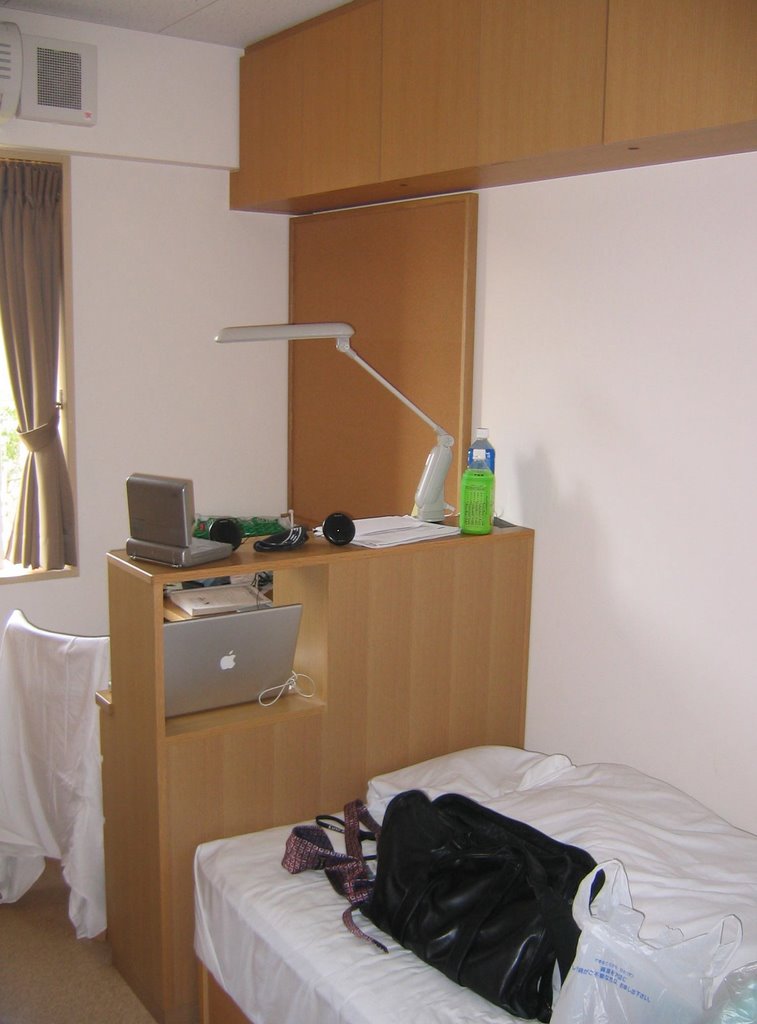
My room, for now -- I couldn't fit the entire room into the picture, but not by much


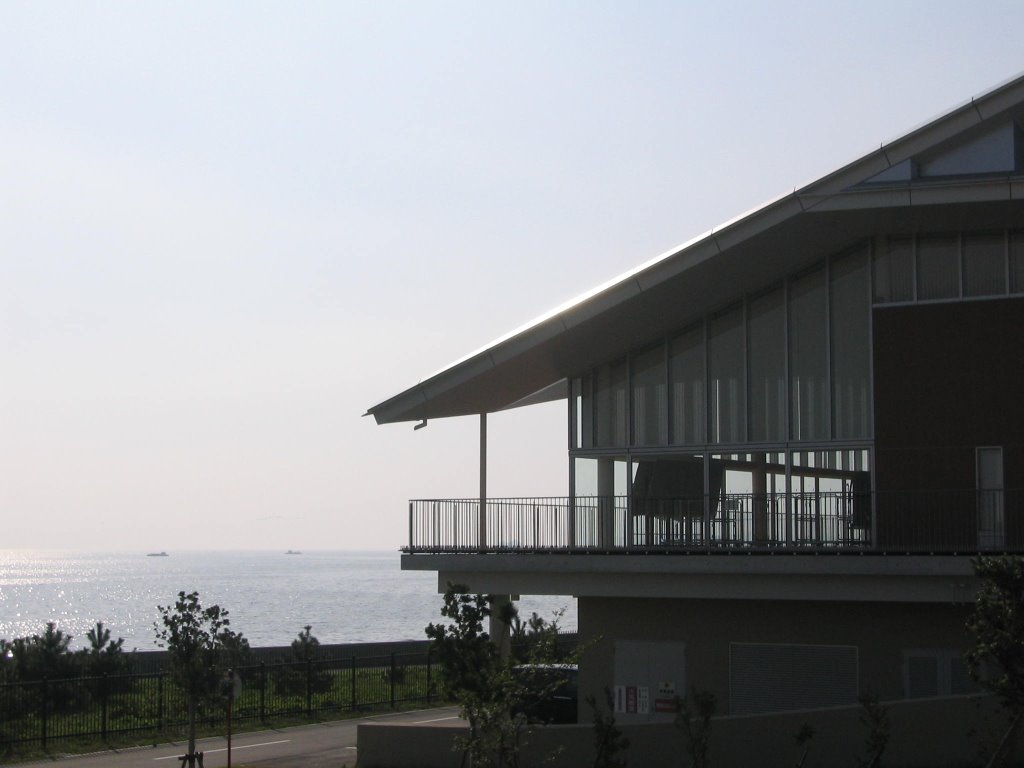
The view from my window -- the school's location is perfect, between mountains and the sea (The building in the picture is the main building on campus, including classrooms, administrative facilities, and dining hall)


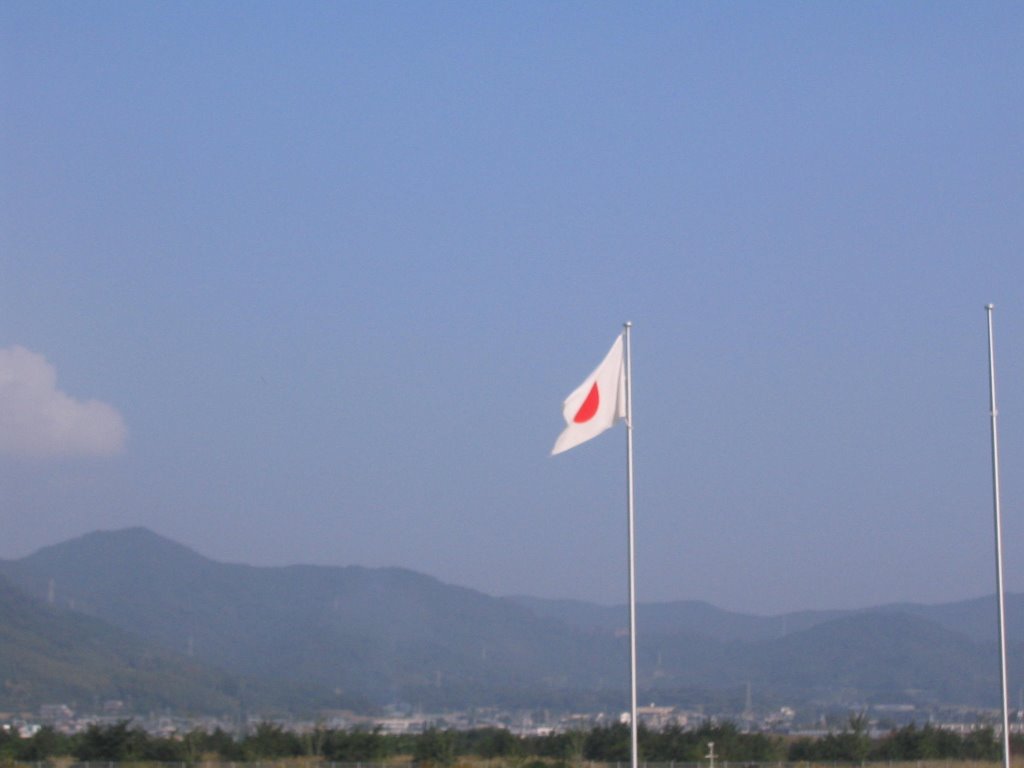
I rather like this picture of the "Hinomaru" set against a backdrop of blue sky and mountains


Wednesday, October 18, 2006

By the shore

おはようござむす!Good morning, all.

I have moved into Kaiyou Gakuen, in Mikaotsuka. Now I am living on a dormitory floor with 20 12-13 year old Japanese boys, at a school with 120 such boys. The school only opened just this past April, so for the moment the facilities dwarf the school's population. There are entire buildings empty for now. Everything is, of course, brand new, and the buildings are well lit. I would post pictures, but since I cannot access the network with my own computer, I will have to figure out how to upload them to the computer they gave me. Said computer's keyboard is tiny and configured differently, so posting might be sparse until I get used to typing on it.

This is a very different way of living than I am used to, especially since I am coming off two months of relaxation at home. The day begins at 6:30am, they take roll at 7am, and go off to breakfast together. Roll is also taken in the evening. The day is seriously cheoreographed. It's been years since I lived in a way anywhere close to this -- perhaps I have never lived in such a regimented environment. Hopefully my Japanese will improve though.

The children were furtive around me yesterday, lots of giggling and so forth.

Now for some links:

In the Wall Street Journal, Cambridge's Brendan Simms, the guru of the Henry Jackson Society had an op-ed review of the always enjoyable Robert Kagan's new book, Dangerous Nation . Kagan's book is the first of two in a history of American foreign policy. Don't be tricked by the title: Kagan hardly thinks that US power is something to be concerned about -- rather, he sees it as dangerous to dysfunctional governments and tyrants everywhere. I have it in my "to read" pile, and will comment more once I've read it.

Over at the Weekly Standard, Peter Berkowitz reviews Douglas Murray's Neoconservatism: Why We Need It. Murray's book is part of the apparent emergence of neoconservatism in British politics, of which the Henry Jackson Society is assumed by many to be part. Personally, I am skeptical about the "exportability" of American neoconservatism. I am inclined to believe that it is a unique response to American conditions. But the review does clarify the numerous misconceptions about neoconservatism that abound in public discussions. (via Arts and Letters Daily)

Those are all the links I can provide for now. I will try to keep up with my posts.

Tuesday, October 17, 2006

Leaving Tokyo

My first day of work was yesterday. I met with Mr. Asao and his staff, and received details about my itinerary for the coming weeks and my living arrangements. It seems that I will be living in Kamakura, in Kanagawa Prefecture. Before I move in, however, I will be working at 海洋学園, an elite boarding school established by Toyota in Aichi Prefecture, for several weeks, to brush up my Japanese.

As such, posting might be slight in the coming weeks, although I will try to write as often as possible.

Some interesting reads...At Slate, Bill Emmott, former Economist editor in chief, and Fareed Zakara, editor of Newsweek International, have been debating Ian Bremmer's The J Curve, this year's must-read international politics book...Also at Slate, Washington Post columnist Anne Applebaum has an article about China's reluctance to discipline North Korea...At The New Yorker, a long review by Anthony Grafton of William Clark's Academic Charisma and the Origins of the Research University (via Arts and Letters Daily)...In The New York Times, Jeff Stein notes a disturbing ignorance among public officials. I have also been reading Thomas Barnett's Blueprint for Action: A Future Worth Creating, about which I will comment soon.

And, finally, today's Japanese word of the day is: 赤絨毯 (akajyuutan). According to Mr. Asao's private secretary, who gave me a tour of the House of Councillors building yesterday, this is a (slightly) pejorative term used to refer to politicians, who spend their days walking about on the red carpets of the Diet building.

Monday, October 16, 2006

North Korea, etc.

Aaron Friedberg, recently returned to Princeton's Woodrow Wilson School after serving as Dick Cheney's deputy assistant for national security affairs, had an op-ed in yesterday's Washington Post that soberly assesses the difficult task in dealing with the Kim Family Regime's (KFR) nuclear arsenal.

Friedberg argues that because Kim Jong Il cares only for his survival, the great powers must craft their approach to exploit this:
The only way to move him is by confronting him with a stark choice -- turn over existing nuclear weapons, dismantle production facilities and submit to rigorous international inspections, or face a steadily rising risk of overthrow and untimely death. This demand can be sweetened with promises of aid and peace pacts, but in the end Kim needs to be presented with an offer he cannot refuse.
The aim, suggests Friedberg, should be to squeeze the KFR to exploit divisions within the regime by disrupting the flow of goods that enables Kim to reward his supporters, with the hope that it will lead to a palace coup (an outcome that I suggested should be the goal for the region's powers here). Friedberg recognizes that China and South Korea's support for this course of action is essential to its success, although it is unclear whether these countries, North Korea's two greatest trading partners, will be willing to pressure the KFR to the point of undermining Kim's support.

Arguably, the US, Japan, China, and South Korea should discuss quietly how to hurry along regime change from within, with China and South Korea taking the lead in encouraging rebellious elements in the regime and the US and Japan promising support to stabilize the new regime. This plan may be fanciful, but it seems to be the only way to reverse a rapidly-worsening situation.

Kim must go: his nuclear gamesmanship dramatically unsettles the regional balance of power and weakens the US position in East Asia. But regime change will happen only if China can be assured that the successor regime will be as keen on regional stability and economic development as Beijing.

Meanwhile, Washington must learn to live with a nuclear DPRK. Doing so entails strengthening the US-Japan and US-RoK alliances and ensuring that Pyongyang is aware of the consequences of nuclear misbehavior (classic nuclear deterrence). It may even entail talking to Pyongyang directly. A nuclear Japan should remain a last resort -- and in any event, it is not for the US to decide whether Japan goes nuclear. Japan must have that debate itself (although the reaction to LDP policy chief Shoichi Nakagawa's remarks indicates how far Japan has to go before it will carefully weigh the costs and benefits of a nuclear arsenal of its own).

These options are not great; but then US North Korea policy has been busted for decades.


I walked around Tokyo this morning, where it was sunny and warm. Having never been here for autumn and winter, I'm curious how Japan's climate transitions from summer to winter. In Chicago, after all, it already snowed. Will it gradually get cooler, with a crisp chill in the air, or will it get cold suddenly, without warning?

In the afternoon I went to the Maruzen bookstore in the Marunouchi Oazo building. Looking at the Politics section, I was amazed at the diversity of information available to Japanese readers, including books designed to provide laymen with in-depth background information on foreign and security policy: manga explaining Japanese defense policy, colorfully illustrated guidebooks providing detailed information about the rise of China and the North Korean threat, prominently displayed political manifestoes, and translations of foreign (usually American) books on international politics. While I can't say who reads them, the selection is impressive.

Oh, and I learned that according to the Nagatcho Power List (Nagatacho is Japan's Capitol Hill), Keiichiro Asao is the 65th most powerful figure in Nagatacho, which is more impressive than it sounds because there are only three or four members of the opposition DPJ in the top fifty, making him one of the DPJ's leading lights. So that's exciting.

Lastly, as my posting at 1:30am might suggest, I'm still terribly jet lagged.


Sunday, October 15, 2006

日本へ戻っている

I am writing at 5am, Tokyo time, which means that I have returned to Japan (i.e, jet lag).

I am here to work as an aide to Keiichiro Asao, a member of the upper house of the Japanese Diet and 次の外務大臣 (literally 'next foreign minister', meaning the shadow foreign minister) for the opposition Democratic Party of Japan.

This will be my longest stay in Japan -- my initial contract is one year -- and unlike my two previous visits, I will be truly integrated into Japanese society. I will be living in Mr. Asao's home prefecture of Kanagawa (the southern part of the Tokyo-Yokohama metropolitan area), and I will be working in an exclusively Japanese work environment, which means that for the most part I will be socializing with Japanese exclusively.

I will therefore once again provide my impressions of life here; however, given that I will be privy to an extremely exciting period in Japanese politics, one of the most exciting in recent history, I will also try to provide my insight on the Japanese political situation.

Sunday, July 11, 2004

Climbing Mt. Fuji

The past five days have been quite eventful: I have climbed two mountains and interviewed Bobby Valentine and two former Major Leaguers, apart from my normal activities. As my time in Japan winds down, expect more e-mails packed with stories like these. I should note that the second of the two mountains was Mount Fuji, as some of you know. The account of that climb will occupy most of this post.

On Wednesday, Conor and I climbed Mount Takao, a sacred mountain rising 599 meters above sea level, technically within metropolitan Tokyo. It was less than an hour's train ride from Shinjuku Station, astounding considering the presence of plant and animal life and the silence. I probably felt more at ease on the mountain than at any time since I arrived in Japan. We started climbing around 3:30pm, at the tail end of a 90+ degree afternoon. As such, by day's end my t-shirt was as soaked as if I had gone swimming in it. The road to the top was dotted with Buddhist and Shinto statues, and the view of Tokyo from the mountain was quite impressive. There were a handful of other climbers, but it was more or less silent but for our own conversation and the occasional bird call. Even better was the trip back down the mountain. We took the long road down, through a heavily forested side of Takao-san (note: the proper names of mountains are followed by "san"). By the time of our descent the sun was setting, so the forest was bathed in the fading light of the setting sun. No one else was on this trail, and it was mind boggling to think that such serenity could exist so close to the giant mass of sensory overload that is Tokyo.

The following day, Thursday, I went to Chiba Marine Stadium in mid-afternoon for my scheduled interview with Bobby Valentine. His interpreter, Shun, met at the front gate and brought me to the field. I watched batting practice and milled about with members of the press, who were waiting for Valentine's daily press conference. The conference began around 3pm. His facial expressions as he fielded questions were priceless, as were his responses to questions. While it was too windy to hear the questions asked by reporters or Shun's translations, I could hear Valentine's answers, which were heavily laden with sarcasm. (I have to imagine that the sarcasm was not translated into Japanese.) His responses included such gems as "The team with the most wins is at the top of the standings" and "I hope to win as many games as possible in the second half." I waited another 45 minutes after the conference to talk to him, interviewing former NY Mets Benny Agbayani and Matt Franco while waiting. Agbayani spoke effusively of his appreciation of Japanese fans, while Franco spoke highly of the Japanese level of play. At about 4pm I spoke to Bobby one-on-one in the Marines dugout. I should have asked one of the photographers who snapped pictures of us talking for a picture (photographers followed Valentine everyone he went on the field). He gave me a cool reception at first, his responses curt. Admittedly, he was not the ideal source to shed light on the more abstract question of the significance of baseball to the Japanese people: he is a manager, and the focus of his thoughts is winning (as Agbayani told me). As the interview progressed, however, he warmed to me and spoke greater depth. Regardless of the utility of the interview for my article, I was glad to talk to have the opportunity to talk with him. I think it was useful to have a professional's perspective of the game, if only to remind myself that it is just a game, that my abstractions are several levels removed from the reality on the field.

The next step on my quest is a game between the Japanese and Cuban national teams on Tuesday.

And now, at last, I come to Mount Fuji.

Climbing Fuji was an item on my list of things to do in Japan, but I had never given much thought to what it would entail. In my mind it was "Fuji," the mountain present in so many Ukiyo-e prints and as emblematic of Japan as cherry blossoms and "Hello Kitty."

I will never think of it that way again.

Conor and I began discussing a Fuji climb several weeks ago, but our plans were vague. We figured that since we would not be able to leave until late Friday afternoon, after classes finished, we would not have enough time to start at the base and still make it to the summit in time for sunrise. Thus we planned to take a bus to the fifth stage, halfway up, and hike to the top from there, as most people do. This would have given us plenty of time to reach the summit before dawn.

Unfortunately we did not consult a bus schedule to see when the last bus to the fifth stage departed. We found out just after arriving in Kawaguchiko, a gateway town to Fuji, that they stop running just after eight o'clock, meaning that the last bus left just as we disembarked at Kawaguchiko Station. Having no back-up plan, we plotted our next move. Not wanting to spend the entire weekend out of town, as waiting until the next day would entail, we floundered about the station until some amused taxi drivers offered their help. They pointed out that we could take a cab to a site at the foot of the mountain, from which it would take nine hours to reach the summit, by their estimate. While it would not get us there by dawn, it was better than hanging out Kawaguchiko for the night.

Little did we know what awaited us at the end of the cab ride.

We expected some sort of send-off area at the foot of the mountain, where climbers could buy food, water, and other essentials. Oh, how wrong we were. The cab dropped us off in an unlit field near a site marking the entrance to the sacred grounds of Fuji. No lights. No vendors. No other climbers. As we left the cab, we wondered whether we made the right decision to ascend at night, an impression confirmed by the "Ki wo tsukete" [Be careful] that were the driver's solemn parting words.

So there we were, in a pitch-dark field, without a map and unclear where the trail even began. We had nothing but a tiny flashlight clearly not designed for mountain-climbing whose battery life we expected to be short-lived, several bottles of water and Pocari Sweat [a Gatorade-like drink] that we wisely purchased at a convenience store near campus, and backpacks full of warm clothing to don when we reached higher altitudes. At about this time, as we made our final preparations to climb in the darkness, my adrenal gland kicked into overdrive. Why exactly are we going through with this? Will we make it to the top, or back down, for that matter? Will find people along the way? Will we manage to eat at some point? (Neither of us had eaten dinner, expecting to find something at the fifth stage. The only food we had was a block, literally, of something called Calorie Mate, similar I suppose to Power bars.) And yet despite these concerns, we went ahead.

Before I continue, I want to provide some basic facts about Mount Fuji so to give a sense of what exactly we were getting into (from The Mount Fuji homepage):

The highest mountain in Japan, Mt.Fuji is 3776-meter high. Mt.Fuji, which had been a sacred mountain, appeared the present form about 10,000 years ago. More than 200,000 people climb to the top of Mt.Fuji in a year. 30% of them is foreigners. Now, Mt.Fuji is a mountain which the people from the world can be friendly.

3775.63m above sea level
Consists mainly of basaltic lava(about 50% silicon dioxide)
Mountaintop temperature: -18°to +8°C (monthly average)
atmospheric pressure 630 to 650 mb

History of Mt.Fuji
Tens of millions of years ago, when the archipelago of Japan was separated from the continent, Fossa Magna was formed. After that,Mikasa Sanchi was formed. Hundreds of thousands of years ago, Komitake is formed by volcanic eruption. Tens of thousands of years ago, Kofuji volcano repeated eruption,covering Komitake volcano. Ten and few thousands of years ago, Shinfuji volcano was active for along time,until the recent form Mt.Fuji appeared. Since recorded history, ten and few times of eruption was repeated to create form of Mt.Fuji now. Most recent record of eruption is that of HoeiZan in 1707.

* * * * * * * *

At 9pm we began, our puny flashlight illuminating the trail. We were moving through the thick forest that covers the lower half of the mountain, and thus could see neither moon nor stars. We frequently came to clearings that appeared to be forks in the trail, but we always managed to find our way. We expected to find way stations at the stages we passed, but found nothing but abandoned shacks designated "Station such-and-such." Nor did we find other people along the trail. It was just us and the mountain.

It was the fifth stage, at a clearing in front of an abandoned building labeled "Fifth Station" [we later found that the fifth station from which most climbers depart is on a different trail] that we had out first sign indicating that we had made the right decision to climb. Prior to this stage we had noticed the forest thinning, with patches of sky visible between the trees. At this clearing, however, we were treated to a sky filled with more stars than I have ever seen in my life, including the skies over the Rocky Mountains, with the Milky Way (in Japanese, Tennogawa, or "river of heaven") clearly visible. Never before I had seen the Milky Way spread out across the sky, indeed looking like a river of heaven. It was a moment to give one pause, and I stood there for several minutes sweaty, muscles aching, and very happy to be alive.

We continued on, finally encountering civilization at the sixth stage. We reached the sixth station at 11pm, two hours into our climb, and found that it was manned and provided food for climbers. We rested for a half-hour, having perhaps the most satisfying bowl of udon noodles I have ever had. We also purchased walking sticks, the definite Fuji souvenir, which is branded with stamps whenever one reaches a way station on the way up. Comforted by finding other people on the mountain, we moved on. The flashlight died not long after we renewed our climb, but by then we had cleared the treeline and thus climbed by moonlight. The trail became much steeper and rockier at this point. The real climb had begun.

We were no longer alone on the trail at this point, as it was filled with climbers who started at higher stages, all of us trying to reach the summit by dawn.

At the risk of sounding cliche, there is nothing that clears one's perspective better than climbing a mountain, particularly one as daunting as Fuji-san. I had come to the mountain annoyed about a presentation for Japanese class that had gone less-than-splendidly, and preoccupied by dozens of other concerns. The fears that accompanied the start of the climb quickly drove these from the forefront of my thoughts, but as we climbed Conor and I still discussed current events and other topics. As we reached the higher stages, however, conversation ceased but for the occasional Lord of the Rings reference (we were, after all, two guys climbing a volcano). Everything that constituted my life suddenly seemed less important than the next breath, the next step, the next station, the summit. Is this a cliched sentiment? Of course. But it was exactly as I felt as we moved closer to the top. It was my will versus the mountain, and, more importantly, my will versus myself. The struggle was as much a struggle to overcome the resistance of my legs, which made it very clear that they wanted me to stop, and the resistance of my mind, which kept telling me that I was doing a very stupid thing, as it was a struggle against the 4,000 meters of rock that are Mount Fuji. I am proud to say that my will won, that we did not stop for the night at a way station. Did it hurt? Yes, to which the soreness of my legs and the cuts on my hands (from using my hands to break my falls on the sharp volcanic rocks that constitute the climbing surface) attest. But I am better for it.

And so we climbed, stopping briefly at way stations for water, breath, and at one point to buy flags to hang from our walking sticks (a nice touch, I thought). Every stage offered a view of the world below better than the one previous. We reached the final station before the summit at 4am, a half-hour before sunrise and an hour from the peak. We were within view of the torii gate that marks the summit when dawn broke, so while we did not make it all the way to the top for sunrise, we were as close as possible without being on the summit, no mean feat considering that we reached the summit more than an hour before expected. After pausing to admire the dawn, we continued on, stumbling through the torii at 4:45am. In less than eight hours we had scaled the entire mountain. After having a small snack and getting the final stamps branded on our walking sticks we found room to nap in a hut at the summit, trying to keep as warm as possible on the windswept summit.

We began our descent at 9:15am, along a winding trail even rockier than the ascending road. Legs sore, it was perhaps more difficult than the hike up the mountain. We finally reached stage 5 [the one we planned to start from] at 12:15pm and took a bus back to Kawaguchiko. Several hours later we boarded a bus back to Shinjuku, and, after an American-sized steak dinner, parted ways.

I know that I will resume my normal ways, caught up in the ebb and flow of public affairs and the things I must do, but I hope I will always retain that "next step, next station" perspective somewhere within me. I know I will never forget standing near the summit of Mount Fuji after climbing for eight hours, watching the sun rise of the clouds arrayed around the mountain, aware that for all the apparent insanity of our hastily prepared ascent, it was the wisest thing I have ever done.

P.S. I have already updated pictures from the climb to my photo page.

Sunday, July 4, 2004

Independence Day

Independence Day

I just wanted to send of a quick e-mail for the Fourth, as mine draws to a close and yours begin. Mine was woefully lacking in barbecued meat products, namely hot dogs, and fireworks. And, of course, I miss the company of you all, who I have celebrated the holiday with at one point or another. It doesn't quite feel like a holiday if no one around you celebrates it.

I spent the day in Yokohama, Tokyo's appendage -- the two cities combined are one of the world's largest conurbations. As you probably expected, I went to a baseball game, my second of the weekend (the other was in the west suburbs of Tokyo on Friday night), and the tenth stadium I have visited. I only have two left to see, in Hiroshima and Sapporo, which I plan to travel to in early August. Thankfully Yokohama Stadium was outdoors, as it was sunny and in the nineties all day. It felt a lot like Shea Stadium, including orange and blue colors.

Last Wednesday my program visited a Japanese elementary school, which confirmed that children the world over have excessive stores of energy and are more than eager to release that energy in the presence of new people. I observed a gym class, where I was made to look foolish due to my lack of fine motor skills. Who knew spinning a top could be so hard!?!?

I will leave you with that anecdote, although I want to add a follow-up to something noted in my last e-mail. This coming Thursday I have an interview scheduled with former Mets and current Chiba Lotte Marines manager Bobby Valentine. I will be sure to let you know how it goes.

Finally, I added a few pictures from this weekend to my photo page. Check it out.

Sunday, June 20, 2004

Tokyo summer

Summer has arrived in full force in Tokyo, though the rainy season has been slow to make its presence known. (This will probably change this week, with a giant typhoon roaring through the archipelago.) It has been mostly warm and sunny, not bad but for the lack of green, open spaces where one can take advantage of the weather.

It has been a long time since I last wrote, but I will try to update you as best as I can. As some of you know, I had a whirlwind, jet-lag-inducing trip return to the United States in mid-May (nine days, meaning that by the time I adjusted to the time change I was headed back to Japan). Between the work I had to make up and the copious amounts of jet-lag-induced sleep, not much of note happened in May.

June has been more interesting. Earlier this month I went to the New York Bar, featured in "Lost In Translation." It probably serves the most expensive drink in Tokyo (but with plenty of competition), but the view makes it all worthwhile. We went on the eve of the rainy season's first storm, and had a great perch from which to watch the clouds saturate the skies over Tokyo. The following weekend I had my first capsule hotel experience. As many of you surely know, capsule hotels are designed for people who miss their last trains. They are named because the sleeping compartments are supposedly capsule-shaped; I expected plastic sleeping tubes. The name, however, is a misnomer. The hotel was more like a dorm. Each floor had a small number of beds, stacked in twos. The sleeping quarters were more like enclosed bunk beds than capsules, with a shade that could be drawn for privacy.

Last weekend I went down to Fukuoka, the largest city on Kyushu, for some R & R, having finally recovered from my return. The ostensible reason for going was to visit my seventh professional baseball stadium, the Fukuoka Dome, home of the defending champion Fukuoka Daiei Hawks. The dome is a retractable dome styled after the Toronto Skydome, but I think it looks more like a giant beetle that emerged from the Korea Strait and died on the shore. The Hawks fans, meanwhile, must be the best in the Pacific League, second only to Tigers fans in the Nippon Professional Baseball League. Unlike nearly all other teams' fans, they cheer throughout the game, even when the Hawks are in the field. The game itself was rather lackluster, as the Hawks dominated the lowly Orix Blue Wave 12-3, this the second game of a series in which the Hawks won all three games, outscoring the Blue Wave by a total of 34-11.

Perhaps the best part of my trip, and quite possibly one of my favorite moments since I arrived in Japan, was last Saturday night in Fukuoka, after the game. My hotel was in Hakata, the city's central district and after the game I ventured out to explore. A canal bisects the district. A row of food stands housed in tents and picnic tables lines the canal for more than a mile, and late Saturday evening every stand is full of boisterous folk drinking and eating freshly grilled delectables. I found a spot at the counter of one of the tents and ending up eating and drinking with a group of locals for almost two hours (and talking in Japanese, of course). The farther you get from Tokyo the more earthy the people get; the food stands of Hakata are worlds away from the department stores of Tokyo.

Speaking of which, I have been to several now, and they are unlike anything I have ever seen, especially on weekends. It suggests that the depiction of Japan as an anti-consumption society is not entirely accurate. Endless crowds flood into the department stores as soon as they have free time, spending untold amounts of money.

Since returning from Fukuoka, I went to a kabuki play last Wednesday. Kabuki cannot be compared to Western theater. The emphasis is on the performers, not what is being performed, so all of the action on-stage is heavily exaggerated. There is no expectation of the viewer to suspend disbelief. That said, the play I saw was the story of a supernatural Buddhist monk who, to spite the Imperial government, sealed away the dragons that controlled the rain, causing a drought. The court dispatches a princess to seduce the monk and get him inebriated, giving her clearance to free the dragons. The plan succeeds flawlessly, and, in an unexpected twist, the monk, enraged by the deception, transforms into a thunder god and vows to hunt the princess down. Needless to say, quite entertaining.

The only other happening to report is that I am hard at work on an article about Japanese baseball, which will hopefully appear in The New Republic. This article has led me to the Japanese Baseball Hall of Fame, and, more recently, to an interview with the director of the MLB's Japan office. It may also lead me to an interview with a certain American managing in Japan, but that remains to be finalized.