With less than a week until the Japanese people select a new House of Representatives and with it a new government, the only question under discussion by the media seems to be whether or not the DPJ will break the 300-seat threshold. Mainichi, for example, cited the possibility that the DPJ will reach 320 seats, which would give the DPJ not just a majority but a supermajority. (Although in Mainichi's article on the survey, it mentions in passing that information is lacking from 40% of single-member districts.)
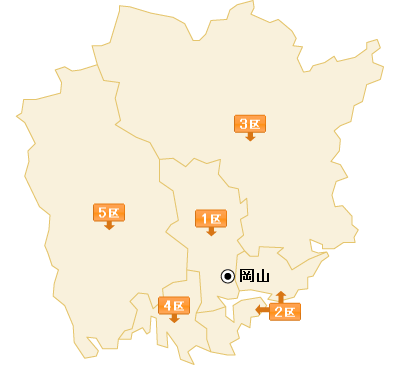
As I mentioned previously, over the weekend I ventured out of Tokyo to try to get a better sense of the state of the campaign in the Shikoku and Chugoku regions. In the end I visited three districts: Kagawa's first and second districts, and Okayama's second district.
One thing I can say for certain after the weekend is that while I suggested that the LDP might hold Kagawa's second district, the DPJ is sure to win it next week, raising my prediction for the DPJ's total to 280.
Simply put, in both Kagawa and Okayama I saw well-organized, disciplined DPJ organizations that will have earned their victories on 30 August. It helps, of course, that the question under discussion is how well the DPJ will do, but that size of the DPJ's victory should not conceal the fact that the DPJ's campaigning abilities — at least in the districts I visited — are impressive. If the DPJ wins big, it won't simply be because of the LDP's mistakes.
I spent the most time in Kagawa's first district, where I attended speeches by LDP candidate Hirai Takuya and DPJ candidate Ogawa Junya back to back on Saturday afternoon.
Hirai's event was held at Kokenji temple in Takamatsu — an unusual location for a campaign speech, the result of links with Komeito (as confirmed by a staffer working at the event). It was a speech intended for longstanding supporters, not outreach to draw in new supporters. It was an old crowd: outside of volunteers (dispatched from companies supporting Hirai), the youngest in attendance could not have been much younger than fifty. Among the notables introducing Hirai was a Komeito member of the Kagawa prefectural assembly. He was joined by LDP politicians — a Takamatsu city assemblywoman and the head of the prefectural assembly — and the head of Hirai's koenkai.
 The energy level in the room was low. Perhaps the word used most frequently by the speakers was "kibishi," referring to the candidate's prospects on 30 August. Hirai's speech itself focused mostly on contradictions in the DPJ's manifesto. The Komeito speaker reminded the audience of what Ozawa Ichiro said about the DPJ's ability to govern when he "resigned" in November 2007, when he asked, "The LDP's hopeless, but does the DPJ truly have the ability to wield political power?" Another speaker alluded to the specter of Yubari, the infamous town in Hokkaido that declared bankruptcy, suggesting that the DPJ's plans would result in a spate of Yubari-like bankruptcies. Hirai criticized the DPJ for the content of its manifesto, and suggested that the DPJ is all talk, no action. Very little was said about the LDP as a ruling party other than that the party has reflected on its shortcomings. Revealingly, the only flyer distributed by Hirai was one touting his own accomplishments and policy positions.
The focus instead was on Hirai and his relationship with his supporters in the district. He concluded his speech by telling the audience that it is not his seat, "but yours." He stressed that he was their advocate, and by extension the district's and region's representative in the National Diet.
Hirai's campaign clearly rests on a foundation of Komeito, JA, and other organizations: in addition to his speech Saturday afternoon, Hirai's Saturday schedule included meetings at JA offices and a fishing cooperative. There appears to be little attempt on Hirai's part to reach out to floating voters or DPJ voters: his pitch was about shoring up the base. Accordingly, there was little mention of Aso Taro or the past several years of LDP government (except to refer to posts held by Hirai) — the policy discussion focused largely on what the DPJ will or will not do. Hirai did not attempt to articulate a reason to give the LDP a new mandate except to argue that the LDP will be more effective at policy implementation.
The contrast with Ogawa Junya's campaign was striking. I saw Ogawa's campaign plant itself outside the parking lot of a busy Marunaka shopping center. His volunteers fanned out to ensure that all passersby received copies of the DPJ manifesto. Volunteers lined the street outside the shopping center holding posters up to passing cars. Meanwhile the demographic Ogawa was delivering his pitch to was completely different. Probably few places in Takamatsu have as many parents with children on a Saturday afternoon as this shopping center had. Ogawa's pitch very much intended for floating voters, for younger voters, for voters, who might, for example appreciate the DPJ's plan for child allowances. His talk focused largely on the contents of the DPJ's manifesto — no mention of Aso, Hirai, or the LDP whatsoever. At the conclusion of his speech, Ogawa and several volunteers mounted bikes in
  order to canvas the area — something that all the DPJ candidates I saw over the weekend are doing.
Because of the location, it was difficult to say precisely how many people were listening, as they were spread throughout the parking lot. Certainly not less than the number of attendees (fifty or so) at Hirai's event that afternoon. The Ogawa campaign was all noise and energy: younger (hard to do bicycle campaigning with an older staff), with a degree of esprit de corps that I did not see among Hirai's staff (not all of Ogawa's volunteers are dispatched from companies, it seems). It is also worth mentioning that Ogawa's emphasis was consistently on the party's message, not on his accomplishments or what he will personally do for the area.
I saw very much the same energy later that evening when I went to a music hall in Kagawa's second district where candidate Tamaki Yuichiro, a former finance ministry official who quit the ministry in 2005 to run for office, spurning the LDP to run as the DPJ candidate, was giving an address. In my predictions for Kagawa, I said Tamaki was in a tight race and would probably lose — but I may have underestimated him. Tamaki was introduced by Uematsu Emiko, the DPJ upper house member from Kagawa who won her seat in 2007 by defeating the LDP incumbent who had held the seat for thirty years; an SDPJ official; the granddaughter of Ohira Masayoshi, who came from Kagawa and is a distant relative of Tamaki; and finally, Fujii Hirohisa.
The connection with Ohira is important: it stresses that the DPJ is not simply about blind change. The DPJ represents a degree of continuity with the past, as Ozawa Ichiro has often said, "change so that things can remain the same." Fujii, for example, drew a distinction between the Showa LDP and the Heisei LDP, Ohira clearly being a leading figure of the former. The point is that while the DPJ's campaign is centered on its manifesto and "change," it is finding ways to tailor that message to the audience in a place like Kagawa. (See Tamaki's remarks here, for example.)
The policy content of Fujii's and Tamaki's speeches focused mostly on administrative reform, and contained nothing particularly different from the manifesto. But Tamaki clearly engaged the audience. And an eager group of young volunteers were waiting outside with Tamaki to greet attendees as they left. Tamaki's staff is packed with his thirty-something friends and younger volunteers.
On Sunday, I traveled to Okayama city, where in the second district the DPJ's Tsumura Keisuke faces field divided among the LDP, the PNP, and an independent postal rebel. Tsumura told me that he is confident that the three will divide the LDP vote amongst themselves, leaving Tsumura to win the district. I also learned that Tsumura has benefited from the support of trucking groups attracted by the DPJ's promise to make expressways toll free, unseating labor and the support groups of upper house member Eda Satsuki as his most important backers.
As for the Tsumura campaign operation, it was very similar to the Ogawa and Tamaki campaigns. The same emphasis on the manifesto. The same emphasis on youthful vitality; his staff wear t-shirts that state, in large letters, "WAKAI CHIKARA" (Young power) and they too campaign on bicycle. Meanwhile I found a sign on the wall of the office of particularly interest. It contained guidelines for the campaign, one of which was "no badmouthing of the LDP and other candidates." I did not have a chance to ask whether these guidelines are DPJ policy or self-imposed rules, but all three DPJ candidates I saw largely conformed with this rule. The DPJ, in stark contrast with the LDP, believes that it will win by being relentlessly upbeat and youthful.
I think that the most important lesson learned on this trip in the value of the DPJ's manifesto. Discussion in the national media and among us bloggers often focuses on whether or not the DPJ can deliver on the contents of its manifesto. But such discussion misses the importance of the role played by the manifesto in unifying DPJ candidates across the country. The DPJ has built a brand, in contrast to the LDP, in which the party's message differs from district to district depending on the candidate's circumstances. While to a certain extent Aso has tried to impose a conservative brand on the LDP in his pronouncements, the message delivered by LDP candidates to voters is relentlessly local. There was little difference between the three DPJ campaigns I saw over the weekend. I suspect much of the credit for this discipline across district lines goes to Ozawa.
The stress placed upon the manifesto by DPJ candidates could have several consequences for the DPJ after the general election. First, it suggests that the party's candidates may be increasingly loyal to a policy message, not, as some pundits fear, to Ozawa. Having been elected by relentlessly touting the manifesto, DPJ politicians will likely be reluctant to cast elements of the manifesto overboard should the DPJ take power. The same will go for the party leadership: despite the public's having low expectations for the DPJ actually being able to deliver on its proposals, the DPJ leadership will be able to abandon proposals only with considerable effort. Similarly, as in the case of Tsumura and the shipping companies, the DPJ may find it hard to abandon portions of the manifesto, because having attracted new supporters the DPJ may be pressured by its own members to stick to the manifesto lest the party be punished by new backers in the next election. Accordingly, when Nagatsuma Akira says that the manifesto should be posted in every bureau if the DPJ wins, he is not just speaking symbolically: until the next election the manifesto is not only how it wants voters to see the party, but how the DPJ's members see the party itself.
As I mentioned previously, over the weekend I ventured out of Tokyo to try to get a better sense of the state of the campaign in the Shikoku and Chugoku regions. In the end I visited three districts: Kagawa's first and second districts, and Okayama's second district.
One thing I can say for certain after the weekend is that while I suggested that the LDP might hold Kagawa's second district, the DPJ is sure to win it next week, raising my prediction for the DPJ's total to 280.
Simply put, in both Kagawa and Okayama I saw well-organized, disciplined DPJ organizations that will have earned their victories on 30 August. It helps, of course, that the question under discussion is how well the DPJ will do, but that size of the DPJ's victory should not conceal the fact that the DPJ's campaigning abilities — at least in the districts I visited — are impressive. If the DPJ wins big, it won't simply be because of the LDP's mistakes.
I spent the most time in Kagawa's first district, where I attended speeches by LDP candidate Hirai Takuya and DPJ candidate Ogawa Junya back to back on Saturday afternoon.
Hirai's event was held at Kokenji temple in Takamatsu — an unusual location for a campaign speech, the result of links with Komeito (as confirmed by a staffer working at the event). It was a speech intended for longstanding supporters, not outreach to draw in new supporters. It was an old crowd: outside of volunteers (dispatched from companies supporting Hirai), the youngest in attendance could not have been much younger than fifty. Among the notables introducing Hirai was a Komeito member of the Kagawa prefectural assembly. He was joined by LDP politicians — a Takamatsu city assemblywoman and the head of the prefectural assembly — and the head of Hirai's koenkai.
 The energy level in the room was low. Perhaps the word used most frequently by the speakers was "kibishi," referring to the candidate's prospects on 30 August. Hirai's speech itself focused mostly on contradictions in the DPJ's manifesto. The Komeito speaker reminded the audience of what Ozawa Ichiro said about the DPJ's ability to govern when he "resigned" in November 2007, when he asked, "The LDP's hopeless, but does the DPJ truly have the ability to wield political power?" Another speaker alluded to the specter of Yubari, the infamous town in Hokkaido that declared bankruptcy, suggesting that the DPJ's plans would result in a spate of Yubari-like bankruptcies. Hirai criticized the DPJ for the content of its manifesto, and suggested that the DPJ is all talk, no action. Very little was said about the LDP as a ruling party other than that the party has reflected on its shortcomings. Revealingly, the only flyer distributed by Hirai was one touting his own accomplishments and policy positions.
The focus instead was on Hirai and his relationship with his supporters in the district. He concluded his speech by telling the audience that it is not his seat, "but yours." He stressed that he was their advocate, and by extension the district's and region's representative in the National Diet.
Hirai's campaign clearly rests on a foundation of Komeito, JA, and other organizations: in addition to his speech Saturday afternoon, Hirai's Saturday schedule included meetings at JA offices and a fishing cooperative. There appears to be little attempt on Hirai's part to reach out to floating voters or DPJ voters: his pitch was about shoring up the base. Accordingly, there was little mention of Aso Taro or the past several years of LDP government (except to refer to posts held by Hirai) — the policy discussion focused largely on what the DPJ will or will not do. Hirai did not attempt to articulate a reason to give the LDP a new mandate except to argue that the LDP will be more effective at policy implementation.
The contrast with Ogawa Junya's campaign was striking. I saw Ogawa's campaign plant itself
 outside the parking lot of a busy Marunaka shopping center. His volunteers fanned out to ensure that all passersby received copies of the DPJ manifesto. Volunteers lined the street outside the shopping center holding posters up to passing cars. Meanwhile the demographic Ogawa was delivering his pitch to was completely different. Probably few places in Takamatsu have as many parents with children on a Saturday afternoon as this shopping center had. Ogawa's pitch very much intended for floating voters, for younger voters, for voters, who might, for example appreciate the DPJ's plan for child allowances. His talk focused largely on the contents of the DPJ's manifesto — no mention of Aso, Hirai, or the LDP whatsoever. At the conclusion of his speech, Ogawa and several volunteers mounted bikes in
  order to canvas the area — something that all the DPJ candidates I saw over the weekend are doing.
Because of the location, it was difficult to say precisely how many people were listening, as they were spread throughout the parking lot. Certainly not less than the number of attendees (fifty or so) at Hirai's event that afternoon. The Ogawa campaign was all noise and energy: younger (hard to do bicycle campaigning with an older staff), with a degree of esprit de corps that I did not see among Hirai's staff (not all of Ogawa's volunteers are dispatched from companies, it seems). It is also worth mentioning that Ogawa's emphasis was consistently on the party's message, not on his accomplishments or what he will personally do for the area.
I saw very much the same energy later that evening when I went to a music hall in Kagawa's second district where candidate Tamaki Yuichiro, a former finance ministry official who quit the ministry in 2005 to run for office, spurning the LDP to run as the DPJ candidate, was giving an address. In my predictions for Kagawa, I said Tamaki was in a tight race and would probably lose — but I may have underestimated him. Tamaki was introduced by Uematsu Emiko, the DPJ upper house member from Kagawa who won her seat in 2007 by defeating the LDP incumbent who had held the seat for thirty years; an SDPJ official; the granddaughter of Ohira Masayoshi, who came from Kagawa and is a distant relative of Tamaki; and finally, Fujii Hirohisa.
The connection with Ohira is important: it stresses that the DPJ is not simply about blind change. The DPJ represents a degree of continuity with the past, as Ozawa Ichiro has often said, "change so that things can remain the same." Fujii, for example, drew a distinction between the Showa LDP and the Heisei LDP, Ohira clearly being a leading figure of the former. The point is that while the DPJ's campaign is centered on its manifesto and "change," it is finding ways to tailor that message to the audience in a place like Kagawa. (See Tamaki's remarks here, for example.)
The policy content of Fujii's and Tamaki's speeches focused mostly on administrative reform, and contained nothing particularly different from the manifesto. But Tamaki clearly engaged the audience. And an eager group of young volunteers were waiting outside with Tamaki to greet attendees as they left. Tamaki's staff is packed with his thirty-something friends and younger volunteers.
On Sunday, I traveled to Okayama city, where in the second district the DPJ's Tsumura Keisuke
 faces field divided among the LDP, the PNP, and an independent postal rebel. Tsumura told me that he is confident that the three will divide the LDP vote amongst themselves, leaving Tsumura to win the district. I also learned that Tsumura has benefited from the support of trucking groups attracted by the DPJ's promise to make expressways toll free, unseating labor and the support groups of upper house member Eda Satsuki as his most important backers.
As for the Tsumura campaign operation, it was very similar to the Ogawa and Tamaki campaigns. The same emphasis on the manifesto. The same emphasis on youthful vitality; his staff wear t-shirts
 that state, in large letters, "WAKAI CHIKARA" (Young power) and they too campaign on bicycle. Meanwhile I found a sign on the wall of the office of particularly interest. It contained guidelines for the campaign, one of which was "no badmouthing of the LDP and other candidates." I did not have a chance to ask whether these guidelines are DPJ policy or self-imposed rules, but all three DPJ candidates I saw largely conformed with this rule. The DPJ, in stark contrast with the LDP, believes that it will win by being relentlessly upbeat and youthful.
I think that the most important lesson learned on this trip in the value of the DPJ's manifesto. Discussion in the national media and among us bloggers often focuses on whether or not the DPJ can deliver on the contents of its manifesto. But such discussion misses the importance of the role played by the manifesto in unifying DPJ candidates across the country. The DPJ has built a brand, in contrast to the LDP, in which the party's message differs from district to district depending on the candidate's circumstances. While to a certain extent Aso has tried to impose a conservative brand on the LDP in his pronouncements, the message delivered by LDP candidates to voters is relentlessly local. There was little difference between the three DPJ campaigns I saw over the weekend. I suspect much of the credit for this discipline across district lines goes to Ozawa.
The stress placed upon the manifesto by DPJ candidates could have several consequences for the DPJ after the general election. First, it suggests that the party's candidates may be increasingly loyal to a policy message, not, as some pundits fear, to Ozawa. Having been elected by relentlessly touting the manifesto, DPJ politicians will likely be reluctant to cast elements of the manifesto overboard should the DPJ take power. The same will go for the party leadership: despite the public's having low expectations for the DPJ actually being able to deliver on its proposals, the DPJ leadership will be able to abandon proposals only with considerable effort. Similarly, as in the case of Tsumura and the shipping companies, the DPJ may find it hard to abandon portions of the manifesto, because having attracted new supporters the DPJ may be pressured by its own members to stick to the manifesto lest the party be punished by new backers in the next election. Accordingly, when Nagatsuma Akira says that the manifesto should be posted in every bureau if the DPJ wins, he is not just speaking symbolically: until the next election the manifesto is not only how it wants voters to see the party, but how the DPJ's members see the party itself.