Showing posts with label US-China-Japan strategic triangle. Show all posts

Sunday, December 21, 2008

Alliance addenda

After seeing the response to my recent post on the US-Japan alliance, I find it necessary to develop a few ideas further.

First, MTC rightly points out that an alliance based on the partnership of Japanese conservatives and their counterparts in Washington is by no means doomed, because the organizations pushing this line "deal death as a matter of course. They will not be deterred by mere logic, economic constraints or human feeling." I fully grant this point. Just because history (or perhaps, History) does not favor their argument does not mean that the conservative grip on the alliance will weaken. The advocates of an alternative vision of the alliance — a vision of the alliance that does more than prepare for a worst case scenario with China that may never come (or that may be hastened by the decisions of the alliance) — must push back, fighting back in the halls of academia and think tanks and in the pages of journals.

Second, I must correct myself: technically speaking the 1996 alliance is not rooted in an alliance between Japanese and American conservatives. It is rooted in an alliance between Japanese conservatives and the American foreign policy establishment (FPE). There is sadly a dearth in creative thinking on the alliance in Democratic corners of the FPE, the think tankers and academics who will likely fill important Asia policy positions. In particular, Joseph Nye, who as assistant secretary of defense for international security affairs in the mid-1990s gave his name to the initiative that produced the 1996 bilateral security declaration and with it the 1996 alliance, and Kurt Campbell, who worked deputy assistant secretary of defense for East Asia during the late 1990s, are the Democratic Party's senior Asia hands and both view the alliance along similar lines as Richard Armitage and Michael Green, their Republican counterparts. Campbell has in fact praised the work of his Republican successors in strengthening the alliance.

Jun Okumura captures precisely this reality on this post regarding a meeting between senior DPJ officials and the "U.S. Democratic Party," as reported in the Yomiuri Shimbun. On a visit to Tokyo, Nye and John Hamre, president of CSIS (home to Michael Green) and an undersecretary of defense in the Clinton adminstration, as well as Green and James Kelly, assistant secretary of state for East Asia and the Pacific in the Bush administration, met with Hatoyama Yukio, Kan Naoto, and other DPJ officials. The point of the meeting, as Jun notes, was to deliver the message to the DPJ that the bipartisan consensus on the alliance is intact — the DPJ should not expect that it will get much traction in its desire to redefine the terms of the 2006 realignment agreement.

The reality, however, might be more complicated. As Jun notes, none of the aforementioned mandarins is in President-elect Obama's inner circle. Is this a message from Mr. Obama? From the Democratic Party? From the FPE? Perhaps we should read this meeting and its message as a message from the guardians of the 1996 alliance, nothing more, nothing less. Confident that they remain responsible for the alliance in Washington, they are apparently planning for the possibility that their conservative partners are forced to cede power to the DPJ. While the media is reporting this as the beginning of an exchange of opinions between the US and Japanese Democratic parties, the presence of Messrs. Green and Kelly suggest that it was nothing of the sort: the alliance mandarinate was issuing a warning.

Finally, I want to respond to comments to my previous post.

First, one anonymous commentator argues that the idea that China has any influence over Washington as a result of its debt holdings is "ridiculous." A second commentator argues that the fundamental arrangement of the alliance — bases for protection — is unchanged, and that not too much has changed with the decline of the 1996 alliance. I will address these comments together because they're linked.

The alliance today is about China. The 1996 alliance was one way of thinking about China. While the alliance managers vary in the extent to which they support engagement with China, they uniformly support strengthening the security relationship, extending the alliance to distant conflicts, improving alliance interoperability, and broadening the alliance to include cooperation with other US allies in East Asia. They are in agreement about the importance of dismantling domestic constraints on Japanese security policy, although naturally they respect the Japanese democratic process. It is an approach to the alliance that sees the alliance as "the core of the United States’ Asia strategy." (For an outline of the consensus on the alliance, see the second Armitage-Nye report — discussed at length in these posts.) They believe that the alliance is important as an end in and of itself, because of shared interests and shared values, which is another way of saying that no matter how much it appears that the US and China have common interests regionally and globally, the Sino-US relationship can never replace the US-Japan relationship because of shared values.

I think the "shared values" approach to the alliance is mistaken. It seeks to create distance between the US and Japan on the one hand and China on the other when what the three countries must be do is find a way to bridge the wide differences that separate them. As the current economic crisis is illustrating, the fates of the US, China, and Japan are linked. The US-Japan-China strategic triangle is a non-zero sum relationship. America's loss is Japan's loss is China's loss; and the impact of the economic crisis within China will likely be felt in Japan and the US.

None of this is to say that the nineteenth-century liberal argument that free markets will lead to perpetual peace is right. What the liberals failed to appreciate is that while global commerce may transform national interests, those interests are not translated into policy without concerted effort on the part of national elites. Elites have to recognize that economic links have transformed their nations' interests and then act to protect those interests. Both Japanese and American conservatives — especially Japanese conservatives — have chosen to minimize the significance of their countries' dependence on the Chinese economy. Accordingly their vision of the alliance emphasizes the security hedge against China rather than efforts to diminish the need for a hedge against China.

I am not arguing that the US-Japan security relationship is dead. Nor am I arguing that it should be dissolved. The alliane is an important aspect of US Asia policy, but for too long the US FPE has failed to asked why. If it is important only because Japan gives the US bases, then frankly the alliance is a necessary but insufficient guarantor of the future stability of the region. The value of the alliance must be measured by how it contributes to regional stability, namely the incorporation of China into a leadership position in East Asia with as little friction as possible. The 1996 alliance has strengthened those actors in Japan most averse to cooperation with China, which has the ironic consequence of diminishing Japan's importance to the US as an ally.

What is needed now is a new alliance that seeks more than just a hedge against a violent turn in China's rise. Accordingly, the alliance needs to be more than just a partnership of national security elites in the US and Japan. Japan and the US ought to be talking about more than just the proper arrangement of US forces in Japan or how Japan can make its token contributions to missions abroad; the focus of every US-Japan bilateral meeting of any significance should be finding new ways to build a trilateral relationship with China. An alliance that's simply a matter of bases for forward-deployed US forces and some tactical and operational cooperation between US and Japanese armed forces is an alliance that increasingly irrelevant to the future of East Asia.

Thursday, December 18, 2008

The alliance is dead, long live the alliance

Barack Obama's inauguration is just about a month away. His transition team is gradually filling in cabinet-level positions. His Asia and Japan policy teams are as of yet unknown, however, leaving Japanese elites to continue to fret about Japan's place on the Obama administration's agenda.

They have good reason to worry.

The reasons to worry have nothing to do with the myth of the Democratic Party's hostility to Japan and predisposition to China. After all, Richard Nixon, the pioneer of Japan passing, was a Republican, and Bill Clinton inherited his trade agenda from George H.W. Bush. No, the reasons for concern are far greater than the Japanese establishment's irrational fear of Democrats.

The post-cold war US-Japan alliance, born in 1996, is dead. It is far from certain what will take its place.

The 1996 alliance — born out of the 1996 reaffirmation of the alliance signed by President Clinton and the late Hashimoto Ryutaro — sought to restore security to its position of prominence in the alliance and rebuild the Chinese wall that had separated security and economics in US-Japan relations until the 1980s. Japan's economic slump made it a less worrisome partner, and China's bullying of Taiwan appeared to provide a target for greater security cooperation, with North Korea's playing a supporting role.

The process of bolstering the alliance stalled after the conclusion of the new guidelines for security cooperation in 1997, but the Clinton administration bequeathed to the Bush administration a framework for deeper security cooperation with Japan. Specifically, it was bequeathed to the group of alliance hawks, led by Richard Armitage, who assumed important positions in the new administration in 2001. Mr. Armitage and his colleagues took the baton passed from their predecessors and developed a particular form of security cooperation following 9/11. As the US prepared for the global war on terror, the US would treat Japan as a first-rank ally, akin to the United Kingdom; learning the lesson of the Gulf War, the US would not issue marching orders to Tokyo but would appeal to Japan's conscience as a major world power to do the right thing by supporting US efforts in some form. The material value of Japan's contribution was inconsequential; what mattered was Japan's showing the flag, not how much oil it was pumping in the Indian Ocean. In exchange, Japan under Koizumi Junichiro became a trusted ally of the Bush administration, which after 2003 needed all the friends it could get. Of course, the US wouldn't be perpetually satisfied with refueling missions and unarmed humanitarian relief missions, but by encouraging Japan with high praise (the frequent refrain during the first half of this decade about the alliance being "the best ever") the US could gradually push Japan in the direction of a more active security role.

This new partnership was cemented not in the Middle East but in Northeast Asia, as the US and Japan moved in lockstep in the six-party talks after 2002, taking a hardline against North Korea on nuclear weapons, missiles, and Japan's abductees, a pact sealed by Ambassador J. Thomas Schieffer's March 2006 visit to Niigata — to the beach from which North Korea abducted Yokota Megumi — and President George W. Bush's meeting with Megumi's mother Sakie in April 2006. In the background loomed China, resulting in the inclusion of the peaceful resolution of the Taiwan Straits crisis as a common strategic objective for the first time in the February 2005 Security Consultative Committee (2+2) statement. It was also cemented via ever deeper cooperation on missile defense in Japan and broader cooperation between US Forces in Japan (USFJ) and the Japanese Self-Defense Forces (JSDF).

This partnership was not nearly as durable as it appeared. First, it was more a partnership of elites than a partnership of nations. Alliance hawks in the US forged a strong relationship with their resurgent Japanese counterparts to promote an alliance agenda that served both their interests. As William Overholt wrote in Asia, America, and The Transformation of Geopolitics (reviewed here):
As the 21st century began, the United States decided to bet its entire position in Asia on the alliance with Japan. In effect, it has bet not just on the Japanese nation but in particular on a newly assertive national-security elite that represents a rather narrow and unrepresentative slice of Japanese society. In all of American history, the United States has never before made such a bet anywhere in the world, with the arguable exception of the bet on Britain in World War II. The current bet is not on the Japan of 1945 or 1975 or 1989 (the year before the bubble burst) or 2000, but on a rearming Japan with an economy, a polity, a foreign policy, and a military evolving faster and more unpredictably than those of any other advanced country, under a new and increasingly right-wing leadership that wants to rebuild national morale by reengineering a failed vision of the first half of the 20th century rather than through an inspiring new vision of the future. Rarely in world history has such a power made such a consequential bet.
Abe Shinzo was the symbol of the US bet on the Japan's neo-conservatives. As Sunohara Tsuyoshi, a Nikkei reporter, documented in the introduction to his book Japan Hand, Michael Green, then National Security director for Japan, Korea, Australia, and New Zealand, saw potential in Mr. Abe, who was deputy chief cabinet secretary at the start of the Koizumi government. Mr. Green effectively made Mr. Abe a project, working to give the future prime minister a direct pipeline to the top of the US government. While serving as LDP secretary-general, he visited Washington in April 2004, where he delivered a speech at the American Enterprise Institute hailing the alliance's new golden era and making the case for constitution revision. On that visit he also met with Mr. Green, Mr. Armitage, Donald Rumsfeld, then-National Security Adviser Condoleeza Rice, and Republican congressional leaders, at which time he was effectively branded a future prime minister of Japan. Mr. Abe had to still be selected by the LDP, of course, but the backing of the US administration surely helped propel Mr. Abe to the premiership despite having no ministerial experience aside from serving as chief cabinet secretary. Mr. Abe, in short, was a direct product of this alliance between US conservatives and Japan's "newly assertive national-security elite."

The death of the 1996 alliance began with the decline and fall of Mr. Abe. The conservative partnership did not expect the Japanese people to deal so harsh a blow to Mr. Abe in the 2007 upper house elections. They failed to appreciate that the Japanese public would have little interest in a debate on constitution revision while Japan's regions stagnated, while the pensions system collapsed, while the national debt prompted questions about how the government would meet its liabilities. (See this post for a discussion of the binational conservative establishment's shock at Mr. Abe's defeat.) They also didn't expect that the DPJ would have considerable success in undermining the illusion of the robust security alliance by forcing a debate on the MSDF refueling mission. The DPJ ultimately lost the battle to block the mission's extension, but in their opposition they exposed how farcical the whole thing was: the lack of accountability in how the mission was conducted and the mismatch between the rhetoric and the reality of the mission (i.e. the contrast between rhetoric that focused on Japan's responsibilities to the international community and the reality of heavy-handed US pressure on Japan to extend the mission, spearheaded by Ambassador Schieffer). By forcing a debate on the refueling mission, the DPJ punctured the image of a golden era. Far from being a sign of how far the alliance had come, the refueling mission became a sordid affair, marked by the whiff of corruption on the part of Japan's defense trading companies and the newly formed ministry of defense and the cowardice of the Japanese establishment, which despite bold rhetoric about contributing to the war on terror was actually not prepared to make real sacrifices to help the coalition in Afghanistan.

But the 1996 alliance was doomed for reasons beyond Japanese domestic politics. The post-1996 security partnership was designed for a unipolar world. Naturally it flourished after 9/11, in the heady days of "shock and awe," as the Bush administration swaggered and flexed the US military's muscles. Accordingly, in some sense the 1996 alliance was a casualty of the Iraq war.

First, US difficulties in Iraq altered the US calculus globally. Would the Bush administration have made such a drastic about-face on North Korea had Iraq gone successfully? If the US could still credibly threaten regime change in North Korea, would Christopher Hill have been given the freedom to negotiate a new agreement? The shift on North Korea, occurring in the immediate aftermath of both North Korea's presumed nuclear test and the aforementioned US-Japan "pact" on North Korea by which the US signaled that the abductees were a priority for the US, has had profound consequences on the alliance, not least of all on the neo-conservatives who now wonder whether they can rely on the US security guarantee.

The shift on North Korea coincided with a pronounced softening in Sino-US relations. The US increasingly needed China as a "responsible stakeholder." With the US bogged down in the Middle East, it needed calm in East Asia — and found that China was the key to maintaining the status quo in North Korea and the Taiwan Straits, the two greatest flashpoints. Accordingly, US North Korea policy increasingly amounted to beseeching China to intervene with Pyongyang to keep North Korea committed to the six-party talks and leaning on Taiwan not to provoke China. At the same time, the US became increasingly indebted to China, thanks in part to the Bush adminstration's decision to finance the Iraq and Afghanistan wars via deficit spending, creating what Niall Ferguson has called "Chimerica." As Admiral William Fallon, formerly head of US Pacific Command, noted in an interview with the Boston Globe last month, China's position as the number one creditor for the US alters the Sino-US agenda. As Fallon said, "The size of the country and its influence is staggering. So we've got to figure this out. There were people who warned me that you'd better get ready for the shoot 'em up here because sooner or later we're going be at war with China. I don't think that's where we want to go."

With both the US and Japan economically interdependent with China, the 1996 alliance's vision of a security partnership that would essentially be preparing for the big war with China has become increasingly unrealistic. Indeed, the global economic crisis may completely transform the strategic landscape by making it clear just how much the three corners of the East Asian triangle need each other. How can the 1996 alliance possibly survive a new system in which China plays "the role of a vigilant creditor" vis-a-vis the US? Negotiations on trade imbalances and the relative values of the dollar, renminbi, and yen will be thorny, but next to these issues the security agenda pales in significance.

And so the 1996 security-centered alliance is dead.

The shell of the alliance will continue to exist, barring the outbreak of war in Northeast Asia. (I don't think the alliance would survive a shooting war.) But will the Obama administration and the Japanese government — whoever is at its head — be able to find a way to build a new alliance?

There are a variety of opinions on how the allies should proceed. Japan's conservatives may be the most confused about the future of the alliance. They had invested their energy in using the alliance as a vehicle for promoting their desire for an independent Japan — greater security cooperation with the US would lead to constitution revision, collective self-defense, and normalization — and a de facto cold war with China, but with the US shift in its relations with North Korea and China the US appears to be as less reliable ally for the Japanese right. Under the Obama administration, conservatives will likely shift to a position on the alliance akin to General Tamogami Toshio's, arguing for a more independent Japanese defense posture and more vocal disagreement with the US, particularly on issues like North Korea. Indeed, General Tamogami may literally become the posterchild of this line of argument. As he argued in his APA contest essay, while "good relations between Japan and the United States are essential to the stability of the Asian region," Japan needs its own preventive strike capabilities and greater diplomatic clout. It is difficult to imagine what the alliance would look like were this scenario to come to pass, but I can imagine that one consequence of Japan's developing independent deterrent capabilities (conventional or nuclear) would be to push the US closer to China, in effect balancing between the two.

If the Obama administration decides to press Japan on history questions — which Sakurai Yoshiko believes is in the offing — it will give the Japanese right a convenient excuse for pressing for a more independent defense posture, but the seeds of that shift were planted in the Bush administration's about-face on North Korea.

It may take years before we learn the extent to which the Bush administration's shift on North Korea affected Japan's hawks, who were "shocked" by the US decision earlier this year to remove North Korea from the list of state sponsors of terrorism. But judging by their initial reactions, the impact has been profound. The impact has also been felt at the popular level. The Cabinet office's annual foreign policy attitudes survey, released earlier this month, recorded a new low in respondents who view US-Japan relations favorably: 68.9% said they see the relationship favorably, compared with 76.3% who answered favorably last year, and 28.1% who see the relationship unfavorably (an increase of eight points from 2007). Mainichi claims that the US government attributes the drop to the US shift on North Korea, hardly surprising considering that the greatest source of concern for the Japanese public in Japan's relations with Noth Korea remains the abductions issue (among respondents, 88.1% see this as an object of concern, compared with only 69.9% who see the nuclear issue as a cause for a concern, a five-point drop from 2007). A recent Yomiuri poll on the US-Japan relationship recorded a similar slip in Japanese public trust in the US, with North Korea explicitly cited as a reason for lower trust in the US.

In the short term, however, it is difficult to say what impact any of this discontent will have on the relationship. Aso Taro is handicapped by the crumbling economic situation and is in no position to devote considerable effort to reimagining the alliance. The LDP is working to build ties with the new administration, but it seems to be driven more by the need to build links where none exist than any particular policy agenda. The DPJ, anticipating that it will have the opportunity to work with Mr. Obama, is working on deepening its links with the incoming administration; Okada Katsuya, possibly Ozawa Ichiro's successor as DPJ president, visited Washington earlier this month for meetings with people in Democratic foreign policy circles.

The Obama administration and a DPJ administration might cooperate well in building a new alliance less focused on purely security matters. The challenge is calibrating the right level of security cooperation so the allies can focus on other, more pressing matters. Security cooperation must be downgraded to but one conversation among several in the alliance. Getting Okinawa and Guam right will help — I'm encouraged by reports that Mr. Obama's Japan team is open to renegotiating the 2006 realignment agreement. Seeing as how the 2006 agreement is already delayed, the US and Japan might as well get it right. This point will undoubtedly be debated at length in the debate over the 2009 budget, which will include a request from the ministry of defense for 100 billion yen for realignment. I expect that DPJ will strenuously resist this request, perhaps using the economic crisis as an additional pretext for opposing it.

But there is still the need to develop a bilateral agenda that encompasses more than security. With the 1996 alliance dead, what will take its place?

My problem with the new AEI report from Michael Auslin and Christopher Griffin is that the answer they provide to this question is basically to deny that the 1996 framework is dead. While acknowledging that the alliance is in a new era, their answer is more of the same: ever greater security cooperation whether in East Asia or globally. Rather than seeing the golden age of the 1996 alliance as having passed, never to return as the result of structural changes, they maintain that the problem is the Japanese domestic political situation, which has halted the process of reforming Japanese national security policy and the national security establishment. The task is to press forward with more and closer security cooperation, creating what they call a "normal alliance." This normal alliance would be a vehicle for the promotion of liberty in East Asia, in cooperation with other democratic alliances in the region (reminiscent of Mr. Abe's arc). As they write, "...The U.S.-Japanese alliance should reorient itself to become an active promoter of political, social, and economic liberalization. Tokyo and Washington should seek to enhance and promote the goal of making democracy, free markets, and transparent security policies the norm in Asia."

This statement is wholly at odds with Asia as it exists today. I'm not certain that the alliance is capable of promoting democracy in Thailand, let alone in Burma, North Korea, or China. And China, as the region's leading trader is a more critical partner as far as free markets for goods and investment are concerned. Of course, Auslin and Griffin are largely concerned with China. In their words, "China is also the only legitimate military threat to long-term stability in the Asia Pacific." They cite China's plans to build a blue-water navy, a distant prospect at best and something that does not necessarily threaten the US or Japan. They acknowledge economic interdependence, but are much more interested in preparing for the worst-case scenarios with China than with getting the trilateral relationship with China right so to stave off the worst-case scenarios. They are trying to resurrect the partnership between conservatives in Tokyo and Washington that produced the "golden age," only it is unclear who is still willing to sign on to this agenda in either Washington or Tokyo. Having been burned in North Korea, I suspect Japan's neo-conservatives will be less enthusiastic about ever deeper security cooperation that has proven to be one-sided in favor of the US. Moreover, I'm not clear whether there is public support in Japan for the kind of alliance they envision. The Japanese people may view East Asia as a frightening neighborhood — see the aforementioned Cabinet Office poll — but that doesn't mean that they're ready to support remilitarization and more vigorous security relationships regionally and globally.

In Washington, the pendulum appears to have shifted away from the China hawks, particularly with Secretary of Defense Robert Gates slated to stay on in the Obama administration. The emphasis appears to be increasingly on stability and order in Asia, instead of the "freedom" agenda desired by Auslin and Griffin. Of course, the greater the emphasis on stability, the greater the need to cooperate with China.

It is still unclear to me what the US-Japan alliance will become, but I'm convinced that what it won't become is the normal alliance outlined by Auslin and Griffin. It may ultimately be the case that the alliance is destined to be limited to ensuring the defense of Japan but little more, with Japan providing token contributions internationally and playing a slightly greater role in providing for its own defense, but little more. As long as Japan is hamstrung by structural problems — its demographics, its shambolic economy, its public finances — it will be unable to be the vigorous partner that, as Sheila Smith argues, Washington needs in the midst of the crisis. But if Japan cannot find a way to overcome its problems, it will not be the partner Washington (and Beijing) need in Asia as they try to build a new, stable regional order.

Tuesday, June 17, 2008

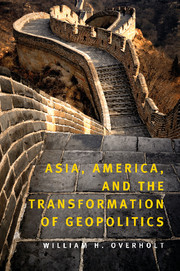
Recommended Book: Asia, America, and The Transformation of Geopolitics, William Overholt

With the prime ministers of Japan and Australia, the US secretary of defense (and other defense ministers in the region), and the Republican presidential candidate issuing statements on the future of Asia over the past month, it has been a fascinating time to ponder the shape of the region over the coming years, especially as the US transitions into the post-Bush era.

William Overholt, director of the RAND Corporation's Center for Asia Pacific Policy, has produced an indispensable contribution to that discussion in Asia, America, and The Transformation of Geopolitics.

In this book, Mr. Overholt examines the transition from the post-cold war to the post-post-cold war period in Asia. He has a clear purpose in doing so: Mr. Overholt thinks that the US did an extraordinary job winning the cold war in Asia by contributing to the development of Japan, South Korea, and countries in Southeast Asia (putting development before democracy), and using its alliance with Japan to stifle Sino-Japanese antagonism (defending Japan from China, while restraining Japan to ease Chinese fears). He fears that the US insufficiently appreciates the scale of its achievement in Asia — the creation of a peaceful, stable, and prosperous Asia — and risks blundering down the road that leads to war and ruin for the region because of misguided fears of China. The result is a thoroughly researched polemic, one that may not sit well with American policymakers (or Japanese policymakers, for that matter).

I am deeply sympathetic with Mr. Overholt's purpose in this book. Like him, I think the task for US Asia policy is to continue to guarantee stability in the region, and must abjure from policies that undermine stability (i.e., values-based diplomacy, a league of democracies comprised of members conveniently located on all sides of China, etc.). Accordingly, the US-Japan alliance's purpose must reflect the overall US mission in Asia — the alliance must also abjure from destabilizing actions.

Mr. Overholt fears that the Bush administration's Japan policy — and Asia policy more broadly — has deviated from the goal of ensuring stability and prosperity throughout Asia. He is concerned that the US-Japan alliance has become an alliance with the Japanese right, and increasingly serves their goals, many of which are prejudicial to stability in the region. He does not make the mistake that some do in equating the ideas of Japanese conservatives with those of the Japanese public at large. He argues instead that the Japanese conservatives have gained prominence because they're operating in a vacuum: "The Japanese public generally does not have strong views or even strong awareness of foreign-policy and national-security issues. In this situation, Prime Minister Koizumi's appointment of hawkish nationalists to key positions, U.S. pressures for a stronger military and a more explicitly anti-China military posture, and China's nationalist excesses have permitted the nationalists to gain a disproportionate influence over Japan's national-security policies" (81). He is fearful that the alliance between US and Japanese conservatives that has deepened since 2001 risks explicitly directing the alliance against China, and consequently setting the region down a more confrontational path.

He is also concerned about Japan's continuing regional and international diplomatic, economic, and intellectual isolation, which the conservatives have done little to reverse in their pursuit of a "beautiful country."

The final two paragraphs of his section on Japan bear quoting:
If they wished to, Japan's leaders could inspire their people and the world with a vision of social maturity; of increasingly wise employment of women and older people and of competition and globalization to achieve grwoth in an economy with a graying and declining population; of peace through integration with and understanding of their neighbors; and of sustainable environmental practices in which Japan is poised to lead the world. Elements of all these are in place. But so far, instead of inspiring their people with a grand vision of the future, the new era's leaders have preferred to prettify a difficult past.

As the 21st century began, the United States decided to bet its entire position in Asia on the alliance with Japan. In effect, it has bet not just on the Japanese nation but in particular on a newly assertive national-security elite that represents a rather narrow and unrepresentative slice of Japanese society. In all of American history, the United States has never before made such a bet anywhere in the world, with the arguable exception of the bet on Britain in World War II. The current bet is not on the Japan of 1945 or 1975 or 1989 (the year before the bubble burst) or 2000, but on a rearming Japan with an economy, a polity, a foreign policy, and a military evolving faster and more unpredictably than those of any other advanced country, under a new and increasingly right-wing leadership that wants to rebuild national morale by reengineering a failed vision of the first half of the 20th century rather than through an inspiring new vision of the future. Rarely in world history has such a power made such a consequential bet.
(I made a similar argument in this post, although probably less effectively than Mr. Overholt does here.)

The picture is of a Japanese leadership that has squandered opportunities, and in doing so not only put the region at risk but failed to provide a secure future for the Japanese people.

Turning to China, Mr. Overholt is optimistic, seeing a regime that is cautiously exploring political reforms to follow its economic reforms. He views China as better placed to serve as a regional leader, precisely because of its openness, economic and otherwise. He does not reject the possibility that China's foreign policy could move in a belligerent direction, but he is confident that barring major disruptions China will moderate politically and become a responsible leader in the region. While not excusing China's overblown responses to Japanese revisionism (overblown in light of China's own historical revisionism), Mr. Overholt suggests that the "militarization" of the US-Japan alliance may be more destabilizing than the rise of China. In short, the US needs to achieve a better balance in its relationships with Japan and China.

In subsequent chapters he looks at conditions on the Korean peninsula and the Taiwan strait, in Southeast Asia, India, Russia, and Washington, D.C. (i.e., US foreign policy). The thrust is the same throughout: for a hopeful Asian future in which war becomes unthinkable, the US needs to focus on how it was able to stabilize Asia during the cold war, and adjust its Asia policies accordingly. It needs to demilitarize its foreign policy, embedding its defense policy in a broader context instead of letting defense policy determine the whole of foreign policy. Doing so will enable the US to marshal its influence in the region and solidify its position as "resident power" for decades to come.

Saturday, June 2, 2007

Building a new relationship in Shangri-La

Contrary to coverage of the Sino-US relationship that greeted the publication of the latest Pentagon report on Chinese military power, Secretary of Defense William Gates is in Singapore, setting out the terms of Sino-US security cooperation (and building on visits to China by General Peter Pace, chairman of the Joint Chiefs of Staff, and Admiral Timothy Keating, head of US Pacific Command).

At the Shangri-La Dialogue, convened annually by the International Institute of Strategic Studies in Singapore, Secretary Gates gave a speech that focuses mostly on trying to convince East Asia's powers that the fate of Central Asia is as much their interest as the interest of the US. But it concludes by summing up the US-China defense relationship for all in attendance:
The United States shares common interests with China on issues like terrorism, counter proliferation, and energy security. But we are concerned about the opaqueness of Beijing’s military spending and modernization programs issues described in the annual report on the Chinese armed forces recently released by the U.S. government. But as General Pete Pace, our Chairman of the Joint Chiefs of Staff, pointed out, there is some difference between capacity and intent. And I believe there is reason to be optimistic about the U.S.-China relationship.

We have increased military-to-military contacts between all levels of our militaries, most recently dramatized when General Pace sat in the cockpit of the top-of-the-line Chinese fighter during his last visit. We obviously have a huge economic and trade relationship. Indeed, I have been told that if just one American company Wal-Mart was a country, it would be China's eighth largest trading partner. The second meeting of the U.S.-China Strategic Economic Dialogue concluded last week in Washington, D.C. a process designed to improve our economic bilateral relationship. As we gain experience in dealing with each other, relationships can be forged that will build trust over time.
As the New York Times reports on Gates's speech, this supposedly contrasts with former Secretary Rumsfeld's speech at Shangri-La in 2005, when he essentially reiterated the contents of the Pentagon report on China's military modernization. But the Times is misleading: the new embrace of China by Washington has been a long time in coming, even if Rumsfeld's stance on China was ambivalent at best.

Reiterating his ideas in a press conference following his speech, Gates said in response to a question from a PLA colonel:
I’ve always believed that the years-long negotiations on strategic arms limitations may or may not have made much of a contribution in terms of limiting arms. But they played an extraordinarily valuable role in creating better understanding on both the Soviet and American sides about what the strategic intentions of each side were, what the strategic thinking was, what their motives were, where they were headed. That dialogue that continued intensively for something like twenty years built a cadre of people who were accustomed to working and talking with one another, who were on opposite sides of a major conflict, and I think that -- while we have no conflict at this point -- this kind of transparency, this kind of discussion is the kind of thing that prevents miscalculation and helps each side understand where the other is headed and what its intentions are.
This is by no means revolutionary change, but it suggests a Sino-US relationship cushioned from the thorny issues surrounding human rights, democracy, Tibet, Taiwan, etc. Whatever events shake the relationship, whatever outside actors (the US Congress, NGOs, etc.) do to raise issues of concern, the relationship will rest in the hands of a "cadre" (how funny that Gates used that word in the Sino-US context) that will keep things on an even keel. Come to think of it, not altogether unlike the US-Japan relationship for most of the cold war, in which alliance managers successfully cordoned off the security relationship from other concerns.

What will be the basis of security cooperation? This People's Daily article suggests that the PLA at least knows what the US wants to hear, with General Zhang Qinsheng, the PLA's deputy chief of staff telling the Shangri-La gathering that China is interested primarily in stability in the region. Zhang said, "International relations in the region are generally stable. Regional cooperation continues to deepen. Economic cooperation and trade is more active than ever. Multiple cultures prosper side by side. Security dialogues are increasingly pragmatic to maintain peace, avoid confrontation and promote development have become shared goals of the Asia-Pacific countries." While that might sound like pablum, for all the tension surrounding maritime claims and energy resources, Asia is shockingly peaceful — barring the Taiwan Straits — considering that the region is home to some of the most significant military and economic powers in the world. To date, Aaron Friedberg's "struggle for mastery in Asia" (PDF) has not quite come to pass.

And what of Japan? Japan was but a footnote in Secretary Gates's speech, grouped with South Korea in a passing reference to how the US is updating old alliances for the new security environment. I cannot help but wonder if that's increasingly how Japan looks to Washington: potentially useful if it gets its legal and constitutional act together (although constitution revision may not be an unmitigated boon for the alliance, as discussed here), but otherwise a distraction for the US as it considers the shape of the broader region and the world. Gates does not strike me as a man who has the time or the patience to indulge Japan's neuroses — and with no Japan hands in other senior positions in the Pentagon (or at State), it seems that Gates has plenty of company.

So military-military cooperation may continue, but as I have argued before, the strategic direction is withering, with the US no longer looking at Asia through a Japanese lens.

Friday, May 25, 2007

The naval arms race in Asia continues

Back in April, Paul Kennedy, professor of history at Yale best known for his The Rise and Fall of the Great Powers, had an op-ed in the IHT in which he discussed the meaning of the growing naval arms race in Northeast Asia in terms of the center of balance of the international system, with a striking imbalance between Europe and Asia in terms of naval strength.

Today saw two more examples to support Professor Kennedy's point — and, thinking slightly less in terms of world history, to support the idea that the East Asian balance of power is becoming, despite US predominance, vigorously multipolar.

First, South Korea has reportedly become the fifth country in the world to deploy an Aegis-equipped warship (hat tip: Marmot's Hole).

Second, the FT reports that the US is concerned about Chinese plans to develop a new ballistic missile submarine. While SSBNs are not necessarily a factor in the naval balance, being more directly related to questions of nuclear deterrence between the US and China (and Japan, on some level), the development of more sophisticated SSBNs will likely put pressure on the US and Japan to improve their anti-submarine warfare capabilities, prompting other navies in the region to respond.

The dance of the powers continues: one week the US offers to help China with its aircraft carrier program, the next it expresses fears about Chinese SSBNs. All the while the US navy presence in the region continues to provide the maritime public goods that growing Asia desperately needs.

Thursday, May 17, 2007

"We would...help them"

Having previously written about the strategic and political questions surrounding China's rumored aircraft carrier program, I found this VOA article (hat tip: China Digital Times) on Admiral Keating's visit to China fascinating.

VOA reports that Keating discussed the operational difficulties of deploying and maintaining aircraft carriers with Vice Admiral Wu Shengli of the PLAN — but not necessarily as a way of dissuading China from developing aircraft carriers.

Rather, Keating apparently said that if China is determined to develop an aircraft carrier, the US will offer its assistance: "It is not an area where we would want any tension to arise unnecessarily...and we would, if they choose to develop [an aircraft carrier program] help them to the degree that they seek and the degree that we're capable, in developing their programs."

With the US offering help to the PLAN in developing aircraft carriers, does anyone still think that the region's security environment can be neatly summarized as the US seeking to build up a coalition to contain China?

I think Keating's suggestion contains a certain logic. US help in building a blue-water navy reinforces the idea that a Chinese blue-water navy need not be a threat to US interests, because the US and China share an interest in keeping maritime Asia stable and open.

I wonder, though, what Japan thinks about Keating's offer.

Monday, April 16, 2007

Towards a trilateral mechanism

Robert Zoellick, former deputy secretary of state and architect of the Bush administration's "responsible stakeholder" approach to Sino-US relations, has an op-ed in the FT -- subscription required -- in which he calls for a new "Shanghai Communiqué."

He wrote:

Chinese leaders place value on determining the principles that should guide policy. That is sound logic. Yet concepts such as “peaceful rise” or “development” have to come to life through policies and actions concerned with real problems and opportunities. Others will assess China’s – and the US’s – rhetoric by considering deeds and achievements. The economic relationship between the US and China has burgeoned since 1972, yet the political foundation for this economic edifice is increasingly lopsided and the risks of slippage are increasing. China has prudently encouraged economic opportunities for countries in other regions.

It would be sensible for China to build the same strong, sustainable mutual interests with its largest economic partner. The US and China will also need to intensify their co-operation on many interconnected foreign and security policy interests – concerning North Korea, Iran, Pakistan and even Sudan.

The challenge of becoming shared stakeholders is not an easy one. China is a rising power and rising powers engender fears. The US is the pre-eminent global power but, unlike most successful powers, it is in the nature of the US to question the status quo. This transforming spirit can cause anxieties in others. Yet America’s practical outlook and openness to change foster respect for China’s accomplishments as well as a proclivity to solve problems. We need to turn to the next stage of work in defining the strategic relationship between China and the US that began with the Shanghai Communiqué.

Zoellick's argument is sensible, but he fails to note that a new communiqué is as important for the US as it is for China, as it would be a means of signalling the importance of a steady Sino-US relationship to the American people, their representatives in Congress, and US allies across the region -- especially Japan. The Sino-US relationship is far more critical now than it was in 1972, and it is time for the US and China to issue a document that updates the principles, goals, and expectations of the relationship for the twenty-first century.

That said, Zoellick's piece lacks imagination, because rather than simply pretending like the Sino-US relationship is all that matters, the new Shanghai Communiqué should be the founding document of a more formalized US-China-Japan trilateral relationship. The strategic triangle is the relationship upon which the peace, security, and stability of the region rests. While recent steps to regularize communication and cooperation within the constitutive relationships of the triangle are important, Tokyo, Washington, and Beijing should become accustomed to addressing regional issues in concert. A trilateral arrangement would also reduce the temptation, surely faced by each government, to divide and conquer, and would do much to undermine the argument that the US and Japan are secretly planning to balance against and contain China.

As Daniel Drezner suggests in this post, due to China's vulnerability in the months leading up to the Beijing Olympics, the time may be right for an ambitious move by the US to lock in China as a "responsible stakeholder" both regionally and globally. Japan, as the major US ally in the region and China's major economic partner in the region, must be a part of this process.

Thursday, April 12, 2007

The first day of a new Sino-Japanese relationship?

So after years of the Sino-Japanese leg being the weakest in the US-Japan-China strategic triangle, it seems that Premier Wen's visit will go a long way towards strengthening the Sino-Japanese relationship to a level similar to the Sino-American relationship.

Similar to the US Military's links with the PLA, Japanese Defense Minister Kyuma announced before Wen's arrival that the JSDF and the PLA are planning reciprocal port visits, a historical first during the postwar era. Otherwise, the agreements reached are extremely modest: China's lifting restrictions on Japanese rice, cooperation on the environment, and expanded cultural exchanges.

But summitry and high-level talks between senior Japanese and Chinese officials, regardless of the tangible benefits, ensure a regularized relationship, and will perhaps moderate each government's behavior in bilateral disputes.

So Wen speaks to the Japanese Diet, speaking frankly about the historical and other issues that divide Japan and China? Great. The evolving Sino-Japanese relationship is little different from China's relationships with other regional powers, the US included: equal parts challenge and opportunity. There's going to be tension, and the problems will not go away overnight. I like Representative Nagashima's response, which emphasized the structural challenge posed by a China rising in all areas (except demographics).

China is not going away -- and whether as a strong, unified great power or a weak, divided, corruption-ridden environmental disaster area, it will profoundly impact the region and the world. All of which calls for realistic expectations about what the Sino-Japanese (and Sino-US) relationships can achieve.

Wednesday, April 11, 2007

Seen and heard this evening

Frank Jannuzi, Hitachi fellow, China expert, and Democratic staffer at the Senate Foreign Relations Committee (on leave), spoke tonight at Temple University Japan on the second Armitage-Nye Report.

I'm not going to give a full summary of his talk -- much of it was spelling out the thinking of the report's drafters and explaining the points at which he diverged from his co-writers -- but it was worthwhile to get a peek behind the curtain, so to speak.

He did mention a few things worth relating here:
  • According to Jannuzi, the average American family gains $1,000/month from US trade with China (presumably due to savings from having shelves stocked with cheap goods). This figure seems believable intuitively, but I'm curious as to how this number was reached. In any case, if it's true, I feel a lot more confident in arguing, as I did in this post, that the administration needs to start making the case for the Sino-American economic relationship loudly and clearly.
  • Another figure cited by Jannuzi is that apparently sixty percent of Americans have a favorable view of China, while a survey of congressional staffers found that only approximately ten percent have a positive view of China. I find this surprising, and somewhat hard to believe (the former, not the latter), considering that nearly all reporting about China is negative in some way -- its arms buildup, its unfair economic practices, etc. Maybe Americans don't buy into Lou Dobbs's "Red China" rubbish.
  • Among the Japanese in attendance, at least those who asked questions after Jannuzi's talk, there was a palpable sense of unease about the state of the US-Japan alliance. Questioners wondered if maybe the report was too sanguine about the alliance, reflecting my previously stated concerns about drift and a shocking lack of communication and coordination between Tokyo and Washington.
All in all, I like Jannuzi's optimism about Sino-American relations, but I wonder if the Armitage-Nye Report, rather than dividing its attention between the region and the alliance, might have been better off focusing on the alliance and exploring how it can dovetail with some form of US-Japan-China security cooperation, an arrangement mentioned in the report in passing.

Waiting for Wen

It seems that today is a China kind of day, as Chinese Premier Wen begins his three-day visit to Japan today.

The much-quoted purpose of this trip is to "melt the ice" between Japan and China.

Call me a skeptic, but I think I'm with the Carnegie Endowment's Minxin Pei, who wrote in an op-ed in the FT (subscription required), "...It would be naive to see the improvement in atmosphere between Tokyo and Beijing as a substantive step towards removing tensions between the two countries. Few detect a fundamental shift in either’s policy. Neither China nor Japan has made real concessions on key bilateral disputes."

I'm not all that convinced that negotiated solutions to many of the bilateral issues between China and Japan are possible, seeing as how they're rooted in the region's changing power dynamics. Let's not forget the insecurity that China's emergence spurs in Japan, even as interdependence between them grows.

But, that said, it is as imperative -- or more imperative -- for Japan to talk with China as it is for the US to talk with China. Regular Sino-Japanese summits -- with or without concrete progress -- have value in and of themselves; stability in the region depends on open communication within the US-China-Japan strategic triangle, and given the issues between Tokyo and Beijing, the Sino-Japanese leg of the triangle may be the most important.

Such is life in multipolar Asia, where every day brings another initiative to enhance communication and cooperation.

Friday, March 23, 2007

Tales from the strategic triangle

General Peter Pace, chairman of the Joint Chiefs of Staff, is currently in China after a stop in Japan, during which he talked with Foreign Minister Aso -- and possibly Defense Minister Kyuma, as Steve Clemons wonders, following the rumors surrounding Vice President Cheney's visit -- about a range of technical issues related to alliance cooperation.

On the agenda was the question of the realignment of US forces in Japan, including the removal of 8,000 US Marines from Okinawa to Guam. The debate on last year's agreement on US realignment, in which Japan agreed to pay $6.9 billion towards the Guam relocation, is likely to heat up now, as the Abe Cabinet has just submitted a realignment bill to the lower house of the Diet. The Democratic Party of Japan -- including the Upper House member for whom I work -- has raised questions about whether it's appropriate for Japan to be contributing this sum towards the cost of preparing Guam for a major influx of US forces. Such questions are reasonable, considering Japan's prevailing budgetary difficulties. And of course Japan should demand transparency and accountability about the project to expand existing US Military facilities on Guam to accommodate the new Marine presence that its contributions will be supporting.

Meanwhile, in China Pace has reiterated US (and Japanese) concerns about the lack of transparency in the People's Liberation Army (PLA). Differences no doubt remain, but I am pleased to see the chairman of the Joint Chiefs meeting with his Chinese counterpart -- and discussing the creation of a US-China military hotline, no less.

The delicate ballet that is the US-China-Japan strategic triangle goes on.

UPDATE: The FT reports that the PLA has reciprocated by offering a list of measures to promote greater openness and enhance cooperation between the Chinese and US militaries.