
This is the eleventh and final installment in my general election guide. For an explanation of my purpose in making this guide, see here. For previous installments, see here, here, here, here, here, here, here, here, here, and here.
The Kyushu regional block contains thirty-eight single-member districts spread over eight prefectures: Fukuoka, Saga, Nagasaki, Kumamoto, Oita, Miyazaki, Kagoshima, and Okinawa. The block elects an additional twenty-one representatives through proportional representation, for a total of fifty-nine seats.
The region's major population center is Fukuoka, which constitutes roughly a third of the region's population, with the rest of the region's prefectures being roughly equal in population. The region's economic profile is mixed, including agricultural production suiting that region's sub-tropical climate and heavy industry in northern Kyushu. It was once a major mining center, home to Aso Mining, the family business of Prime Minister Aso Taro.
Along with Shikoku and Chugoku it has been a historically important electoral base for the LDP.
In 2005, opposition parties won seven SMDs, four of those being won by DPJ candidates. Meanwhile the LDP won twenty-five seats and Komeito won six. In PR voting, the LDP won nine, the DPJ seven, Komeito three, and the SDPJ and JCP one each. In 2003, the LDP won twenty-six seats, Komeito one, and the opposition parties eleven, with the DPJ winning eight.
However, opposition parties in five of the region's single-member upper house districts in 2007, suggesting the possibility of DPJ gains in the region.
Fukuoka
In Fukuoka in 2005, the LDP won nine seats and Komeito and the DPJ one each.
The DPJ's Matsumoto Ryu (first district) should easily win the district in which he has won every election since the first election under the new system in 1996.
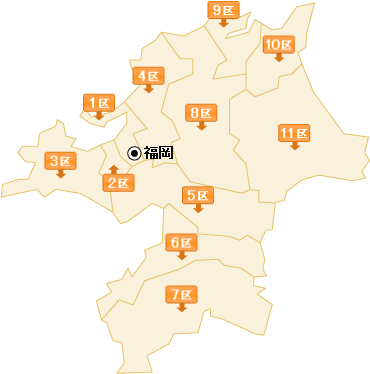 Meanwhile LDP candidates are likely safe in two districts: Aso Taro (eighth district) and Takeda Ryota (eleventh district). Given that Aso is acting as if his seat is vulnerable — he is declined to run simultaneously as a PR candidate — perhaps I should not list his seat as safe, but I think that Aso will not join John Howard as a leader who loses his government and his constituency in the same election. DPJ candidate Yamamoto Gosei may put pressure on the prime minister — he'll be helped by the absence of a JCP candidate — but I expect Aso will win. If he doesn't, perhaps these predictions are the lower bound for the DPJ's performance on 30 August.
Takeda, who after three attempts finally won a seat in 2003 as a conservative independent who joined the LDP in 2004 only to leave it in 2005 as a postal rebel and win the district as an independent once more, will run as the LDP's candidate this year. He faces the SDPJ's Yamaguchi Haruna and JCP candidate Yamashita Tomiko. The fight will be over the 78,000 votes received by Yamamoto Kozo, the LDP candidate in 2005. Takeda will likely win.
But otherwise LDP candidates across Fukuoka are vulnerable. In the second district, Yamasaki Taku, an LDP faction leader, has profited from divided fields in 2003 and 2005 to win reelection. In 2000, the last time the field included only a DPJ candidate and a JCP candidate (as it does this year) Yamasaki lost by 10,000 votes. Yamasaki is high on the list of LDP heavyweights likely to go down to defeat, bested by DPJ newcomer Inatomi Shuji.
Ota Seiichi in the third district may be even more vulnerable than Yamasaki: in 2005 Ota defeated Fujita Kazue, this year's DPJ candidate and winner of the district in 2003. Fujita will likely win again.
In the fourth district the DPJ may benefit from the absence of a JCP candidate, as JCP candidates received around 15,000 votes in the past several elections, turning what would have been close races into comfortable victories for LDP incumbent Watanabe Tomoyoshi. This time DPJ candidate Koga Takaaki has the field to himself, and could emerge as the winner as a result.
Similarly, in the fifth district DPJ candidate Kusuda Daizo will try for the third time to unseat LDP incumbent Harada Yoshiaki. Harada won by 35,000 votes in 2005, 25,000 in 2003, when Kusuda won a PR seat. But in 2003 Harada shared the field with candidates from the JCP and the SDPJ, who combined for 30,000 votes, enough to swing the election to Harada. This time Harada won't have help from other opposition parties.
Also vulnerable is Hatoyama Kunio, DPJ leader Yukio's brother, who parachuted into the sixth district in 2005 and defeated DPJ incumbent Koga Issei. Koga lost by 22,000 votes and won a PR seat, with a JCP candidate taking 11,000 votes. The absence of a JCP candidate should help Koga, but for his part he is publicly skeptical of his chances, citing the press Hatoyama received due to his departure from the Aso cabinet. Hatoyama may hold on to win.
A third LDP faction leader — besides Yamasaki and Aso — is up for reelection in Fukuoka, Koga Makoto in the seventh district. Like Aso, Koga has declined to run simultaneously as an SMD and PR candidate. Koga faces the DPJ's Noda Kuniyoshi, who previously served as mayor of Yameshi city — and no other candidates. The JCP, for example, took nearly 20,000 votes in 2005, which made little difference in 2005 but could be decisive this year, especially since Koga's vote total has fallen gradually since 2000. Like Yamasaki, I think Koga will lose.
The DPJ may have an even easier time in the ninth district, which until 2005 had been represented by Kitahashi Kenji, first elected in 1996 as an NFP candidate and reelected in 2000 and 2003 as a DPJ candidate. He lost by 15,000 votes in 2005 and won a PR seat, but resigned to run for and win the mayoralty of Kita Kyushu city. In his place the DPJ is running Ogata Rintaro, a former foreign ministry official. Given the DPJ's history in the district, I suspect Ogata will win against LDP incumbent Mihara Asahiko.
Finally, in the tenth district LDP incumbent Nishikawa Kyoko faces the DPJ's Kii Takashi, who first ran in 2003 and finished 12,000 votes behind the LDP's Jimi Shozaburo. Jimi left the party as a postal rebel in 2005 and finished second behind Nishikawa with 65,000 votes, 5,000 votes ahead of Kii. The JCP is running a candidate again, but the SDPJ, which received 10,000 votes in 2005, is not. If Kii can take the bulk of the votes received by Jimi in 2005, he should win the seat.
The DPJ should do very well in Fukuoka, winning at least eight of eleven seats.
Saga
In 2005, postal rebels won two of three seats, with the LDP winning the third. As the postal rebels have returned to the LDP, the LDP is defending all three seats in the prefecture.
In the first district, DPJ candidate Haraguchi Kazuhiro has run in each of the four elections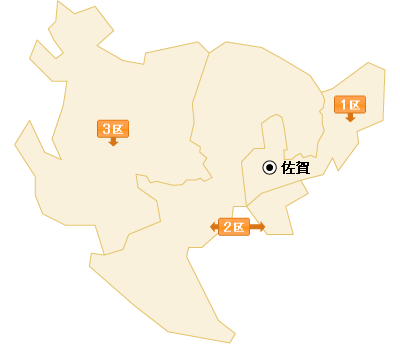 since 1996, winning in 1996 as an NFP candidate and 2003 as a DPJ candidate, and losing in 2000 and 2005 as a DPJ candidate but returning as a PR representative. In this race he faces Fukuoka Takamoro, the victorious LDP candidate from 2005 who Haraguchi defeated in 2003. Haraguchi should return as the SMD representative.
In the second district, 2005 postal rebel Imamura Masahiro returns as the LDP candidate facing Oogushi Hiroshi, the DPJ candidate from 2005 who lost by 15,000 votes and won a PR seat. The question in the second district is what will happen to the 35,000 voters who supported LDP candidate Dokai Chiaki in 2005: do they vote for the party or for the policy line, and if so, which policy line? Imamura could hold on to his seat.
The third district features, in addition to the LDP's Hori Kosuke — another postal rebel — and the DPJ-backed SDPJ candidate Yanase Eiji, candidates from the JCP and Watanabe's YP. Hori should retain the seat.
The DPJ will win at least one of three seats in Saga.
Nagasaki
In Nagasaki's four districts in 2005, the LDP won three and the DPJ one.
The DPJ Takaki Yoshiaki (first district), who has represented the district since 2000, should win reelection comfortably.
 In the second district, Kyuma Fumio, Japan's first ever defense minister, faces Fukuda Eriko, the twenty-eight-year-old leader of the Kyushu group of victims of Hepatitis-tainted blood transfusions, handpicked by Ozawa to run against Kyuma. Kyuma is clearly worried after having years of being reelected comfortably. Like Koga Makoto in Fukuoka, Kyuma's vote shares have gradually declined in recent elections. Kyuma may also suffer from memories of the remarks regarding the Nagasaki bombing in 2007 that led to his resignation as defense minister. With the DPJ focused on defeating Kyuma, Fukuda might win the upset.
Tanigawa Yaichi, the LDP's incumbent in the third district, has fought close elections with the DPJ's Yamada Masahiko in the past two elections, winning by 6,000 votes in 2003 and 9,000 votes in 2005. Yamada won PR seats in both elections. Reporting suggests that Tanigawa is confident that he can retain his seat on the back of Komeito support in the district, as is the LDP's Kitamura Seigo in the fourth district, who faces DPJ candidate Miyajima Daisuke. Miyajima won a by-election in the district in 1998 as an LDP candidate but lost to Kitamura by 30,000 votes in 2005.
The result could be a split in Nagasaki.
Kumamoto
In Kumamoto in 2005 the LDP won four seats and the DPJ won one.
The DPJ's Matsumoto Yorihisa (first district) will win the seat he first won in 2000.
In the second district the LDP's Hayashida Takeshi, running again in the SMD after alternating with Noda Takeshi in a Costa Rica arrangement, faces DPJ newcomer Fukushima Kenichiro and should win the district.
The third district was won by the late Matsuoka Toshikatsu in 2005, and was won by independent Sakamoto Tetsushi in the by-election following Matsuoka's suicide. Sakamoto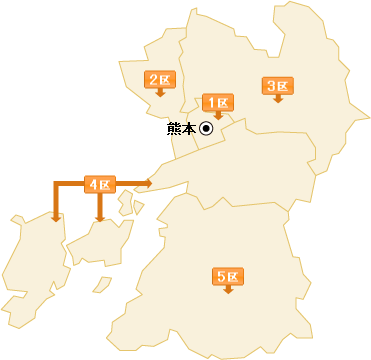 has since joined the LDP, and faces the DPJ's Goto Hidetomo and former LDP member Miura Issui, running as an independent. It seems, however, that Sakamoto and Miura may divide the support of groups that have traditionally supported the LDP. Nevertheless, the DPJ has never done well in the district, and the winner will be either Sakamoto or Miura. Miura may edge out Sakamoto, who did the same to Matsuoka running as an independent in 2003.
In the fourth district LDP incumbent Sonoda Hiroyuki should win reelection easily, as should Kaneko Yasushi in the fifth district.
The LDP will win three, the DPJ one, and an independent conservative one.
Oita
The LDP took two seats and the DPJ one in Oita in 2005.
The DPJ's Kira Shuji (first district), who first won as an independent in 2003 and won reelection in 2005, should win the seat again.
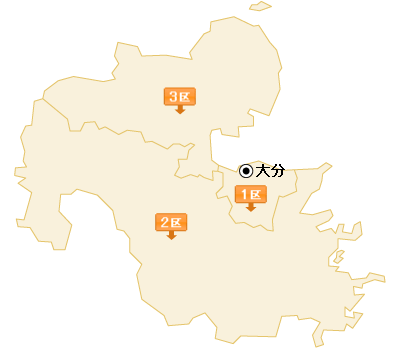 In the second district, the SDPJ may be poised to pick up a seat, as Shigeno Yasumasa runs for the third time against LDP incumbent Eto Seishiro. Shigeno lost by 21,000 votes in 2005, closing the gap from 2003 and earning Shigeno a PR seat. With no JCP candidate running this time — the JCP received nearly 15,000 votes in 2005 — Shigeno could unseat Eto.
In the third district, the DPJ's Yokomitsu Katsuhiko will try for the third time to unseat LDP incumbent Iwaya Takeshi. Yokomitsu, losing by 12,000 votes in 2003 and 15,000 votes in 2005, won PR seats both times. The election will be close, and may ultimately depend on the ability of Yokomitsu to bring out SDPJ voters — Yokomitsu ran in 2003 as an SDPJ candidate before switching to the DPJ, and the two parties had a bitter dispute over who should run in Oita in the 2007 upper house election, resulting in both parties' fielding candidates and the LDP's winning the Oita single-member district.
Iwaya could hold on, with the result that the DPJ wins one, the LDP one, and the SDPJ one.
Miyazaki
Miyazaki is odd: LDP-affiliated candidates won all three seats in 2005, although at the time two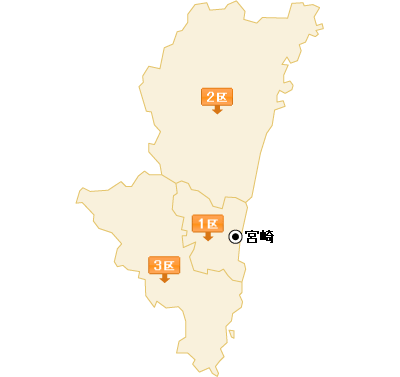 of three were running as independent postal rebels (and both had first won in 2003 by running as independents, joining the LDP after the election). The postal rebels have returned to the LDP, but meanwhile, Nakayama Nariaki (first district), the one LDP member who did win in 2005 and is now known for resigning three days after taking office as Aso's transport minister due to comments about Nikkyoso, initially announced that he would retire but changed his mind and is now running as an independent, albeit as an independent with the support of senior LDP leaders like Machimura Nobutaka.
In the first district, the field includes, in addition to Nakayama, LDP-related independent Uesugi Mitsuhiro, a former upper house member who ran as the LDP candidate in the second district in 2005 and lost, Kawamura Hidesaburo, a former MAFF official running as an independent with DPJ, SDPJ, and PNP backing, and a JCP candidate. I suspect that Nakayama will win reelection.
Eto Taku, a postal rebel who returned to the LDP, is seeking another term in the second district, facing the DPJ's Dokyu Seichiro and an independent. Eto will likely win reelection.
In the third district, Furukawa Yoshihisa should win reelection easily.
With Nakayama likely to return to the LDP after the election, the LDP will presumably win three seats in Miyazaki.
Kagoshima
Although the LDP did not win all five seats in 2005, it is now defending all five seats in Kagoshima.
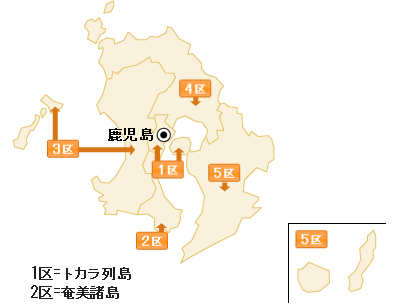 The DPJ's best chance of picking up a seat is in the first district, where LDP incumbent Yasuoka Okiharu faces the DPJ's Kawauchi Hiroshi, who has lost to Yasuoka by roughly 20,000 votes the past two elections and 9,000 votes in 2000, winning PR seats each time. The JCP is fielding a candidate and independent Yamashita Junichi is running, but Kawauchi may manage to win the district this time.
The LDP candidate in the second district, Tokuda Takeshi, was elected as an independent in 2005 but migrated to the LDP and now faces DPJ candidate Uchikoshi Akashi, a former prefectural assemblyman. As the DPJ has never fielded a candidate in the district, it is unclear how the DPJ brand will do. Uchikoshi ran as an independent in 2005 and received nearly 45,000 votes, but Tokuda and the LDP candidate combined for nearly 160,000 votes. Tokuda will probably be reelected.
In the third district, the PNP may be poised to pick up a seat as the joint PNP-DPJ candidate, Matsushita Tadahiro, finished second in 2005 to the LDP's Miyaji Kazuaki, but the DPJ vote combined with Matsushita's votes would have bested Miyaji.
The DPJ candidate in the fourth district is former Rengo Kagoshima vice president Minayoshi Inao, who faces LDP incumbent Ozato Yasuhiro. Ozato has consistently beaten opposition candidate by 40,000 votes and should win again.
Moriyama Hiroshi, the LDP's former postal rebel incumbent in the fifth district, won by 55,000 votes of an LDP "assassin" in 2005 and in 2003 defeated the DPJ's candidate by nearly 100,000 votes. He will be reelected.
The LDP will win three seats, the DPJ one, and the PNP one.
Okinawa
In Okinawa in 2005 the LDP won two seats, the SDPJ won one, and a DPJ-backed independent who has since joined the PNP won one.
In the first district, PNP incumbent Shimoji Mikio should win reelection, as should the SDPJ's Teruya Kantoku in the second district.
The LDP's incumbent in the third district, Kakazu Chiken, won in 2005 because both the DPJ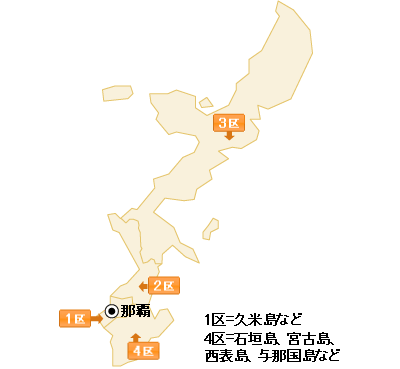 and the SDPJ fielded candidates, Tamaki Deni and Tomon Mitsuko respectively. Once again the two opposition parties will be fielding these candidates, despite their combined vote in 2005 being enough to defeat Kakazu. All that may change this year is that Tamaki finishes second instead of Tomon.
Finally, in the fourth district the LDP's Nishime Kosaburo faces DPJ newcomer Zukeran Chobin. Nishime also won due to a divided field, with the DPJ, JCP, and PNP dividing up 72,000 votes that would have been sufficient to beat Nishime. Zukeran, having the field to himself, may win the district for the DPJ.
The result in Okinawa will be one for the DPJ, one for the LDP, one for the SDPJ, and one for the PNP.
Proportional representation
It is unlikely that the DPJ will run as strong in the Kyushu regional block as it will elsewhere, especially because Komeito will run stronger in Kyushu than it will elsewhere. In 2005, for example, Komeito received nearly 16% of the vote and won three PR seats. The likely PR outcome is for the LDP and the DPJ to reverse their totals, and perhaps the PNP winning a seat instead of the SDPJ, leaving the distribution at nine for the DPJ, seven for the LDP, three for Komeito, one for the JCP, and one for the PNP.
If these predictions, the DPJ will win twenty-four seats, the LDP twenty-five, the PNP three, Komeito three, the SDPJ two, the JCP one, and an independent conservative will win the last seat.
The Kyushu regional block contains thirty-eight single-member districts spread over eight prefectures: Fukuoka, Saga, Nagasaki, Kumamoto, Oita, Miyazaki, Kagoshima, and Okinawa. The block elects an additional twenty-one representatives through proportional representation, for a total of fifty-nine seats.
The region's major population center is Fukuoka, which constitutes roughly a third of the region's population, with the rest of the region's prefectures being roughly equal in population. The region's economic profile is mixed, including agricultural production suiting that region's sub-tropical climate and heavy industry in northern Kyushu. It was once a major mining center, home to Aso Mining, the family business of Prime Minister Aso Taro.
Along with Shikoku and Chugoku it has been a historically important electoral base for the LDP.
In 2005, opposition parties won seven SMDs, four of those being won by DPJ candidates. Meanwhile the LDP won twenty-five seats and Komeito won six. In PR voting, the LDP won nine, the DPJ seven, Komeito three, and the SDPJ and JCP one each. In 2003, the LDP won twenty-six seats, Komeito one, and the opposition parties eleven, with the DPJ winning eight.
However, opposition parties in five of the region's single-member upper house districts in 2007, suggesting the possibility of DPJ gains in the region.
Fukuoka
In Fukuoka in 2005, the LDP won nine seats and Komeito and the DPJ one each.
The DPJ's Matsumoto Ryu (first district) should easily win the district in which he has won every election since the first election under the new system in 1996.
Meanwhile LDP candidates are likely safe in two districts: Aso Taro (eighth district) and Takeda Ryota (eleventh district). Given that Aso is acting as if his seat is vulnerable — he is declined to run simultaneously as a PR candidate — perhaps I should not list his seat as safe, but I think that Aso will not join John Howard as a leader who loses his government and his constituency in the same election. DPJ candidate Yamamoto Gosei may put pressure on the prime minister — he'll be helped by the absence of a JCP candidate — but I expect Aso will win. If he doesn't, perhaps these predictions are the lower bound for the DPJ's performance on 30 August.Takeda, who after three attempts finally won a seat in 2003 as a conservative independent who joined the LDP in 2004 only to leave it in 2005 as a postal rebel and win the district as an independent once more, will run as the LDP's candidate this year. He faces the SDPJ's Yamaguchi Haruna and JCP candidate Yamashita Tomiko. The fight will be over the 78,000 votes received by Yamamoto Kozo, the LDP candidate in 2005. Takeda will likely win.
But otherwise LDP candidates across Fukuoka are vulnerable. In the second district, Yamasaki Taku, an LDP faction leader, has profited from divided fields in 2003 and 2005 to win reelection. In 2000, the last time the field included only a DPJ candidate and a JCP candidate (as it does this year) Yamasaki lost by 10,000 votes. Yamasaki is high on the list of LDP heavyweights likely to go down to defeat, bested by DPJ newcomer Inatomi Shuji.
Ota Seiichi in the third district may be even more vulnerable than Yamasaki: in 2005 Ota defeated Fujita Kazue, this year's DPJ candidate and winner of the district in 2003. Fujita will likely win again.
In the fourth district the DPJ may benefit from the absence of a JCP candidate, as JCP candidates received around 15,000 votes in the past several elections, turning what would have been close races into comfortable victories for LDP incumbent Watanabe Tomoyoshi. This time DPJ candidate Koga Takaaki has the field to himself, and could emerge as the winner as a result.
Similarly, in the fifth district DPJ candidate Kusuda Daizo will try for the third time to unseat LDP incumbent Harada Yoshiaki. Harada won by 35,000 votes in 2005, 25,000 in 2003, when Kusuda won a PR seat. But in 2003 Harada shared the field with candidates from the JCP and the SDPJ, who combined for 30,000 votes, enough to swing the election to Harada. This time Harada won't have help from other opposition parties.
Also vulnerable is Hatoyama Kunio, DPJ leader Yukio's brother, who parachuted into the sixth district in 2005 and defeated DPJ incumbent Koga Issei. Koga lost by 22,000 votes and won a PR seat, with a JCP candidate taking 11,000 votes. The absence of a JCP candidate should help Koga, but for his part he is publicly skeptical of his chances, citing the press Hatoyama received due to his departure from the Aso cabinet. Hatoyama may hold on to win.
A third LDP faction leader — besides Yamasaki and Aso — is up for reelection in Fukuoka, Koga Makoto in the seventh district. Like Aso, Koga has declined to run simultaneously as an SMD and PR candidate. Koga faces the DPJ's Noda Kuniyoshi, who previously served as mayor of Yameshi city — and no other candidates. The JCP, for example, took nearly 20,000 votes in 2005, which made little difference in 2005 but could be decisive this year, especially since Koga's vote total has fallen gradually since 2000. Like Yamasaki, I think Koga will lose.
The DPJ may have an even easier time in the ninth district, which until 2005 had been represented by Kitahashi Kenji, first elected in 1996 as an NFP candidate and reelected in 2000 and 2003 as a DPJ candidate. He lost by 15,000 votes in 2005 and won a PR seat, but resigned to run for and win the mayoralty of Kita Kyushu city. In his place the DPJ is running Ogata Rintaro, a former foreign ministry official. Given the DPJ's history in the district, I suspect Ogata will win against LDP incumbent Mihara Asahiko.
Finally, in the tenth district LDP incumbent Nishikawa Kyoko faces the DPJ's Kii Takashi, who first ran in 2003 and finished 12,000 votes behind the LDP's Jimi Shozaburo. Jimi left the party as a postal rebel in 2005 and finished second behind Nishikawa with 65,000 votes, 5,000 votes ahead of Kii. The JCP is running a candidate again, but the SDPJ, which received 10,000 votes in 2005, is not. If Kii can take the bulk of the votes received by Jimi in 2005, he should win the seat.
The DPJ should do very well in Fukuoka, winning at least eight of eleven seats.
Saga
In 2005, postal rebels won two of three seats, with the LDP winning the third. As the postal rebels have returned to the LDP, the LDP is defending all three seats in the prefecture.
In the first district, DPJ candidate Haraguchi Kazuhiro has run in each of the four elections
since 1996, winning in 1996 as an NFP candidate and 2003 as a DPJ candidate, and losing in 2000 and 2005 as a DPJ candidate but returning as a PR representative. In this race he faces Fukuoka Takamoro, the victorious LDP candidate from 2005 who Haraguchi defeated in 2003. Haraguchi should return as the SMD representative.In the second district, 2005 postal rebel Imamura Masahiro returns as the LDP candidate facing Oogushi Hiroshi, the DPJ candidate from 2005 who lost by 15,000 votes and won a PR seat. The question in the second district is what will happen to the 35,000 voters who supported LDP candidate Dokai Chiaki in 2005: do they vote for the party or for the policy line, and if so, which policy line? Imamura could hold on to his seat.
The third district features, in addition to the LDP's Hori Kosuke — another postal rebel — and the DPJ-backed SDPJ candidate Yanase Eiji, candidates from the JCP and Watanabe's YP. Hori should retain the seat.
The DPJ will win at least one of three seats in Saga.
Nagasaki
In Nagasaki's four districts in 2005, the LDP won three and the DPJ one.
The DPJ Takaki Yoshiaki (first district), who has represented the district since 2000, should win reelection comfortably.
In the second district, Kyuma Fumio, Japan's first ever defense minister, faces Fukuda Eriko, the twenty-eight-year-old leader of the Kyushu group of victims of Hepatitis-tainted blood transfusions, handpicked by Ozawa to run against Kyuma. Kyuma is clearly worried after having years of being reelected comfortably. Like Koga Makoto in Fukuoka, Kyuma's vote shares have gradually declined in recent elections. Kyuma may also suffer from memories of the remarks regarding the Nagasaki bombing in 2007 that led to his resignation as defense minister. With the DPJ focused on defeating Kyuma, Fukuda might win the upset.Tanigawa Yaichi, the LDP's incumbent in the third district, has fought close elections with the DPJ's Yamada Masahiko in the past two elections, winning by 6,000 votes in 2003 and 9,000 votes in 2005. Yamada won PR seats in both elections. Reporting suggests that Tanigawa is confident that he can retain his seat on the back of Komeito support in the district, as is the LDP's Kitamura Seigo in the fourth district, who faces DPJ candidate Miyajima Daisuke. Miyajima won a by-election in the district in 1998 as an LDP candidate but lost to Kitamura by 30,000 votes in 2005.
The result could be a split in Nagasaki.
Kumamoto
In Kumamoto in 2005 the LDP won four seats and the DPJ won one.
The DPJ's Matsumoto Yorihisa (first district) will win the seat he first won in 2000.
In the second district the LDP's Hayashida Takeshi, running again in the SMD after alternating with Noda Takeshi in a Costa Rica arrangement, faces DPJ newcomer Fukushima Kenichiro and should win the district.
The third district was won by the late Matsuoka Toshikatsu in 2005, and was won by independent Sakamoto Tetsushi in the by-election following Matsuoka's suicide. Sakamoto
has since joined the LDP, and faces the DPJ's Goto Hidetomo and former LDP member Miura Issui, running as an independent. It seems, however, that Sakamoto and Miura may divide the support of groups that have traditionally supported the LDP. Nevertheless, the DPJ has never done well in the district, and the winner will be either Sakamoto or Miura. Miura may edge out Sakamoto, who did the same to Matsuoka running as an independent in 2003.In the fourth district LDP incumbent Sonoda Hiroyuki should win reelection easily, as should Kaneko Yasushi in the fifth district.
The LDP will win three, the DPJ one, and an independent conservative one.
Oita
The LDP took two seats and the DPJ one in Oita in 2005.
The DPJ's Kira Shuji (first district), who first won as an independent in 2003 and won reelection in 2005, should win the seat again.
In the second district, the SDPJ may be poised to pick up a seat, as Shigeno Yasumasa runs for the third time against LDP incumbent Eto Seishiro. Shigeno lost by 21,000 votes in 2005, closing the gap from 2003 and earning Shigeno a PR seat. With no JCP candidate running this time — the JCP received nearly 15,000 votes in 2005 — Shigeno could unseat Eto.In the third district, the DPJ's Yokomitsu Katsuhiko will try for the third time to unseat LDP incumbent Iwaya Takeshi. Yokomitsu, losing by 12,000 votes in 2003 and 15,000 votes in 2005, won PR seats both times. The election will be close, and may ultimately depend on the ability of Yokomitsu to bring out SDPJ voters — Yokomitsu ran in 2003 as an SDPJ candidate before switching to the DPJ, and the two parties had a bitter dispute over who should run in Oita in the 2007 upper house election, resulting in both parties' fielding candidates and the LDP's winning the Oita single-member district.
Iwaya could hold on, with the result that the DPJ wins one, the LDP one, and the SDPJ one.
Miyazaki
Miyazaki is odd: LDP-affiliated candidates won all three seats in 2005, although at the time two
of three were running as independent postal rebels (and both had first won in 2003 by running as independents, joining the LDP after the election). The postal rebels have returned to the LDP, but meanwhile, Nakayama Nariaki (first district), the one LDP member who did win in 2005 and is now known for resigning three days after taking office as Aso's transport minister due to comments about Nikkyoso, initially announced that he would retire but changed his mind and is now running as an independent, albeit as an independent with the support of senior LDP leaders like Machimura Nobutaka.In the first district, the field includes, in addition to Nakayama, LDP-related independent Uesugi Mitsuhiro, a former upper house member who ran as the LDP candidate in the second district in 2005 and lost, Kawamura Hidesaburo, a former MAFF official running as an independent with DPJ, SDPJ, and PNP backing, and a JCP candidate. I suspect that Nakayama will win reelection.
Eto Taku, a postal rebel who returned to the LDP, is seeking another term in the second district, facing the DPJ's Dokyu Seichiro and an independent. Eto will likely win reelection.
In the third district, Furukawa Yoshihisa should win reelection easily.
With Nakayama likely to return to the LDP after the election, the LDP will presumably win three seats in Miyazaki.
Kagoshima
Although the LDP did not win all five seats in 2005, it is now defending all five seats in Kagoshima.
The DPJ's best chance of picking up a seat is in the first district, where LDP incumbent Yasuoka Okiharu faces the DPJ's Kawauchi Hiroshi, who has lost to Yasuoka by roughly 20,000 votes the past two elections and 9,000 votes in 2000, winning PR seats each time. The JCP is fielding a candidate and independent Yamashita Junichi is running, but Kawauchi may manage to win the district this time.The LDP candidate in the second district, Tokuda Takeshi, was elected as an independent in 2005 but migrated to the LDP and now faces DPJ candidate Uchikoshi Akashi, a former prefectural assemblyman. As the DPJ has never fielded a candidate in the district, it is unclear how the DPJ brand will do. Uchikoshi ran as an independent in 2005 and received nearly 45,000 votes, but Tokuda and the LDP candidate combined for nearly 160,000 votes. Tokuda will probably be reelected.
In the third district, the PNP may be poised to pick up a seat as the joint PNP-DPJ candidate, Matsushita Tadahiro, finished second in 2005 to the LDP's Miyaji Kazuaki, but the DPJ vote combined with Matsushita's votes would have bested Miyaji.
The DPJ candidate in the fourth district is former Rengo Kagoshima vice president Minayoshi Inao, who faces LDP incumbent Ozato Yasuhiro. Ozato has consistently beaten opposition candidate by 40,000 votes and should win again.
Moriyama Hiroshi, the LDP's former postal rebel incumbent in the fifth district, won by 55,000 votes of an LDP "assassin" in 2005 and in 2003 defeated the DPJ's candidate by nearly 100,000 votes. He will be reelected.
The LDP will win three seats, the DPJ one, and the PNP one.
Okinawa
In Okinawa in 2005 the LDP won two seats, the SDPJ won one, and a DPJ-backed independent who has since joined the PNP won one.
In the first district, PNP incumbent Shimoji Mikio should win reelection, as should the SDPJ's Teruya Kantoku in the second district.
The LDP's incumbent in the third district, Kakazu Chiken, won in 2005 because both the DPJ
and the SDPJ fielded candidates, Tamaki Deni and Tomon Mitsuko respectively. Once again the two opposition parties will be fielding these candidates, despite their combined vote in 2005 being enough to defeat Kakazu. All that may change this year is that Tamaki finishes second instead of Tomon.Finally, in the fourth district the LDP's Nishime Kosaburo faces DPJ newcomer Zukeran Chobin. Nishime also won due to a divided field, with the DPJ, JCP, and PNP dividing up 72,000 votes that would have been sufficient to beat Nishime. Zukeran, having the field to himself, may win the district for the DPJ.
The result in Okinawa will be one for the DPJ, one for the LDP, one for the SDPJ, and one for the PNP.
Proportional representation
It is unlikely that the DPJ will run as strong in the Kyushu regional block as it will elsewhere, especially because Komeito will run stronger in Kyushu than it will elsewhere. In 2005, for example, Komeito received nearly 16% of the vote and won three PR seats. The likely PR outcome is for the LDP and the DPJ to reverse their totals, and perhaps the PNP winning a seat instead of the SDPJ, leaving the distribution at nine for the DPJ, seven for the LDP, three for Komeito, one for the JCP, and one for the PNP.
If these predictions, the DPJ will win twenty-four seats, the LDP twenty-five, the PNP three, Komeito three, the SDPJ two, the JCP one, and an independent conservative will win the last seat.
